



 Chat with AI
Exam 14: Our Starthe Sun

Exam 1: Thinking Like an Astronomer 97 Questions
Exam 2: Patterns in the Skymotions of Earth and the Moon101 Questions
Exam 3: Motion of Astronomical Bodies99 Questions
Exam 4: Gravity and Orbits100 Questions
Exam 5: Light100 Questions
Exam 6: The Tools of the Astronomer100 Questions
Exam 7: The Formation of Planetary Systems100 Questions
Exam 8: The Terrestrial Planets and Earths Moon100 Questions
Exam 9: Atmospheres of the Terrestrial Planets100 Questions
Exam 10: Worlds of Gas and Liquidthe Giant Planets100 Questions
Exam 11: Planetary Moons and Rings100 Questions
Exam 12: Dwarf Planets and Small Solar System Bodies100 Questions
Exam 13: Taking the Measure of Stars101 Questions
Exam 14: Our Starthe Sun100 Questions
Exam 15: The Interstellar Medium and Star Formation100 Questions
Exam 16: Evolution of Low-Mass Stars100 Questions
Exam 17: Evolution of High-Mass Stars100 Questions
Exam 18: Relativity and Black Holes97 Questions
Exam 19: Galaxies100 Questions
Exam 20: The Milky Waya Normal Spiral Galaxy100 Questions
Exam 21: The Expanding Universe98 Questions
Exam 22: Cosmology100 Questions
Exam 23: Large-Scale Structure in the Universe103 Questions
Exam 24: Life100 Questions
Select questions type


Suppose coronal holes covered a larger fraction of the Sun's surface than they currently do. Which of the following consequences would result?
(Multiple Choice)
4.9/5  (72)
(72) Density, temperature, and pressure increase as you move inward in the interior of the Sun.This means that the weight of the star pushing inward at a given radius ________ as you move toward the core.
(Multiple Choice)
4.8/5 (69)
(69) Explain why the radiative zone in the solar interior gives way to a convective zone approximately two-thirds of the way to the surface.
(Essay)
4.8/5 (79)
(79) The net effect of the proton-proton chain is that four hydrogen nuclei are converted to one helium nucleus and ________ are released.
(Multiple Choice)
4.7/5 (76)
(76) What is "limb darkening"? Explain why limb darkening occurs in the Sun.
(Essay)
4.8/5 (73)
(73) How do periods of strong solar activity affect near-Earth-orbiting spacecraft?
(Essay)
4.7/5 (86)
(86) The region of dominance of the solar wind over the interstellar medium is called the
(Multiple Choice)
4.9/5 (78)
(78) Because the Sun is in hydrostatic equilibrium, the correct order of the inner layers by density, from most dense to least dense, is
(Multiple Choice)
4.7/5 (82)
(82) Which of these can travel directly from the center of the Sun to Earth in about 8 minutes?
(Multiple Choice)
4.9/5 (86)
(86) In the figure below, one can see that the Sun's surface appears darker towards the edges or "limbs" of the disk of the Sun.Why does this happen? 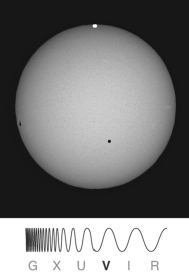
(Multiple Choice)
4.8/5 (84)
(84) The figure below shows a diagram of the Sun with zones labeled A, B, and C.Explain how energy is being transferred in each of the three regions. 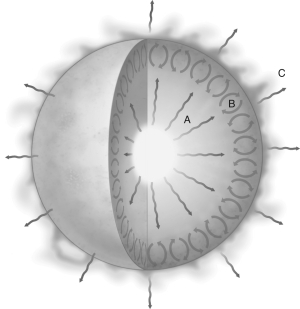
(Essay)
4.8/5 (87)
(87) The solar spectrum is an example of a(n) ________ spectrum.
(Multiple Choice)
4.7/5 (88)
(88) The figure below shows the Sun during a solar eclipse at visible wavelengths.Which part of the Sun is visible around the shadow of the Moon? 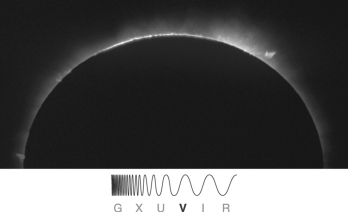
(Multiple Choice)
4.9/5 (82)
(82) Suppose by some mysterious process the nuclear fusion rate in the core of the Sun were to increase.What would certainly happen to the appearance of the Sun?
(Multiple Choice)
5.0/5 (75)
(75) Through hydrogen fusion, the Sun loses approximately 4 million metric tons of mass each second.
If it burns hydrogen at this rate for 10 billion years, what percentage of its original mass will it
lose in all? (Note: The mass of the Sun is 1.99*1030 kg, and 1 metric ton=1,000 kg.)
(Essay)
4.9/5 (70)
(70) In the figure labeled below, which solar layer is the chromosphere? 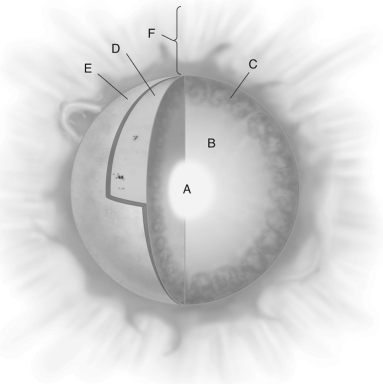
(Multiple Choice)
4.9/5 (69)
(69) 
Filters
- Essay(0)
- Multiple Choice(0)
- Short Answer(0)
- True False(0)
- Matching(0)