



 Chat with AI
Exam 14: Our Starthe Sun

Exam 1: Thinking Like an Astronomer 97 Questions
Exam 2: Patterns in the Skymotions of Earth and the Moon101 Questions
Exam 3: Motion of Astronomical Bodies99 Questions
Exam 4: Gravity and Orbits100 Questions
Exam 5: Light100 Questions
Exam 6: The Tools of the Astronomer100 Questions
Exam 7: The Formation of Planetary Systems100 Questions
Exam 8: The Terrestrial Planets and Earths Moon100 Questions
Exam 9: Atmospheres of the Terrestrial Planets100 Questions
Exam 10: Worlds of Gas and Liquidthe Giant Planets100 Questions
Exam 11: Planetary Moons and Rings100 Questions
Exam 12: Dwarf Planets and Small Solar System Bodies100 Questions
Exam 13: Taking the Measure of Stars101 Questions
Exam 14: Our Starthe Sun100 Questions
Exam 15: The Interstellar Medium and Star Formation100 Questions
Exam 16: Evolution of Low-Mass Stars100 Questions
Exam 17: Evolution of High-Mass Stars100 Questions
Exam 18: Relativity and Black Holes97 Questions
Exam 19: Galaxies100 Questions
Exam 20: The Milky Waya Normal Spiral Galaxy100 Questions
Exam 21: The Expanding Universe98 Questions
Exam 22: Cosmology100 Questions
Exam 23: Large-Scale Structure in the Universe103 Questions
Exam 24: Life100 Questions
Select questions type


In the radiative zone inside the Sun, photons are transported from the core to the convective zone over a time of
(Multiple Choice)
4.8/5  (76)
(76) Approximately how long does it take the photons released in nuclear reactions in the core of the Sun to exit the Sun?
(Multiple Choice)
4.8/5 (76)
(76) Each helium atom created through the proton-proton chain, illustrated in the figure below, is made up of two protons and two neutrons.How many neutrons and protons are required as inputs to the proton-proton chain? 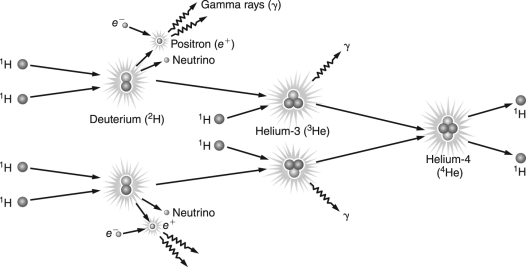
(Multiple Choice)
4.9/5 (80)
(80) Explain why hydrostatic equilibrium results in the center of the Sun having the highest pressure and temperature.
(Essay)
4.9/5 (62)
(62) How does the fact that the surface of the Sun rings like a bell help us better understand the Sun?
(Multiple Choice)
4.9/5 (78)
(78) In addition to the laws of physics and chemistry, what information do we need to know about our
Sun to calculate its internal structure and radius?
(Essay)
4.9/5 (80)
(80) If a coronal mass ejection occurs on the Sun that expels material at a speed of 800 km/s, how long will it take these charged particles to reach the Earth?
(Multiple Choice)
4.9/5 (70)
(70) If a coronal mass ejection occurred on the Sun and ejected particles toward the Earth that traveled at the speed of 1,000 km/s, how long would it take them to reach Earth?
(Essay)
4.8/5 (82)
(82) The layers of the Sun's atmosphere, from innermost to outermost, are
(Multiple Choice)
4.9/5 (71)
(71) If the Sun converts 5 * 1011 kg of H to He per second and 10 percent of the Sun's total mass is available for nuclear burning, how long might we expect the Sun to live?
(Multiple Choice)
4.8/5 (75)
(75) The best wavelength to use to observe a solar prominence is
(Multiple Choice)
4.8/5 (71)
(71) If you observe a maximum number of sunspots right now, how long would you have to wait to see the next solar maximum?
(Multiple Choice)
4.9/5 (79)
(79) What is the approximate temperature at the center of the Sun?
(Multiple Choice)
4.9/5 (90)
(90) The net result of the proton-proton chain of nuclear reactions is that four protons are converted into
(Multiple Choice)
4.8/5 (81)
(81) The Sun's corona has a temperature of approximately 1 million degrees.At what wavelength and in what part of the electromagnetic spectrum does its radiation peak?
(Multiple Choice)
4.9/5 (74)
(74) 
Filters
- Essay(0)
- Multiple Choice(0)
- Short Answer(0)
- True False(0)
- Matching(0)