



 Chat with AI
Exam 14: Our Starthe Sun

Exam 1: Thinking Like an Astronomer 97 Questions
Exam 2: Patterns in the Skymotions of Earth and the Moon101 Questions
Exam 3: Motion of Astronomical Bodies99 Questions
Exam 4: Gravity and Orbits100 Questions
Exam 5: Light100 Questions
Exam 6: The Tools of the Astronomer100 Questions
Exam 7: The Formation of Planetary Systems100 Questions
Exam 8: The Terrestrial Planets and Earths Moon100 Questions
Exam 9: Atmospheres of the Terrestrial Planets100 Questions
Exam 10: Worlds of Gas and Liquidthe Giant Planets100 Questions
Exam 11: Planetary Moons and Rings100 Questions
Exam 12: Dwarf Planets and Small Solar System Bodies100 Questions
Exam 13: Taking the Measure of Stars101 Questions
Exam 14: Our Starthe Sun100 Questions
Exam 15: The Interstellar Medium and Star Formation100 Questions
Exam 16: Evolution of Low-Mass Stars100 Questions
Exam 17: Evolution of High-Mass Stars100 Questions
Exam 18: Relativity and Black Holes97 Questions
Exam 19: Galaxies100 Questions
Exam 20: The Milky Waya Normal Spiral Galaxy100 Questions
Exam 21: The Expanding Universe98 Questions
Exam 22: Cosmology100 Questions
Exam 23: Large-Scale Structure in the Universe103 Questions
Exam 24: Life100 Questions
Select questions type


Describe how helioseismologists measure the opacity of the solar interior.
(Essay)
4.7/5  (62)
(62) If the Sun went through a period where there were many sunspots for several decades straight, what would be the possible impact(s) on the Earth?
(Essay)
4.7/5 (77)
(77) If a sunspot is half as bright as the surrounding photosphere of the Sun, what is the approximate temperature of the gas in the sunspot if the photosphere's average temperature is 5800 K?
(Essay)
4.8/5 (85)
(85) If the core of the Sun were hotter than it is now, how would the Sun's energy production change?
(Multiple Choice)
4.8/5 (86)
(86) Solar wind particles hit the surface of the Moon, but they don't make it to the surface of the Earth because the Earth
(Multiple Choice)
4.9/5 (89)
(89) In the proton-proton chain, pictured in the figure below, what happens to the emitted gamma rays? 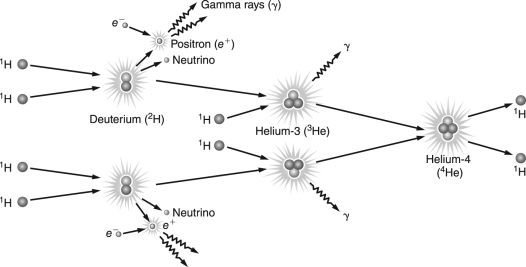
(Multiple Choice)
4.9/5 (63)
(63) What makes neutrinos so different from other particles of matter?
(Multiple Choice)
4.7/5 (91)
(91) The Sun's internal magnetic field becomes tangled over time because of
(Multiple Choice)
4.9/5 (88)
(88) The figure shown below, taken at visible wavelengths, shows a section of the Sun with sunspots visible.Which of the labeled regions is the lowest temperature? 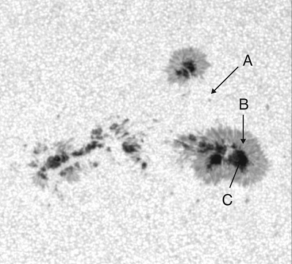
(Multiple Choice)
4.9/5 (80)
(80) Explain why magnetic fields trap coronal gas over much of the solar surface but allow it to escape in coronal holes.
(Essay)
4.9/5 (65)
(65) Calculate the amount of energy released by converting four hydrogen atoms into one helium atom.The mass of a hydrogen atom is 1.67 * 10-27 kg; the mass of a helium atom is
6.65 * 10-27 kg.The speed of light is 3 * 108 m/s.
(Essay)
4.9/5 (78)
(78) Some restaurants place food under infrared heat lamps so that it stays warm after it has been cooked.This is an example of energy being transported by
(Multiple Choice)
4.8/5 (81)
(81) If neutrinos oscillated between five different types of neutrino with equal probability during their transit from the Sun to Earth, and we could only detect one type of neutrino, then how many neutrinos would we have detected compared with what was emitted by the Sun?
(Multiple Choice)
4.8/5 (83)
(83) The figure below illustrates the proton-proton chain.How many gamma rays are produced for each helium (4He) nucleus created? 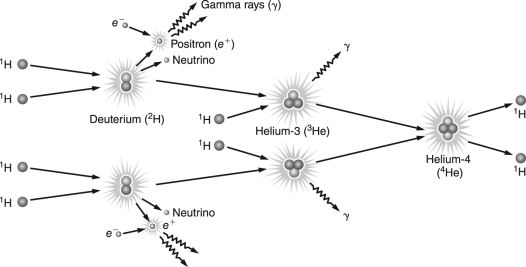
(Multiple Choice)
4.8/5 (69)
(69) 
Filters
- Essay(0)
- Multiple Choice(0)
- Short Answer(0)
- True False(0)
- Matching(0)