



 Chat with AI
Exam 9: Atmospheres of the Terrestrial Planets

Exam 1: Thinking Like an Astronomer 97 Questions
Exam 2: Patterns in the Skymotions of Earth and the Moon101 Questions
Exam 3: Motion of Astronomical Bodies99 Questions
Exam 4: Gravity and Orbits100 Questions
Exam 5: Light100 Questions
Exam 6: The Tools of the Astronomer100 Questions
Exam 7: The Formation of Planetary Systems100 Questions
Exam 8: The Terrestrial Planets and Earths Moon100 Questions
Exam 9: Atmospheres of the Terrestrial Planets100 Questions
Exam 10: Worlds of Gas and Liquidthe Giant Planets100 Questions
Exam 11: Planetary Moons and Rings100 Questions
Exam 12: Dwarf Planets and Small Solar System Bodies100 Questions
Exam 13: Taking the Measure of Stars101 Questions
Exam 14: Our Starthe Sun100 Questions
Exam 15: The Interstellar Medium and Star Formation100 Questions
Exam 16: Evolution of Low-Mass Stars100 Questions
Exam 17: Evolution of High-Mass Stars100 Questions
Exam 18: Relativity and Black Holes97 Questions
Exam 19: Galaxies100 Questions
Exam 20: The Milky Waya Normal Spiral Galaxy100 Questions
Exam 21: The Expanding Universe98 Questions
Exam 22: Cosmology100 Questions
Exam 23: Large-Scale Structure in the Universe103 Questions
Exam 24: Life100 Questions
Select questions type


Earth's atmosphere is a (seemingly) enormous blanket roughly 250 km thick.What percentage of Earth's radius, which is 6,400 km, does this represent? How does it compare to the average depth of the oceans, which is 3 km?
(Essay)
4.9/5  (70)
(70) Earth releases the energy it receives from the Sun by emitting ________ radiation.
(Multiple Choice)
4.8/5 (79)
(79) For the first 1 billion years of Earth's evolution, the fraction of oxygen in its atmosphere was approximately
(Multiple Choice)
4.9/5 (86)
(86) According to the following figure, as you increase in altitude in Earth's atmosphere, the atmospheric pressure ________ dramatically at a(n) ________ rate. 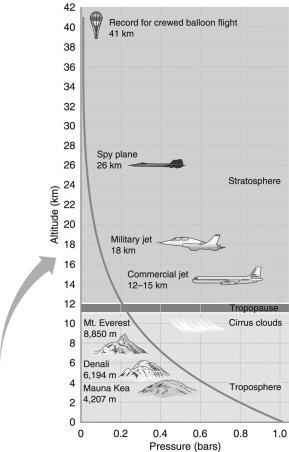
(Multiple Choice)
4.8/5 (73)
(73) Anthropogenic climate change refers to climate change caused by
(Multiple Choice)
4.9/5 (79)
(79) Most of Earth's present-day atmosphere comes from a combination of what three sources?
(Essay)
4.8/5 (76)
(76) The best way to use a telescope to look for life on other planets is to
(Multiple Choice)
4.8/5 (74)
(74) If you found absorption from ________ in the spectrum of a planet, you could conclude that it might contain some form of life.
(Multiple Choice)
4.8/5 (79)
(79) If the average CO2 molecule in Venus's atmosphere has a velocity of 0.6 km/s, what would be the velocity for a hydrogen atom in Venus's atmosphere? Note the mass of a CO2 molecule is 44 times that of a hydrogen atom.
(Essay)
4.8/5 (79)
(79) The only two layers of Earth's atmosphere that have temperature gradients that allow convection to take place are 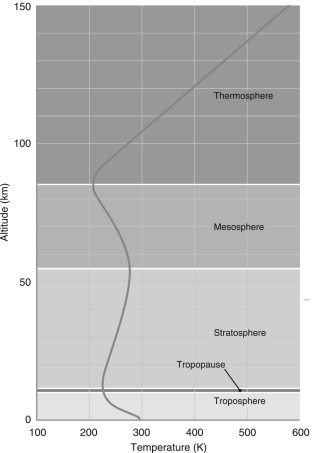
(Multiple Choice)
4.8/5 (83)
(83) Based solely on mass and distance from the Sun, which of the following terrestrial planets would you expect to be unable to retain a secondary atmosphere?
(Multiple Choice)
4.8/5 (79)
(79) What makes carbon dioxide a highly effective greenhouse gas?
(Multiple Choice)
4.8/5 (85)
(85) Venus and Earth probably formed with similar amounts of carbon dioxide in their secondary atmospheres.Which of the following is true?
(Multiple Choice)
4.8/5 (93)
(93) How does the fraction of oxygen in Earth's atmosphere today compare to what it was 3 billion years ago?
(Multiple Choice)
4.8/5 (74)
(74) What factors drive the long-term periodic variations in Earth's average temperature (known as the Milankovitch cycle)?
(Essay)
4.9/5 (91)
(91) Without the ozone layer, life on Earth would be in danger from increased levels of ________ radiation.
(Multiple Choice)
4.8/5 (82)
(82) 
Filters
- Essay(0)
- Multiple Choice(0)
- Short Answer(0)
- True False(0)
- Matching(0)