



 Chat with AI
Exam 9: Atmospheres of the Terrestrial Planets

Exam 1: Thinking Like an Astronomer 97 Questions
Exam 2: Patterns in the Skymotions of Earth and the Moon101 Questions
Exam 3: Motion of Astronomical Bodies99 Questions
Exam 4: Gravity and Orbits100 Questions
Exam 5: Light100 Questions
Exam 6: The Tools of the Astronomer100 Questions
Exam 7: The Formation of Planetary Systems100 Questions
Exam 8: The Terrestrial Planets and Earths Moon100 Questions
Exam 9: Atmospheres of the Terrestrial Planets100 Questions
Exam 10: Worlds of Gas and Liquidthe Giant Planets100 Questions
Exam 11: Planetary Moons and Rings100 Questions
Exam 12: Dwarf Planets and Small Solar System Bodies100 Questions
Exam 13: Taking the Measure of Stars101 Questions
Exam 14: Our Starthe Sun100 Questions
Exam 15: The Interstellar Medium and Star Formation100 Questions
Exam 16: Evolution of Low-Mass Stars100 Questions
Exam 17: Evolution of High-Mass Stars100 Questions
Exam 18: Relativity and Black Holes97 Questions
Exam 19: Galaxies100 Questions
Exam 20: The Milky Waya Normal Spiral Galaxy100 Questions
Exam 21: The Expanding Universe98 Questions
Exam 22: Cosmology100 Questions
Exam 23: Large-Scale Structure in the Universe103 Questions
Exam 24: Life100 Questions
Select questions type


Why did the terrestrial planets lose the majority of the gases in their primary atmospheres?
(Multiple Choice)
4.8/5  (78)
(78) If an average hydrogen atom in Earth's atmosphere has a velocity of 2.5 km/s, what would be the average velocity of an oxygen molecule in Earth's atmosphere? Note that the atomic mass of an oxygen atom is 16 times that of a hydrogen atom.
(Multiple Choice)
4.8/5 (88)
(88) In the Southern Hemisphere, hurricanes ________ compared to hurricanes in the Northern Hemisphere because of the Coriolis effect.
(Multiple Choice)
4.8/5 (73)
(73) Describe how the lack of a strong magnetic field on Mars may lead to loss of its atmosphere over time.
(Essay)
4.9/5 (81)
(81) The terrestrial planets, ranked in order of decreasing atmospheric density, are
(Multiple Choice)
4.7/5 (84)
(84) By examining the three images in the following figure, what can you conclude? 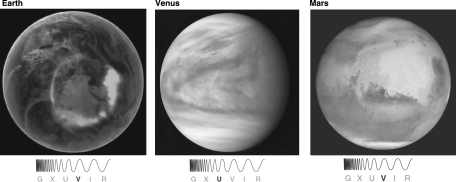
(Multiple Choice)
4.9/5 (81)
(81) Describe how the closer location of Venus to the Sun compared to Earth led to the runaway greenhouse effect observed on Venus today.
(Essay)
4.8/5 (81)
(81) Why does the temperature decrease as you go higher in altitude in the troposphere on Earth?
(Essay)
4.7/5 (82)
(82) When the Martian springtime arrives and the daytime temperature reaches 20°C, what occurs?
(Multiple Choice)
4.9/5 (70)
(70) By approximately ________ years ago, ________ had produced oxygen in enough amounts for it to make up a significant fraction of Earth's atmosphere.
(Multiple Choice)
4.9/5 (83)
(83) Approximately how long after the Solar System formed did it take for oxygen to get to within 80 percent of its present abundance in Earth's atmosphere?
(Multiple Choice)
4.9/5 (85)
(85) If the carbon dioxide in Earth's rocks were suddenly released into its atmosphere, what would happen?
(Multiple Choice)
4.9/5 (80)
(80) The variations in sulfuric acid in Venus's atmosphere are thought to be evidence that
(Multiple Choice)
4.7/5 (84)
(84) Weather is the ________ state of the atmosphere, while climate is the ________ state of the atmosphere.
(Multiple Choice)
5.0/5 (86)
(86) Carbon dioxide levels in Earth's atmosphere have been rising by about 4 percent per decade because of the use of fossil fuels.Describe at least two major changes that would take place on Earth if this trend continues.
(Essay)
5.0/5 (93)
(93) The amount of carbon dioxide in Earth's atmosphere has been increasing over the last 50 years because of
(Multiple Choice)
4.8/5 (82)
(82) 
Filters
- Essay(0)
- Multiple Choice(0)
- Short Answer(0)
- True False(0)
- Matching(0)