



 Chat with AI
Exam 9: Atmospheres of the Terrestrial Planets

Exam 1: Thinking Like an Astronomer 97 Questions
Exam 2: Patterns in the Skymotions of Earth and the Moon101 Questions
Exam 3: Motion of Astronomical Bodies99 Questions
Exam 4: Gravity and Orbits100 Questions
Exam 5: Light100 Questions
Exam 6: The Tools of the Astronomer100 Questions
Exam 7: The Formation of Planetary Systems100 Questions
Exam 8: The Terrestrial Planets and Earths Moon100 Questions
Exam 9: Atmospheres of the Terrestrial Planets100 Questions
Exam 10: Worlds of Gas and Liquidthe Giant Planets100 Questions
Exam 11: Planetary Moons and Rings100 Questions
Exam 12: Dwarf Planets and Small Solar System Bodies100 Questions
Exam 13: Taking the Measure of Stars101 Questions
Exam 14: Our Starthe Sun100 Questions
Exam 15: The Interstellar Medium and Star Formation100 Questions
Exam 16: Evolution of Low-Mass Stars100 Questions
Exam 17: Evolution of High-Mass Stars100 Questions
Exam 18: Relativity and Black Holes97 Questions
Exam 19: Galaxies100 Questions
Exam 20: The Milky Waya Normal Spiral Galaxy100 Questions
Exam 21: The Expanding Universe98 Questions
Exam 22: Cosmology100 Questions
Exam 23: Large-Scale Structure in the Universe103 Questions
Exam 24: Life100 Questions
Select questions type


Would water molecules in Venus's atmosphere, whose temperature is 740 K, eventually escape into outer space? Note that a water molecule has a mass that is 18 times that of a hydrogen atom.The escape velocity of Venus is 10 km/s.For comparison, a hydrogen atom has an average velocity of 2.5 km/s at a temperature of 300 K.
(Multiple Choice)
4.9/5  (84)
(84) On the surface of Mars, water could exist in what form(s): solid, liquid, and/or gas? How does this vary with the seasons on Mars? Why are the seasonal variations on Mars different in its northern and southern hemispheres?
(Essay)
4.8/5 (56)
(56) The obliquity of Earth's rotation axis has remained stable at 23 degrees over its history, whereas that of Mars is believed to have varied from 13 to 40 degrees.Why?
(Essay)
4.8/5 (81)
(81) A gas eventually will escape from a planet's atmosphere if the average velocity of the atoms exceeds 1/6 times the escape velocity of the planet.If the average velocity of water vapor in Venus's atmosphere is 0.9 km/s, would it eventually escape into outer space? Note that Venus's mass is 5 *1024 kg, its radius is 6,050 km, and G = 6.67 *10 - 11 N m 2 /kg 2 .
(Multiple Choice)
4.9/5 (79)
(79) All direct weather and wind on Earth are a result of convection in the
(Multiple Choice)
5.0/5 (82)
(82) The main greenhouse gases in the atmosphere of the terrestrial planets are
(Multiple Choice)
4.9/5 (81)
(81) Heating from ________ causes the top of Earth's stratosphere to be warmer than the bottom.
(Multiple Choice)
4.9/5 (70)
(70) The ________ in our atmosphere is a direct consequence of the emergence of life.
(Multiple Choice)
4.8/5 (83)
(83) The presence of gases such as carbon dioxide and water vapor in a planet's atmosphere is direct evidence of ________ in a planet's history.
(Multiple Choice)
4.8/5 (83)
(83) The planet-wide flow of air from Earth's equator to the colder poles is called Hadley circulation.An example of this effect is also seen
(Multiple Choice)
4.9/5 (76)
(76) Venus's surface temperature is fairly uniform from the equator to the poles because
(Multiple Choice)
4.9/5 (85)
(85) Which of the following processes did NOT contribute gas to Earth's secondary atmosphere?
(Multiple Choice)
4.8/5 (96)
(96) List the three planets shown in the following figure in order of decreasing surface temperature, and cite evidence that can be seen in the images that supports your choice. 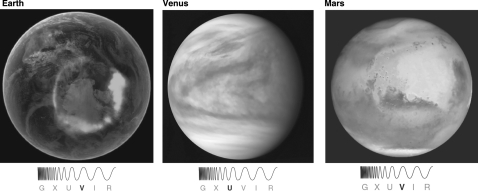
(Essay)
4.9/5 (90)
(90) What is the main reason Hadley circulation in a planet's atmosphere breaks up into zonal winds?
(Multiple Choice)
4.9/5 (87)
(87) If water vapor were released from Venus's surface because of tectonic activity into its upper atmosphere, what would most likely happen to it?
(Multiple Choice)
4.7/5 (67)
(67) Earth has roughly ________ times more atmospheric pressure than Mars and ________ times less than Venus.
(Multiple Choice)
4.9/5 (83)
(83) A gas eventually will escape from a planet's atmosphere if the average velocity of its atoms exceeds 1/6 times the escape velocity of the planet.If the average velocity of water vapor in Venus's atmosphere is 0.5 km/s, what would be the average velocity of a single hydrogen atom? If Venus's escape velocity is 11 km/s, will hydrogen atoms eventually escape?
(Essay)
4.9/5 (77)
(77) What are the radiation belts surrounding Earth, and why do they exist?
(Essay)
4.7/5 (66)
(66) 
Filters
- Essay(0)
- Multiple Choice(0)
- Short Answer(0)
- True False(0)
- Matching(0)