



 Chat with AI
Exam 7: Taxation and Government Intervention

Exam 1: Economics and Economic Reasoning158 Questions
Exam 2: The Production Possibility Model, Trade, and Globalization133 Questions
Exam 3: Economic Institutions163 Questions
Exam 4: Supply and Demand182 Questions
Exam 5: Using Supply and Demand163 Questions
Exam 6: Describing Supply and Demand: Elasticities216 Questions
Exam 7: Taxation and Government Intervention201 Questions
Exam 8: Market Failure Versus Government Failure197 Questions
Exam 9: Comparative Advantage, Exchange Rates, and Globalization118 Questions
Exam 10: International Trade Policy99 Questions
Exam 11: Production and Cost Analysis I194 Questions
Exam 12: Production and Cost Analysis II152 Questions
Exam 13: Perfect Competition170 Questions
Exam 14: Monopoly and Monopolistic Competition274 Questions
Exam 15: Oligopoly and Antitrust Policy142 Questions
Exam 16: Real-World Competition and Technology108 Questions
Exam 17: Work and the Labor Market150 Questions
Exam 18: Who Gets What the Distribution of Income131 Questions
Exam 19: The Logic of Individual Choice: the Foundation of Supply and Demand170 Questions
Exam 20: Game Theory, Strategic Decision Making, and Behavioral Economics103 Questions
Exam 21: Thinking Like a Modern Economist97 Questions
Exam 22: Behavioral Economics and Modern Economic Policy126 Questions
Exam 23: Microeconomic Policy, Economic Reasoning, and Beyond134 Questions
Exam 24: Economic Growth, Business Cycles, and Unemployment124 Questions
Exam 25: Measuring and Describing the Aggregate Economy229 Questions
Exam 26: The Keynesian Short-Run Policy Model: Demand-Side Policies220 Questions
Exam 27: The Classical Long-Run Policy Model: Growth and Supply-Side Policies133 Questions
Exam 28: The Financial Sector and the Economy214 Questions
Exam 29: Monetary Policy243 Questions
Exam 30: Financial Crises, Panics, and Unconventional Monetary Policy109 Questions
Exam 31: Deficits and Debt: the Austerity Debate150 Questions
Exam 32: The Fiscal Policy Dilemma119 Questions
Exam 33: Jobs and Unemployment78 Questions
Exam 34: Inflation, Deflation, and Macro Policy175 Questions
Exam 35: International Financial Policy211 Questions
Exam 36: Macro Policy in a Global Setting134 Questions
Exam 37: Structural Stagnation and Globalization125 Questions
Exam 38: Macro Policy in Developing Countries142 Questions
Select questions type


The price of gasoline is generally higher in Hawaii than in the continental United States. Therefore, the Hawaiian legislature passed a law forbidding gas stations from charging a price higher than the average price of gas on the West Coast of the United States. This is an example of:
(Multiple Choice)
4.9/5  (80)
(80) Demonstrate graphically and explain verbally that the welfare loss of a tax on suppliers will be smaller the less elastic is demand.
(Essay)
4.9/5 (73)
(73) Refer to the graphs shown. In which graph is there no consumer surplus either with or without a per-unit tax? 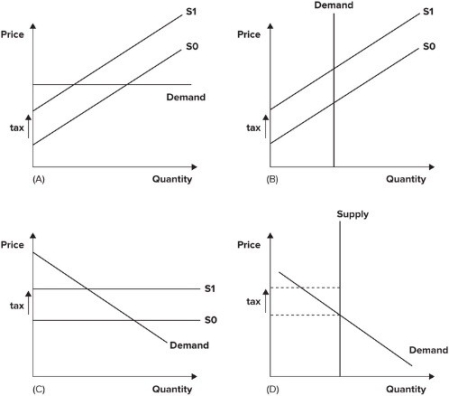
(Multiple Choice)
4.8/5 (74)
(74) Refer to the graph shown. When the market is in equilibrium, consumer surplus is equal to: 
(Multiple Choice)
4.9/5 (76)
(76) Refer to the graph shown. An effective price ceiling at Pc imposes a deadweight loss shown by: 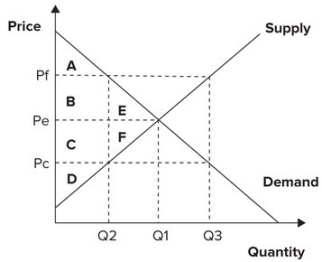
(Multiple Choice)
5.0/5 (81)
(81) If elasticity of demand is 1.8, elasticity of supply is 0.2, and a 20 percent excise tax is levied on the good:
(Multiple Choice)
4.8/5 (92)
(92) Refer to the graph shown. If the price of this product fell from $10 to $8, producer surplus would fall from: 
(Multiple Choice)
4.8/5 (68)
(68) Refer to the graph shown. If the government imposed a price ceiling of $4, producer surplus would: 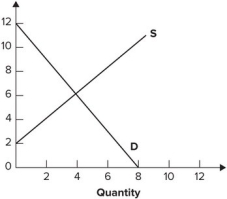
(Multiple Choice)
5.0/5 (81)
(81) Refer to the graph shown. An effective price floor at $8 imposes a deadweight loss of: 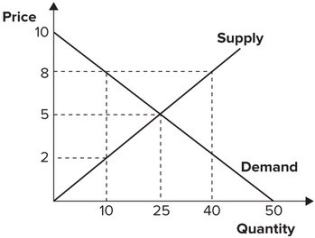
(Multiple Choice)
5.0/5 (91)
(91) Refer to the graph shown. An effective price ceiling at Pc causes producer surplus to: 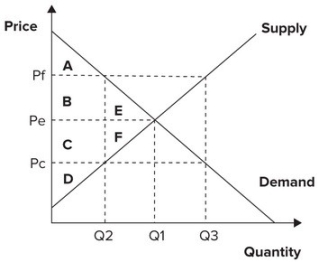
(Multiple Choice)
4.9/5 (87)
(87) Refer to the graph shown. The difference between total surplus in equilibrium and total surplus when price is $8.15 and quantity is 220 is: 
(Multiple Choice)
4.9/5 (78)
(78) Refer to the graph shown. An effective price floor at Pf causes consumer surplus to: 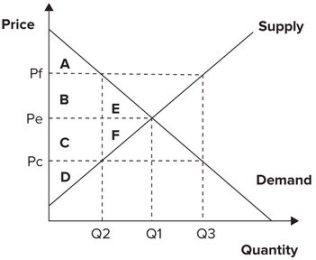
(Multiple Choice)
4.9/5 (88)
(88) Demonstrate graphically and explain verbally how a price ceiling may be viewed as essentially a tax and subsidy scheme.
(Essay)
4.8/5 (82)
(82) If price is increased by law from a market equilibrium value of $5 to a higher value of $6:
(Multiple Choice)
4.8/5 (82)
(82) Refer to the graph shown. Given the same supply elasticity, the burden of a 10 percent tax would be borne the most by the consumer in segment: 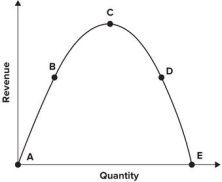
(Multiple Choice)
4.9/5 (72)
(72) Refer to the graph shown. With an effective price floor at $8, total surplus is reduced by: 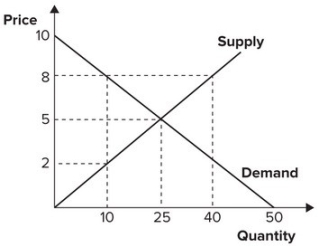
(Multiple Choice)
4.8/5 (81)
(81) Refer to the graph shown. Assume that the market is initially in equilibrium at a price of $6 and a quantity of 40 units. If the government imposes a $2 per-unit tax on this product, equilibrium quantity will change to: 
(Multiple Choice)
4.9/5 (73)
(73) Refer to the graph shown. Assume that the market is initially in equilibrium at a price of $10 and a quantity of 500 units. If the government imposes a $4 per-unit tax on this product, the deadweight loss from the tax will be: 
(Multiple Choice)
4.9/5 (95)
(95) When the Federal government reinstated a 10% excise tax on airline tickets,the industry wanted to pass on the full 10% ticket tax but was only able to boost fares by 4%.
(a)What can you conclude regarding the elasticity of demand for airline tickets?
(b)If you know that elasticity of demand is 2 and the elasticity of supply is 1,who bears the larger burden of the tax?
(c)Show the incidence of the tax graphically.
(Essay)
4.8/5 (79)
(79) Refer to the graph shown. If the price were at the market equilibrium price, the total surplus would be the combination of the areas: 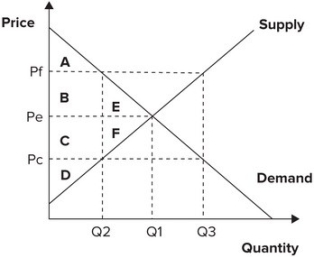
(Multiple Choice)
4.8/5 (82)
(82) 
Filters
- Essay(0)
- Multiple Choice(0)
- Short Answer(0)
- True False(0)
- Matching(0)