



 Chat with AI
Exam 7: Taxation and Government Intervention

Exam 1: Economics and Economic Reasoning158 Questions
Exam 2: The Production Possibility Model, Trade, and Globalization133 Questions
Exam 3: Economic Institutions163 Questions
Exam 4: Supply and Demand182 Questions
Exam 5: Using Supply and Demand163 Questions
Exam 6: Describing Supply and Demand: Elasticities216 Questions
Exam 7: Taxation and Government Intervention201 Questions
Exam 8: Market Failure Versus Government Failure197 Questions
Exam 9: Comparative Advantage, Exchange Rates, and Globalization118 Questions
Exam 10: International Trade Policy99 Questions
Exam 11: Production and Cost Analysis I194 Questions
Exam 12: Production and Cost Analysis II152 Questions
Exam 13: Perfect Competition170 Questions
Exam 14: Monopoly and Monopolistic Competition274 Questions
Exam 15: Oligopoly and Antitrust Policy142 Questions
Exam 16: Real-World Competition and Technology108 Questions
Exam 17: Work and the Labor Market150 Questions
Exam 18: Who Gets What the Distribution of Income131 Questions
Exam 19: The Logic of Individual Choice: the Foundation of Supply and Demand170 Questions
Exam 20: Game Theory, Strategic Decision Making, and Behavioral Economics103 Questions
Exam 21: Thinking Like a Modern Economist97 Questions
Exam 22: Behavioral Economics and Modern Economic Policy126 Questions
Exam 23: Microeconomic Policy, Economic Reasoning, and Beyond134 Questions
Exam 24: Economic Growth, Business Cycles, and Unemployment124 Questions
Exam 25: Measuring and Describing the Aggregate Economy229 Questions
Exam 26: The Keynesian Short-Run Policy Model: Demand-Side Policies220 Questions
Exam 27: The Classical Long-Run Policy Model: Growth and Supply-Side Policies133 Questions
Exam 28: The Financial Sector and the Economy214 Questions
Exam 29: Monetary Policy243 Questions
Exam 30: Financial Crises, Panics, and Unconventional Monetary Policy109 Questions
Exam 31: Deficits and Debt: the Austerity Debate150 Questions
Exam 32: The Fiscal Policy Dilemma119 Questions
Exam 33: Jobs and Unemployment78 Questions
Exam 34: Inflation, Deflation, and Macro Policy175 Questions
Exam 35: International Financial Policy211 Questions
Exam 36: Macro Policy in a Global Setting134 Questions
Exam 37: Structural Stagnation and Globalization125 Questions
Exam 38: Macro Policy in Developing Countries142 Questions
Select questions type


How are price ceilings similar to taxes on producers? How are price floors similar to taxes on consumers? How are both price ceilings and price floors different from taxes?
(Essay)
4.8/5  (67)
(67) Refer to the graph shown. In equilibrium, consumer surplus is equal to: 
(Multiple Choice)
4.9/5 (76)
(76) A general rule of political economy in a democracy is that when small groups are helped by a government action and large groups are hurt by that action by an equal and offsetting amount, policies tend to reflect:
(Multiple Choice)
4.8/5 (83)
(83) Refer to the graphs shown. The most tax revenue collected by a given per-unit tax on producers is shown by graphs: 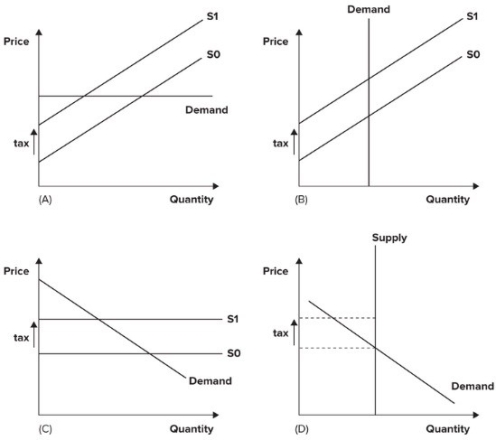
(Multiple Choice)
4.9/5 (70)
(70) Refer to the graph shown. With an effective price floor at Pf, total surplus is reduced by: 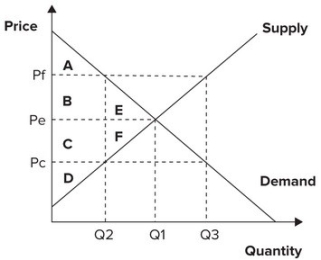
(Multiple Choice)
4.9/5 (87)
(87) Refer to the graph shown. When market supply shifts from S0 to S1, the revenue gain to suppliers resulting from increased quantity demanded is shown by area: 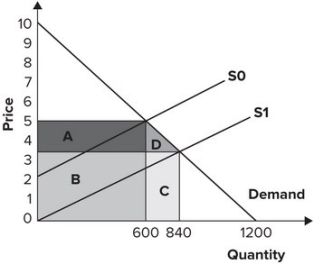
(Multiple Choice)
4.7/5 (85)
(85) As a result of advances in productivity, farmers can produce more at a lower cost. The effect of these changes has been to:
(Multiple Choice)
4.7/5 (71)
(71) Refer to the graph shown. With an effective price ceiling at $3, total surplus is reduced by: 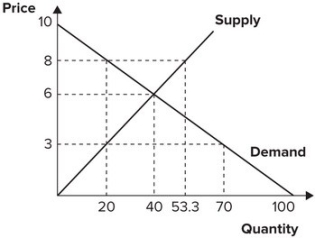
(Multiple Choice)
4.9/5 (87)
(87) Explain why the person who physically pays the tax is not necessarily the person who bears the tax.Who is most likely to bear the greater proportion of the tax burden? How does this apply to Social Security taxes?
(Essay)
4.7/5 (81)
(81) Refer to the graph shown. An effective price ceiling at $3 causes consumer surplus to: 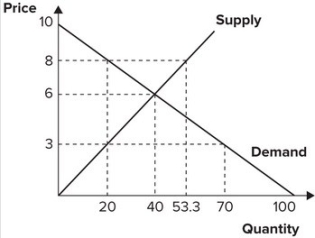
(Multiple Choice)
4.7/5 (74)
(74) Refer to the graph shown. Initially, the market is in equilibrium with price equal to $3 and quantity equal to 100. Government imposes a tax on suppliers of $1 per unit. The effect of the tax is to: 
(Multiple Choice)
4.9/5 (81)
(81) Refer to the graph shown. When the market is in equilibrium, consumer surplus is equal to: 
(Multiple Choice)
4.8/5 (77)
(77) Refer to the graph shown. Assume the market is initially in equilibrium at point b in the graph but the imposition of a per-unit tax on this product shifts the supply curve up from S0 to S1. The lost producer surplus of this tax is equal to the area: 
(Multiple Choice)
4.9/5 (72)
(72) Refer to the graph shown. Assume that the market is initially in equilibrium at a price of $6 and a quantity of 40 units. If the government imposes a $2 per-unit tax on this product, it will collect tax revenue in the amount of: 
(Multiple Choice)
4.8/5 (85)
(85) If demand is perfectly inelastic, the burden of a tax on suppliers is borne:
(Multiple Choice)
4.9/5 (80)
(80) If the demand curve is perfectly elastic, the burden of a tax on suppliers is borne:
(Multiple Choice)
4.8/5 (62)
(62) Suppose elasticity of demand is 0.2, elasticity of supply is 0.7, and a 10 percent excise tax is levied on producers. Which of the following changes will reduce the share of the tax paid by consumers?
(Multiple Choice)
4.9/5 (69)
(69) Suppose the equilibrium price of textbooks is $40 a textbook. At that price, the quantity of textbooks demanded and supplied is 20,000. If a $5 tax per textbook paid by consumers increases the price paid by consumers to $42 a textbook and reduces the equilibrium quantity sold to 18,000, elasticity of:
(Multiple Choice)
4.9/5 (90)
(90) Refer to the graph shown. Initially, the market is in equilibrium where the demand curve intersects S0. In the initial equilibrium, producer surplus is equal to: 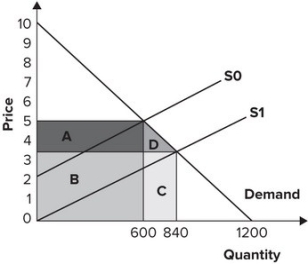
(Multiple Choice)
4.9/5 (82)
(82) 
Filters
- Essay(0)
- Multiple Choice(0)
- Short Answer(0)
- True False(0)
- Matching(0)