



 Chat with AI
Exam 7: Taxation and Government Intervention

Exam 1: Economics and Economic Reasoning158 Questions
Exam 2: The Production Possibility Model, Trade, and Globalization133 Questions
Exam 3: Economic Institutions163 Questions
Exam 4: Supply and Demand182 Questions
Exam 5: Using Supply and Demand163 Questions
Exam 6: Describing Supply and Demand: Elasticities216 Questions
Exam 7: Taxation and Government Intervention201 Questions
Exam 8: Market Failure Versus Government Failure197 Questions
Exam 9: Comparative Advantage, Exchange Rates, and Globalization118 Questions
Exam 10: International Trade Policy99 Questions
Exam 11: Production and Cost Analysis I194 Questions
Exam 12: Production and Cost Analysis II152 Questions
Exam 13: Perfect Competition170 Questions
Exam 14: Monopoly and Monopolistic Competition274 Questions
Exam 15: Oligopoly and Antitrust Policy142 Questions
Exam 16: Real-World Competition and Technology108 Questions
Exam 17: Work and the Labor Market150 Questions
Exam 18: Who Gets What the Distribution of Income131 Questions
Exam 19: The Logic of Individual Choice: the Foundation of Supply and Demand170 Questions
Exam 20: Game Theory, Strategic Decision Making, and Behavioral Economics103 Questions
Exam 21: Thinking Like a Modern Economist97 Questions
Exam 22: Behavioral Economics and Modern Economic Policy126 Questions
Exam 23: Microeconomic Policy, Economic Reasoning, and Beyond134 Questions
Exam 24: Economic Growth, Business Cycles, and Unemployment124 Questions
Exam 25: Measuring and Describing the Aggregate Economy229 Questions
Exam 26: The Keynesian Short-Run Policy Model: Demand-Side Policies220 Questions
Exam 27: The Classical Long-Run Policy Model: Growth and Supply-Side Policies133 Questions
Exam 28: The Financial Sector and the Economy214 Questions
Exam 29: Monetary Policy243 Questions
Exam 30: Financial Crises, Panics, and Unconventional Monetary Policy109 Questions
Exam 31: Deficits and Debt: the Austerity Debate150 Questions
Exam 32: The Fiscal Policy Dilemma119 Questions
Exam 33: Jobs and Unemployment78 Questions
Exam 34: Inflation, Deflation, and Macro Policy175 Questions
Exam 35: International Financial Policy211 Questions
Exam 36: Macro Policy in a Global Setting134 Questions
Exam 37: Structural Stagnation and Globalization125 Questions
Exam 38: Macro Policy in Developing Countries142 Questions
Select questions type


Refer to the graph shown. An effective price floor at $8 causes producer surplus to: 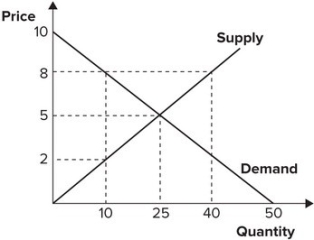
(Multiple Choice)
4.8/5  (86)
(86) Demonstrate graphically and explain verbally how a price floor may be viewed as essentially a tax and subsidy scheme.
(Essay)
5.0/5 (93)
(93) What are the three costs of taxation? What is the deadweight loss of taxation? What causes deadweight loss?
(Essay)
4.8/5 (86)
(86) The distance between the supply curve and the price the producer receives for a product for a given quantity supplied is referred to as:
(Multiple Choice)
4.8/5 (66)
(66) Refer to the graph shown. When market supply shifts from S0 to S1, total producer revenue: 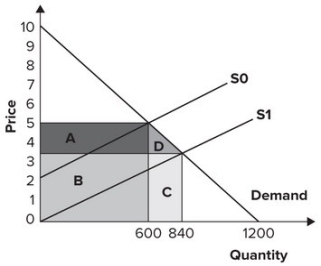
(Multiple Choice)
4.7/5 (86)
(86) Suppose the price elasticity of demand is 1.5 and the price elasticity of supply is 0.5,what is the percentage of a tax borne by the consumer,and what is the percentage of the same tax borne by the producer?
(Essay)
5.0/5 (71)
(71) If elasticity of demand is 0.7, elasticity of supply is 0.7, and a 5 percent excise tax is levied on the good:
(Multiple Choice)
5.0/5 (88)
(88) When elasticities of supply and demand are both equal to 1, the burden of a tax will be:
(Multiple Choice)
5.0/5 (80)
(80) 
The United States currently imposes a tariff on imported sugar.How does the burden imposed on suppliers and consumers by this tariff relate to the relative elasticities for sugar? Explain.NOTE: Be sure to include supply and demand diagrams as part of your explanation and vary the elasticity of demand,keeping elasticity of supply constant.
(Essay)
4.8/5 (75)
(75) Suppose the current equilibrium price of a good is $10,the elasticity of demand is 0,and the elasticity of supply is 2.If the government levies a $1 tax on the supplier,calculate the new equilibrium price and the percentage of the tax borne by both the demander and the supplier of the good.
(Essay)
4.9/5 (83)
(83) Demonstrate graphically and explain verbally why the equilibrium values of price and quantity in a supply and demand model lead to the maximum combination of consumer and producer surplus.
(Essay)
4.8/5 (75)
(75) A price ceiling is, in essence, an implicit tax on producers and an implicit subsidy to consumers.
(True/False)
4.9/5 (74)
(74) Suppose elasticity of demand is 1, elasticity of supply is 2, and a 5 percent excise tax is levied on consumers. Which of the following changes will reduce the burden of the tax on consumers?
(Multiple Choice)
4.9/5 (67)
(67) Demonstrate graphically and explain verbally how the size of a surplus created by a price floor is related to the elasticity of the supply and demand curves.
(Essay)
5.0/5 (68)
(68) When government imposes a per-unit tax on a product, the net price producers actually receive for the product (after taxation)typically:
(Multiple Choice)
4.8/5 (83)
(83) If the demand for Insulin is highly inelastic, the burden of a tax on Insulin will be borne almost entirely by sellers.
(True/False)
4.9/5 (88)
(88) 
Filters
- Essay(0)
- Multiple Choice(0)
- Short Answer(0)
- True False(0)
- Matching(0)