



 Chat with AI
Exam 7: Taxation and Government Intervention

Exam 1: Economics and Economic Reasoning158 Questions
Exam 2: The Production Possibility Model, Trade, and Globalization133 Questions
Exam 3: Economic Institutions163 Questions
Exam 4: Supply and Demand182 Questions
Exam 5: Using Supply and Demand163 Questions
Exam 6: Describing Supply and Demand: Elasticities216 Questions
Exam 7: Taxation and Government Intervention201 Questions
Exam 8: Market Failure Versus Government Failure197 Questions
Exam 9: Comparative Advantage, Exchange Rates, and Globalization118 Questions
Exam 10: International Trade Policy99 Questions
Exam 11: Production and Cost Analysis I194 Questions
Exam 12: Production and Cost Analysis II152 Questions
Exam 13: Perfect Competition170 Questions
Exam 14: Monopoly and Monopolistic Competition274 Questions
Exam 15: Oligopoly and Antitrust Policy142 Questions
Exam 16: Real-World Competition and Technology108 Questions
Exam 17: Work and the Labor Market150 Questions
Exam 18: Who Gets What the Distribution of Income131 Questions
Exam 19: The Logic of Individual Choice: the Foundation of Supply and Demand170 Questions
Exam 20: Game Theory, Strategic Decision Making, and Behavioral Economics103 Questions
Exam 21: Thinking Like a Modern Economist97 Questions
Exam 22: Behavioral Economics and Modern Economic Policy126 Questions
Exam 23: Microeconomic Policy, Economic Reasoning, and Beyond134 Questions
Exam 24: Economic Growth, Business Cycles, and Unemployment124 Questions
Exam 25: Measuring and Describing the Aggregate Economy229 Questions
Exam 26: The Keynesian Short-Run Policy Model: Demand-Side Policies220 Questions
Exam 27: The Classical Long-Run Policy Model: Growth and Supply-Side Policies133 Questions
Exam 28: The Financial Sector and the Economy214 Questions
Exam 29: Monetary Policy243 Questions
Exam 30: Financial Crises, Panics, and Unconventional Monetary Policy109 Questions
Exam 31: Deficits and Debt: the Austerity Debate150 Questions
Exam 32: The Fiscal Policy Dilemma119 Questions
Exam 33: Jobs and Unemployment78 Questions
Exam 34: Inflation, Deflation, and Macro Policy175 Questions
Exam 35: International Financial Policy211 Questions
Exam 36: Macro Policy in a Global Setting134 Questions
Exam 37: Structural Stagnation and Globalization125 Questions
Exam 38: Macro Policy in Developing Countries142 Questions
Select questions type


Refer to the graph shown. If consumers had to pay $13 per unit for this product instead of $10 per unit, consumer surplus would fall from: 
(Multiple Choice)
5.0/5  (82)
(82) The more inelastic the demand for agricultural output, the stronger the incentive for farmers to engage in rent-seeking activities.
(True/False)
4.8/5 (75)
(75) Refer to the graph shown. Assume that the market is initially in equilibrium at a price of $6 and a quantity of 40 units. In equilibrium, producer surplus is equal to: 
(Multiple Choice)
4.8/5 (65)
(65) Refer to the graph shown. Assume the market is initially in equilibrium at point j in the graph but the imposition of a per-unit tax on this product shifts the supply curve up from S0 to S1. The lost consumer surplus of this tax is equal to the area: 
(Multiple Choice)
4.8/5 (83)
(83) Refer to the graph shown. When the market is in equilibrium, producer surplus is area: 
(Multiple Choice)
4.7/5 (70)
(70) Refer to the graphs shown. Deadweight loss is the least with the imposition of a given per-unit tax on producers in graphs: 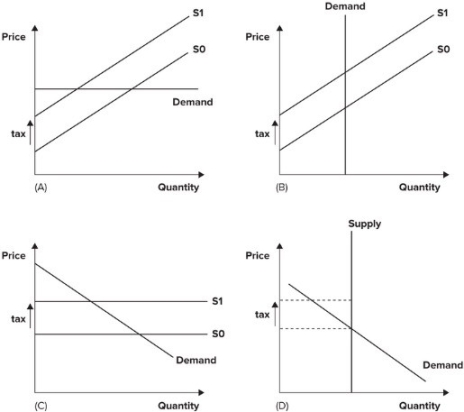
(Multiple Choice)
4.9/5 (57)
(57) Refer to the graph shown. Assume that the market is initially in equilibrium at a price of $6 and a quantity of 40 units. If the government imposes a $2 per-unit tax on this product, consumer surplus will fall from: 
(Multiple Choice)
4.8/5 (84)
(84) If the supply curve is perfectly elastic, the burden of a tax on suppliers is borne:
(Multiple Choice)
4.8/5 (86)
(86) Define consumer surplus and producer surplus.Explain why the equilibrium price and quantity maximizes the sum of producer plus consumer surplus (the total surplus).
(Essay)
4.9/5 (85)
(85) Refer to the graph shown. An effective price floor at $8 causes consumer surplus to: 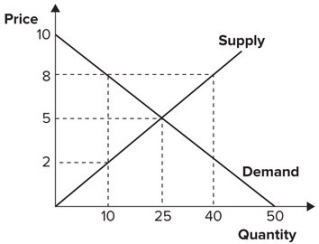
(Multiple Choice)
4.7/5 (83)
(83) Refer to the graph shown. Assume that the market is initially in equilibrium at a price of $6 and a quantity of 40 units. If the government imposes a $2 per-unit tax on this product, the deadweight loss from the tax will be: 
(Multiple Choice)
4.9/5 (79)
(79) The military draft can be seen as an implicit tax on potential recruits and a subsidy to those who demand defense services.
(True/False)
4.7/5 (81)
(81) Use the diagram below to compute the dollar value of the consumer and producer surplus. 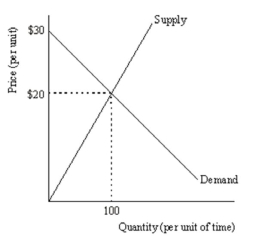
(Essay)
4.9/5 (83)
(83) A local government is considering a 10 percent tax on items A, B, and C. They want to tax only those goods for which the burden of the tax is lowest on suppliers. They know that the elasticity of supply of all the suppliers in question is about equal and have observed that when the price of A, B, and C rose 10 percent, total sales receipts for A and B rose 2 percent but declined 2 percent for C. From this information, they should:
(Multiple Choice)
4.9/5 (82)
(82) Refer to the graph shown. In equilibrium, producer surplus is equal to: 
(Multiple Choice)
4.9/5 (71)
(71) Refer to the graphs shown. The burden of the tax is borne entirely by consumers in graphs: 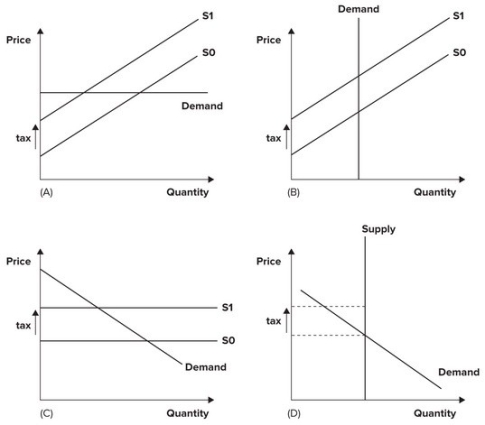
(Multiple Choice)
4.9/5 (88)
(88) Refer to the graph shown. Initially, the market is in equilibrium with price equal to $12 and quantity equal to 140. As a result of a per-unit tax imposed by the government, the supply curve shifts from S0 to S1. The effect of the tax is to: 
(Multiple Choice)
4.8/5 (74)
(74) If the government's goal is to alter people's behavior through taxation, taxing goods with relatively elastic demand and supply would be most effective.
(True/False)
4.9/5 (73)
(73) If a tax is legally required to be paid by sellers, sellers typically bear the full burden of the tax.
(True/False)
4.8/5 (74)
(74) Refer to the graph shown. Assume that the market is initially in equilibrium at a price of $10 and a quantity of 500 units. If the government imposes a $4 per-unit tax on this product, it will collect tax revenue in the amount of: 
(Multiple Choice)
4.8/5 (88)
(88) 
Filters
- Essay(0)
- Multiple Choice(0)
- Short Answer(0)
- True False(0)
- Matching(0)