



 Chat with AI
Exam 7: Taxation and Government Intervention

Exam 1: Economics and Economic Reasoning158 Questions
Exam 2: The Production Possibility Model, Trade, and Globalization133 Questions
Exam 3: Economic Institutions163 Questions
Exam 4: Supply and Demand182 Questions
Exam 5: Using Supply and Demand163 Questions
Exam 6: Describing Supply and Demand: Elasticities216 Questions
Exam 7: Taxation and Government Intervention201 Questions
Exam 8: Market Failure Versus Government Failure197 Questions
Exam 9: Comparative Advantage, Exchange Rates, and Globalization118 Questions
Exam 10: International Trade Policy99 Questions
Exam 11: Production and Cost Analysis I194 Questions
Exam 12: Production and Cost Analysis II152 Questions
Exam 13: Perfect Competition170 Questions
Exam 14: Monopoly and Monopolistic Competition274 Questions
Exam 15: Oligopoly and Antitrust Policy142 Questions
Exam 16: Real-World Competition and Technology108 Questions
Exam 17: Work and the Labor Market150 Questions
Exam 18: Who Gets What the Distribution of Income131 Questions
Exam 19: The Logic of Individual Choice: the Foundation of Supply and Demand170 Questions
Exam 20: Game Theory, Strategic Decision Making, and Behavioral Economics103 Questions
Exam 21: Thinking Like a Modern Economist97 Questions
Exam 22: Behavioral Economics and Modern Economic Policy126 Questions
Exam 23: Microeconomic Policy, Economic Reasoning, and Beyond134 Questions
Exam 24: Economic Growth, Business Cycles, and Unemployment124 Questions
Exam 25: Measuring and Describing the Aggregate Economy229 Questions
Exam 26: The Keynesian Short-Run Policy Model: Demand-Side Policies220 Questions
Exam 27: The Classical Long-Run Policy Model: Growth and Supply-Side Policies133 Questions
Exam 28: The Financial Sector and the Economy214 Questions
Exam 29: Monetary Policy243 Questions
Exam 30: Financial Crises, Panics, and Unconventional Monetary Policy109 Questions
Exam 31: Deficits and Debt: the Austerity Debate150 Questions
Exam 32: The Fiscal Policy Dilemma119 Questions
Exam 33: Jobs and Unemployment78 Questions
Exam 34: Inflation, Deflation, and Macro Policy175 Questions
Exam 35: International Financial Policy211 Questions
Exam 36: Macro Policy in a Global Setting134 Questions
Exam 37: Structural Stagnation and Globalization125 Questions
Exam 38: Macro Policy in Developing Countries142 Questions
Select questions type


Given the same price elasticity of supply, sellers would be able to pass along the smallest portion of a 10 percent tax on which item?
(Multiple Choice)
4.9/5  (82)
(82) If elasticity of demand is 1.8, elasticity of supply is 0.7, and a 20 percent excise tax is levied on the good:
(Multiple Choice)
5.0/5 (81)
(81) Suppose that 75 percent of a cigarette tax is borne by consumers. If the supply elasticity is 1, the demand elasticity is equal to:
(Multiple Choice)
4.8/5 (74)
(74) Refer to the graph shown. With an effective price floor at Pf, the effect is an implicit tax on: 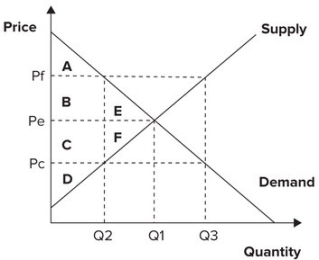
(Multiple Choice)
4.9/5 (76)
(76) Refer to the graph shown. If price is increased from $3 to $4, total surplus will fall by: 
(Multiple Choice)
4.9/5 (78)
(78) Refer to the graph shown. An effective price ceiling at Pc causes consumer surplus to: 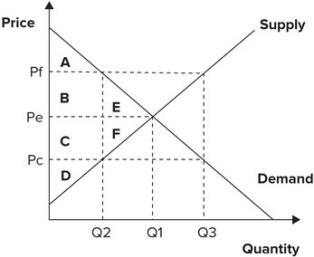
(Multiple Choice)
4.9/5 (82)
(82) Refer to the graph shown. An effective price floor at Pf causes producer surplus to: 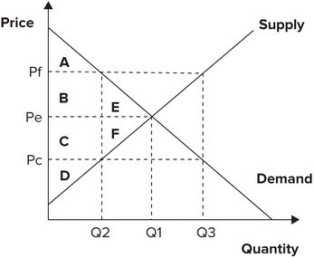
(Multiple Choice)
4.7/5 (80)
(80) If elasticity of demand is 0.2, elasticity of supply is 0.6, and a 10 percent excise tax is levied on the good:
(Multiple Choice)
4.9/5 (80)
(80) Demonstrate graphically and explain verbally the concept of producer surplus.
(Essay)
4.9/5 (75)
(75) Define rent-seeking activities and give an example.Use agricultural price supports to demonstrate that the value of rent seeking is linked to elasticity.
(Essay)
4.8/5 (76)
(76) Consumers have the greatest incentive to lobby for price controls in the short run when supply is:
(Multiple Choice)
4.9/5 (78)
(78) Refer to the graph shown. Assume the market is initially in equilibrium at point j in the graph but the imposition of a per-unit tax on this product shifts the supply curve up from S0 to S1. The welfare loss triangle from this tax is represented by area: 
(Multiple Choice)
4.8/5 (81)
(81) Refer to the graph shown. Assume that the market is initially in equilibrium at a price of $10 and a quantity of 500 units. In equilibrium, consumer surplus is equal to: 
(Multiple Choice)
4.8/5 (78)
(78) Demonstrate graphically and explain verbally the cost to producers of a tax of t per carton imposed on the sellers of cigarettes.Where does the lost producer surplus go?
(Essay)
4.8/5 (66)
(66) An excise tax on alcohol causes the supply of alcohol to decrease and the price of alcohol to decrease.
(True/False)
4.7/5 (70)
(70) Assuming a binding price floor, the more inelastic the supply and the demand curves are, the:
(Multiple Choice)
4.8/5 (71)
(71) Refer to the following graph. 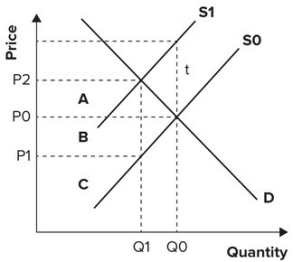 Given a tax of t on suppliers, revenue collected is:
 (Multiple Choice)
4.7/5 (76)
(76) 
Filters
- Essay(0)
- Multiple Choice(0)
- Short Answer(0)
- True False(0)
- Matching(0)