



 Chat with AI
Exam 8: Market Failure Versus Government Failure

Exam 1: Economics and Economic Reasoning158 Questions
Exam 2: The Production Possibility Model, Trade, and Globalization133 Questions
Exam 3: Economic Institutions163 Questions
Exam 4: Supply and Demand182 Questions
Exam 5: Using Supply and Demand163 Questions
Exam 6: Describing Supply and Demand: Elasticities216 Questions
Exam 7: Taxation and Government Intervention201 Questions
Exam 8: Market Failure Versus Government Failure197 Questions
Exam 9: Comparative Advantage, Exchange Rates, and Globalization118 Questions
Exam 10: International Trade Policy99 Questions
Exam 11: Production and Cost Analysis I194 Questions
Exam 12: Production and Cost Analysis II152 Questions
Exam 13: Perfect Competition170 Questions
Exam 14: Monopoly and Monopolistic Competition274 Questions
Exam 15: Oligopoly and Antitrust Policy142 Questions
Exam 16: Real-World Competition and Technology108 Questions
Exam 17: Work and the Labor Market150 Questions
Exam 18: Who Gets What the Distribution of Income131 Questions
Exam 19: The Logic of Individual Choice: the Foundation of Supply and Demand170 Questions
Exam 20: Game Theory, Strategic Decision Making, and Behavioral Economics103 Questions
Exam 21: Thinking Like a Modern Economist97 Questions
Exam 22: Behavioral Economics and Modern Economic Policy126 Questions
Exam 23: Microeconomic Policy, Economic Reasoning, and Beyond134 Questions
Exam 24: Economic Growth, Business Cycles, and Unemployment124 Questions
Exam 25: Measuring and Describing the Aggregate Economy229 Questions
Exam 26: The Keynesian Short-Run Policy Model: Demand-Side Policies220 Questions
Exam 27: The Classical Long-Run Policy Model: Growth and Supply-Side Policies133 Questions
Exam 28: The Financial Sector and the Economy214 Questions
Exam 29: Monetary Policy243 Questions
Exam 30: Financial Crises, Panics, and Unconventional Monetary Policy109 Questions
Exam 31: Deficits and Debt: the Austerity Debate150 Questions
Exam 32: The Fiscal Policy Dilemma119 Questions
Exam 33: Jobs and Unemployment78 Questions
Exam 34: Inflation, Deflation, and Macro Policy175 Questions
Exam 35: International Financial Policy211 Questions
Exam 36: Macro Policy in a Global Setting134 Questions
Exam 37: Structural Stagnation and Globalization125 Questions
Exam 38: Macro Policy in Developing Countries142 Questions
Select questions type


The following table shows four firms, the amount each pollutes, the marginal cost for each firm to clean up pollution, and the total cost to each firm of eliminating all pollution. Firm Total Discharge (in tons) Marginal Cost of Cleanup (per tan) Total Cost of Cleanup A 60 \ 5.00 \ 300 B 70 \ 8.00 \ 560 C 80 \ 7.50 \ 600 D 90 \ 4.00 \ 360 The total discharge of these four companies is 300 tons. Assume there is no one else who pollutes. If the government establishes a regulation requiring each company to reduce pollution by 50 percent, what will be spent on reducing pollution?
(Multiple Choice)
4.8/5  (74)
(74) What do economists mean when they say there is "market failure"?
(Multiple Choice)
4.9/5 (83)
(83) Based on economic theory, most economists believe market incentive plans are:
(Multiple Choice)
4.9/5 (81)
(81) Refer to the graph shown, which shows the demand and supply for a new vaccine against the common cold. Once vaccinated, a person cannot catch a cold or give a cold to someone else. If government does not subsidize the production of this vaccine: 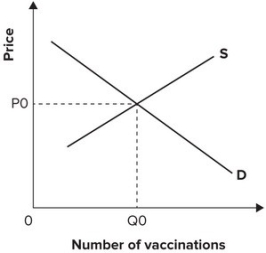
(Multiple Choice)
4.9/5 (78)
(78) Alex is playing his music at full volume in his dorm room. The other people living on his floor are enjoying his music, but Alex does not know or care. Alex's music playing is an example of a:
(Multiple Choice)
4.8/5 (78)
(78) A good that if supplied to one person is supplied to all and whose consumption by one individual does not prevent its consumption by another individual is known as:
(Multiple Choice)
4.9/5 (74)
(74) If government undertakes to reduce water usage by using a market incentive plan:
(Multiple Choice)
4.8/5 (80)
(80) Refer to the graph shown. There is a negative externality associated with the production of the good depicted. The socially efficient level of output is: 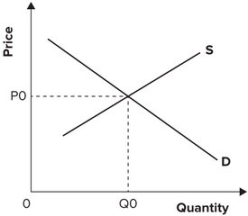
(Multiple Choice)
4.8/5 (82)
(82) Why can imperfect information lead to market failure? Explain the adverse selection problem and give an example.How could markets for information resolve this problem?
(Essay)
4.9/5 (75)
(75) A system in which power plants buy and sell the right to pollute in the form of emission credits is known as:
(Multiple Choice)
4.7/5 (85)
(85) Opponents of government intervention in the economy argue that government's attempts to correct informational problems:
(Multiple Choice)
4.8/5 (94)
(94) James enjoys gardening in the nude because he says it puts him in touch with nature. His neighbors find his gardening routine very offensive, but James replies that they should mind their own business and not watch him. To an economist this situation illustrates the concept of:
(Multiple Choice)
4.9/5 (87)
(87) Economists believe that if government provides information about product quality:
(Multiple Choice)
4.8/5 (80)
(80) The Environment Ministry in Japan proposed a new carbon tax to meet Japan's obligations to reduce carbon dioxide emissions under the Kyoto Treaty. The tax would be levied on producers and importers of fossil fuels, and the expectation is that it would be largely passed on to consumers. This proposal is an example of a:
(Multiple Choice)
4.8/5 (83)
(83) If the benefit of a public good is small to each individual in a society of millions of individuals:
(Multiple Choice)
5.0/5 (83)
(83) A European Union official, Mr. McGreevey, claims a portion of EU law involves overregulation. McGreevey is suggesting the EU suffers in part from:
(Multiple Choice)
4.9/5 (94)
(94) The following table shows the quantity demanded of a public good at different price levels by John and Elizabeth. Quantity Demanded Price John Elizabeth 0 100 100 0.5 90 80 1 80 60 1.5 70 40 2 60 20 2.5 50 0 3 40 0 3.5 30 0 4 20 0 4.5 10 0 5 0 0 Answer the following questions:
(1)Draw the demand curve for both John and Elizabeth.
(2)Draw the market demand for this public good.
(3)If the marginal cost of providing one unit of the good is $3 per unit,what is the socially optimal amount of the public good (show this on the same graph)?
(4)In this case,how much will each individual be willing to pay?
(Essay)
4.9/5 (71)
(71) Since trash generation involves an externality, the way economists might address the problem of trash generation that is most likely to be optimal is by:
(Multiple Choice)
4.9/5 (73)
(73) Economists are likely to oppose direct regulation because they do not believe there is any need for government to take action when negative externalities exist.
(True/False)
4.9/5 (80)
(80) 
Filters
- Essay(0)
- Multiple Choice(0)
- Short Answer(0)
- True False(0)
- Matching(0)