



 Chat with AI
Exam 8: Market Failure Versus Government Failure

Exam 1: Economics and Economic Reasoning158 Questions
Exam 2: The Production Possibility Model, Trade, and Globalization133 Questions
Exam 3: Economic Institutions163 Questions
Exam 4: Supply and Demand182 Questions
Exam 5: Using Supply and Demand163 Questions
Exam 6: Describing Supply and Demand: Elasticities216 Questions
Exam 7: Taxation and Government Intervention201 Questions
Exam 8: Market Failure Versus Government Failure197 Questions
Exam 9: Comparative Advantage, Exchange Rates, and Globalization118 Questions
Exam 10: International Trade Policy99 Questions
Exam 11: Production and Cost Analysis I194 Questions
Exam 12: Production and Cost Analysis II152 Questions
Exam 13: Perfect Competition170 Questions
Exam 14: Monopoly and Monopolistic Competition274 Questions
Exam 15: Oligopoly and Antitrust Policy142 Questions
Exam 16: Real-World Competition and Technology108 Questions
Exam 17: Work and the Labor Market150 Questions
Exam 18: Who Gets What the Distribution of Income131 Questions
Exam 19: The Logic of Individual Choice: the Foundation of Supply and Demand170 Questions
Exam 20: Game Theory, Strategic Decision Making, and Behavioral Economics103 Questions
Exam 21: Thinking Like a Modern Economist97 Questions
Exam 22: Behavioral Economics and Modern Economic Policy126 Questions
Exam 23: Microeconomic Policy, Economic Reasoning, and Beyond134 Questions
Exam 24: Economic Growth, Business Cycles, and Unemployment124 Questions
Exam 25: Measuring and Describing the Aggregate Economy229 Questions
Exam 26: The Keynesian Short-Run Policy Model: Demand-Side Policies220 Questions
Exam 27: The Classical Long-Run Policy Model: Growth and Supply-Side Policies133 Questions
Exam 28: The Financial Sector and the Economy214 Questions
Exam 29: Monetary Policy243 Questions
Exam 30: Financial Crises, Panics, and Unconventional Monetary Policy109 Questions
Exam 31: Deficits and Debt: the Austerity Debate150 Questions
Exam 32: The Fiscal Policy Dilemma119 Questions
Exam 33: Jobs and Unemployment78 Questions
Exam 34: Inflation, Deflation, and Macro Policy175 Questions
Exam 35: International Financial Policy211 Questions
Exam 36: Macro Policy in a Global Setting134 Questions
Exam 37: Structural Stagnation and Globalization125 Questions
Exam 38: Macro Policy in Developing Countries142 Questions
Select questions type


If government action is likely to do some good, it is always best for government to intervene in the marketplace.
(True/False)
4.9/5  (71)
(71) Problems that involve an externality (such as pollution)may be addressed by a number of alternative means.The most obvious is direct regulation,in which the use of some resource is directly limited by government.For example,pollution might be prohibited or limited to some fixed amount by direct regulation.Economists generally prefer some alternative solution to direct regulation,because regulation will not generally get persons to act so as to equate marginal social costs and marginal social benefits.Suppose it has been decided to implement a social policy to reduce electricity consumption by 10%,because the production of electricity results in pollution and consumes valuable resources.
(a)Give an example of how this goal could be achieved by direct regulation.What effect on incentives will the direct regulation you propose have? Will it equate the marginal benefits and marginal costs of electricity consumption? Why or why not?
(b)Now suggest two alternative methods to achieve the goal of 10% reduction in electricity consumption.What effect will these alternatives have on incentives? Will they result in the marginal benefits and marginal costs of electricity consumption being made equal?
(Essay)
4.8/5 (64)
(64) The rule for making optimal decisions is that an activity should be increased until:
(Multiple Choice)
4.7/5 (72)
(72) Refer to the graph shown. The amount of a tax sufficient to reduce quantity supplied to the level that individuals would have supplied had they included the cost in their decision on third parties is: 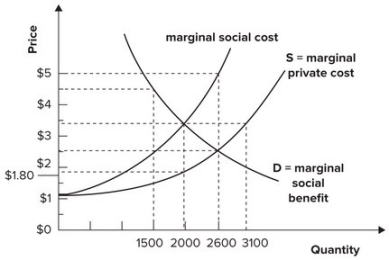
(Multiple Choice)
4.9/5 (70)
(70) Refer to the graph shown. Say that there is a negative externality associated with the production of the good depicted. The marginal social cost from consuming this good at the competitive equilibrium output level is: 
(Multiple Choice)
4.8/5 (83)
(83) Opponents of government intervention in the economy argue that externalities:
(Multiple Choice)
4.8/5 (75)
(75) Economists' attitude toward voluntary programs causes them to:
(Multiple Choice)
4.9/5 (87)
(87) An economist is most likely to support all of the following methods to address the negative externalities created by the waste from newspapers except:
(Multiple Choice)
4.7/5 (72)
(72) Which policy is likely to be the most efficient in dealing with automobile emission pollution?
(Multiple Choice)
4.7/5 (79)
(79) A policy that requires all the people to certify that they have reduced total consumption, not necessarily their own individual consumption, by a specified amount, is a(n):
(Multiple Choice)
4.9/5 (71)
(71) If a program requires people to pay a price that reflects the cost of an externality associated with their actions that they previously did not pay, it will be in their best interest to change their behavior.
(True/False)
4.9/5 (77)
(77) What are the three alternative methods of dealing with externalities? Briefly explain each one.
(Essay)
4.9/5 (81)
(81) If a consumer is willing to pay $100 for a used vintage record player that is a "cherry" and $30 for a used vintage record player that is a "lemon," the consumer will offer:
(Multiple Choice)
4.8/5 (73)
(73) Economists generally call the effect of an agreement on others that is not taken into account by the parties making the agreement:
(Multiple Choice)
4.9/5 (100)
(100) Three methods of dealing with externalities are direct regulation,incentive policies,and voluntary restrictions.Explain and evaluate each of these options.
(Essay)
4.9/5 (83)
(83) When positive externalities exist in the consumption of a good, the marginal social benefit:
(Multiple Choice)
4.8/5 (76)
(76) 
Filters
- Essay(0)
- Multiple Choice(0)
- Short Answer(0)
- True False(0)
- Matching(0)