



 Chat with AI
Exam 8: Market Failure Versus Government Failure

Exam 1: Economics and Economic Reasoning158 Questions
Exam 2: The Production Possibility Model, Trade, and Globalization133 Questions
Exam 3: Economic Institutions163 Questions
Exam 4: Supply and Demand182 Questions
Exam 5: Using Supply and Demand163 Questions
Exam 6: Describing Supply and Demand: Elasticities216 Questions
Exam 7: Taxation and Government Intervention201 Questions
Exam 8: Market Failure Versus Government Failure197 Questions
Exam 9: Comparative Advantage, Exchange Rates, and Globalization118 Questions
Exam 10: International Trade Policy99 Questions
Exam 11: Production and Cost Analysis I194 Questions
Exam 12: Production and Cost Analysis II152 Questions
Exam 13: Perfect Competition170 Questions
Exam 14: Monopoly and Monopolistic Competition274 Questions
Exam 15: Oligopoly and Antitrust Policy142 Questions
Exam 16: Real-World Competition and Technology108 Questions
Exam 17: Work and the Labor Market150 Questions
Exam 18: Who Gets What the Distribution of Income131 Questions
Exam 19: The Logic of Individual Choice: the Foundation of Supply and Demand170 Questions
Exam 20: Game Theory, Strategic Decision Making, and Behavioral Economics103 Questions
Exam 21: Thinking Like a Modern Economist97 Questions
Exam 22: Behavioral Economics and Modern Economic Policy126 Questions
Exam 23: Microeconomic Policy, Economic Reasoning, and Beyond134 Questions
Exam 24: Economic Growth, Business Cycles, and Unemployment124 Questions
Exam 25: Measuring and Describing the Aggregate Economy229 Questions
Exam 26: The Keynesian Short-Run Policy Model: Demand-Side Policies220 Questions
Exam 27: The Classical Long-Run Policy Model: Growth and Supply-Side Policies133 Questions
Exam 28: The Financial Sector and the Economy214 Questions
Exam 29: Monetary Policy243 Questions
Exam 30: Financial Crises, Panics, and Unconventional Monetary Policy109 Questions
Exam 31: Deficits and Debt: the Austerity Debate150 Questions
Exam 32: The Fiscal Policy Dilemma119 Questions
Exam 33: Jobs and Unemployment78 Questions
Exam 34: Inflation, Deflation, and Macro Policy175 Questions
Exam 35: International Financial Policy211 Questions
Exam 36: Macro Policy in a Global Setting134 Questions
Exam 37: Structural Stagnation and Globalization125 Questions
Exam 38: Macro Policy in Developing Countries142 Questions
Select questions type


A person who has auto insurance is likely to drive a little less safely and to take less care in parking their car in a safe place off the street. This is an example of a problem called:
(Multiple Choice)
5.0/5  (74)
(74) Opponents of government intervention argue that government makes decisions based on:
(Multiple Choice)
4.7/5 (69)
(69) In the Flint Hills area of Kansas, proposals to build wind turbines to generate electricity have pitted environmentalist against environmentalist. Members of the Kansas Sierra Club support the turbines as a way to reduce use of fossil fuel, but local chapters of the Nature Conservancy say they will befoul the landscape. An argument that supports the Sierra Club position is that that wind turbines:
(Multiple Choice)
5.0/5 (73)
(73) Television broadcasts are often given as examples of a public good. However, it is possible to code a broadcast so that only people who pay for the decoder box can view it. The use of a coded signal does what to a television broadcast?
(Multiple Choice)
4.8/5 (92)
(92) The following table shows four firms, the amount each pollutes, the marginal cost for each firm to clean up pollution, and the total cost to each firm of eliminating all pollution. Firm Total Discharge (in tons) Marginal Cost of Cleanup (per tan) Total Cost of Cleanup A 60 \ 5.00 \ 300 B 70 \ 8.00 \ 560 C 80 \ 7.50 \ 600 D 90 \ 4.00 \ 360 The total discharge of these four companies is 300 tons. Assume there is no one else who pollutes. If the government establishes an effluent fee of $7.00 per ton, how much would the firms spend on reducing pollution?
(Multiple Choice)
4.8/5 (84)
(84) If a negative externality exists in the production of paper and paper is sold in a perfectly competitive market, at the equilibrium output:
(Multiple Choice)
4.9/5 (79)
(79) What is the difference between a negative and a positive externality? Give an example of each.
(Essay)
4.8/5 (76)
(76) Music spreads easily and cheaply on computer networks. As a result, music has become more like:
(Multiple Choice)
4.9/5 (87)
(87) Refer to the graph shown. There is a $.010 per-gallon marginal cost external to the trade associated with the use of gasoline. Assuming that gasoline is sold in perfectly competitive markets, the market equilibrium price will be: 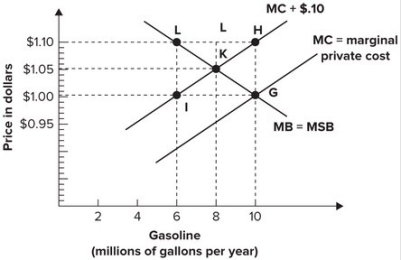
(Multiple Choice)
4.8/5 (74)
(74) Which of the following does not illustrate the free rider problem?
(Multiple Choice)
4.9/5 (81)
(81) The city of Spillsville is worried that its municipal landfill is going to fill up.As a result,the city's sanitation engineer has proposed two solutions:
Solution 1: Require each household to reduce its garbage disposal by 100 pounds per month.
Solution 2: Impose a tax of $.05 per pound of garbage that will overall result in the same decline in garbage disposal as Solution 1.
Which of the two solutions would an economist prefer to have implemented? Explain.
(Essay)
4.9/5 (85)
(85) The basis of the argument favoring government intervention to correct informational and rationality problems is that:
(Multiple Choice)
4.7/5 (86)
(86) Moral hazard problems can occur when insured individuals change their behavior to the detriment of the insurer.
(True/False)
4.8/5 (76)
(76) An efficient policy to reduce pollution would reduce pollution to the point where:
(Multiple Choice)
4.8/5 (86)
(86) Refer to the graph shown, which shows the demand and supply for a new vaccine against the common cold. Suppose once vaccinated, a person cannot catch a cold or give a cold to someone else. At the competitively determined output level, the marginal social benefit will be: 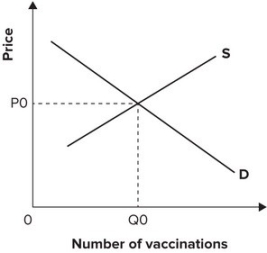
(Multiple Choice)
4.7/5 (80)
(80) Alex is playing his music at full volume in his dorm room. The other people living on his floor find this to be nuisance, but Alex does not care. Alex's music playing is an example of a:
(Multiple Choice)
4.9/5 (86)
(86) Which of the following is the best example of an adverse selection problem?
(Multiple Choice)
4.8/5 (72)
(72) Government attempts to offset market failures can prevent the market from dealing with a problem more effectively.
(True/False)
4.9/5 (86)
(86) In the case of a public good, a demand curve that shows the marginal benefit of the good is:
(Multiple Choice)
4.9/5 (75)
(75) 
Filters
- Essay(0)
- Multiple Choice(0)
- Short Answer(0)
- True False(0)
- Matching(0)