



 Chat with AI
Exam 8: Market Failure Versus Government Failure

Exam 1: Economics and Economic Reasoning158 Questions
Exam 2: The Production Possibility Model, Trade, and Globalization133 Questions
Exam 3: Economic Institutions163 Questions
Exam 4: Supply and Demand182 Questions
Exam 5: Using Supply and Demand163 Questions
Exam 6: Describing Supply and Demand: Elasticities216 Questions
Exam 7: Taxation and Government Intervention201 Questions
Exam 8: Market Failure Versus Government Failure197 Questions
Exam 9: Comparative Advantage, Exchange Rates, and Globalization118 Questions
Exam 10: International Trade Policy99 Questions
Exam 11: Production and Cost Analysis I194 Questions
Exam 12: Production and Cost Analysis II152 Questions
Exam 13: Perfect Competition170 Questions
Exam 14: Monopoly and Monopolistic Competition274 Questions
Exam 15: Oligopoly and Antitrust Policy142 Questions
Exam 16: Real-World Competition and Technology108 Questions
Exam 17: Work and the Labor Market150 Questions
Exam 18: Who Gets What the Distribution of Income131 Questions
Exam 19: The Logic of Individual Choice: the Foundation of Supply and Demand170 Questions
Exam 20: Game Theory, Strategic Decision Making, and Behavioral Economics103 Questions
Exam 21: Thinking Like a Modern Economist97 Questions
Exam 22: Behavioral Economics and Modern Economic Policy126 Questions
Exam 23: Microeconomic Policy, Economic Reasoning, and Beyond134 Questions
Exam 24: Economic Growth, Business Cycles, and Unemployment124 Questions
Exam 25: Measuring and Describing the Aggregate Economy229 Questions
Exam 26: The Keynesian Short-Run Policy Model: Demand-Side Policies220 Questions
Exam 27: The Classical Long-Run Policy Model: Growth and Supply-Side Policies133 Questions
Exam 28: The Financial Sector and the Economy214 Questions
Exam 29: Monetary Policy243 Questions
Exam 30: Financial Crises, Panics, and Unconventional Monetary Policy109 Questions
Exam 31: Deficits and Debt: the Austerity Debate150 Questions
Exam 32: The Fiscal Policy Dilemma119 Questions
Exam 33: Jobs and Unemployment78 Questions
Exam 34: Inflation, Deflation, and Macro Policy175 Questions
Exam 35: International Financial Policy211 Questions
Exam 36: Macro Policy in a Global Setting134 Questions
Exam 37: Structural Stagnation and Globalization125 Questions
Exam 38: Macro Policy in Developing Countries142 Questions
Select questions type


If a positive externality exists in the provision of education when education is provided in a perfectly competitive market without government intervention, at the market equilibrium level of education:
(Multiple Choice)
4.8/5  (93)
(93) Public television periodically runs pledge drives to raise money. Only a small percentage of the people who benefit from public television are willing to pay. What do economists call the people who do not pay?
(Multiple Choice)
4.8/5 (65)
(65) Give the definition of "externality" and indicate why externalities can result in a failure to achieve equality between social marginal cost and social marginal benefit.Demonstrate your answer graphically with a negative externality.
(Essay)
4.8/5 (75)
(75) Refer to the graph shown. Assuming a $0.10-per-gallon marginal cost external to the trade that is associated with gasoline, the market price of gasoline necessary to induce consumers to purchase the efficient quantity each year is: 
(Multiple Choice)
4.9/5 (81)
(81) Wearing a light long-sleeved sweater adds about 2 degrees of warmth to the wearer and allows such individuals to keep their homes at 2 degrees lower temperature.Such sweaters cost approximately $20,or three for $60.The 2-degree decrease in heat can save $200 a year in heating bills.
(a)Assuming that the government is committed to saving electricity,should it require people to wear such sweaters and keep their homes 2 degrees cooler?
(b)What are two alternatives to this regulation?
(c)If it is cheaper to keep warm with sweaters than with furnaces,why don't people voluntarily wear more sweaters?
(Essay)
4.8/5 (82)
(82) Suppose there are only two firms that pollute, A and B, and each emits 10 tons of waste into the air. Firm A can reduce its pollution at a cost of $100 per ton, and Firm B can reduce its pollution at a cost of $500 per ton. Each has been given an emission credit that allows it to pollute 6 tons. If firms maximize profits, what will happen?
(Multiple Choice)
4.9/5 (77)
(77) Direct regulation means that government sets specific limits on the use of scarce resources.
(True/False)
4.8/5 (70)
(70) A life insurance company is likely to require a health examination of a person applying for insurance. This helps reduce the informational problem through the process of:
(Multiple Choice)
4.8/5 (91)
(91) Apple products are able to play digital music that have a special encoding which makes pirating music more difficult. In economic terms, this encoding is an attempt to:
(Multiple Choice)
4.9/5 (85)
(85) Suppose that a negative externality creates $1 billion worth of costs to third parties. The government attacks the problem with regulations that cut the cost of the externality to $500 million but cost business and consumers $1.5 billion. This situation illustrates the idea that:
(Multiple Choice)
4.7/5 (82)
(82) The following table shows four firms, the amount each pollutes, the marginal cost for each firm to clean up pollution, and the total cost to each firm of eliminating all pollution. Firm Total Discharge (in tons) Marginal Cost of Cleanup (per tan) Total Cost of Cleanup A 60 \ 5.00 \ 300 B 70 \ 8.00 \ 560 C 80 \ 7.50 \ 600 D 90 \ 4.00 \ 360 The total discharge of these four companies is 300 tons. Assume there is no one else who pollutes and these firms want to maximize profits. If the government wishes to cut discharge by 50 percent, it could do so by establishing an effluent fee of:
(Multiple Choice)
4.9/5 (71)
(71) A per-unit tax designed to internalize the costs of production imposed on third parties is called:
(Multiple Choice)
4.9/5 (92)
(92) The diagram below illustrates a positive externality.D is the marginal private benefit and D1 is the marginal social benefit. 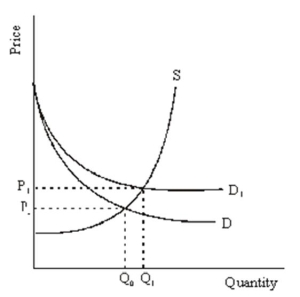 Referencing this diagram describe how a government can use direct regulation to eliminate the problem caused by the positive externality.What is a potential problem with this approach?
 (Essay)
4.9/5 (82)
(82) All of the following are considered sources of market failure except:
(Multiple Choice)
4.9/5 (94)
(94) If a negative externality is associated with burning firewood:
(Multiple Choice)
4.8/5 (79)
(79) Information problems may be a problem of the lack of a market.Explain.
(Essay)
4.8/5 (88)
(88) The Environment Ministry in Japan proposed a new carbon tax to meet Japan's obligations to reduce carbon dioxide emissions under the Kyoto Treaty. The tax would be levied on producers and importers of fossil fuels and raise the cost of using fossil fuels. How do most economists view a tax such as this?
(Multiple Choice)
4.8/5 (69)
(69) The following table shows the marginal private cost (MPC)and the marginal social cost (MSC)of a chemical factory.
Tons af Chenicals MPC MSC 1 100 120 2 110 130 3 120 140 4 130 150 5 140 160 Answer the following questions:
(1)What is the marginal cost of the factory's externality? Is it constant at all quantities?
(2)If the factory is a perfectly competitive firm and is not required by the government to internalize its external cost,how many tons should the factory produce,given that the market price of a ton of chemicals is $130?
(3)If the factory is a perfectly competitive firm and is required by the government to internalize its external cost,how many tons should the factory produce,given that the market price of a ton of chemicals is $130?
(4)Draw a graph illustrating your answers.
(Essay)
5.0/5 (92)
(92) Proposals in Flint Hills, Kansas, to build wind turbines to generate electricity have pitted environmentalist against environmentalist. Members of the Kansas Sierra Club support the turbines as a way to reduce use of fossil fuel, but local chapters of the Nature Conservancy say they will befoul the landscape. The Nature Conservancy is arguing that that wind turbines:
(Multiple Choice)
5.0/5 (86)
(86) 
Filters
- Essay(0)
- Multiple Choice(0)
- Short Answer(0)
- True False(0)
- Matching(0)