



 Chat with AI
Exam 12: Production and Cost Analysis II

Exam 1: Economics and Economic Reasoning158 Questions
Exam 2: The Production Possibility Model, Trade, and Globalization133 Questions
Exam 3: Economic Institutions163 Questions
Exam 4: Supply and Demand182 Questions
Exam 5: Using Supply and Demand163 Questions
Exam 6: Describing Supply and Demand: Elasticities216 Questions
Exam 7: Taxation and Government Intervention201 Questions
Exam 8: Market Failure Versus Government Failure197 Questions
Exam 9: Comparative Advantage, Exchange Rates, and Globalization118 Questions
Exam 10: International Trade Policy99 Questions
Exam 11: Production and Cost Analysis I194 Questions
Exam 12: Production and Cost Analysis II152 Questions
Exam 13: Perfect Competition170 Questions
Exam 14: Monopoly and Monopolistic Competition274 Questions
Exam 15: Oligopoly and Antitrust Policy142 Questions
Exam 16: Real-World Competition and Technology108 Questions
Exam 17: Work and the Labor Market150 Questions
Exam 18: Who Gets What the Distribution of Income131 Questions
Exam 19: The Logic of Individual Choice: the Foundation of Supply and Demand170 Questions
Exam 20: Game Theory, Strategic Decision Making, and Behavioral Economics103 Questions
Exam 21: Thinking Like a Modern Economist97 Questions
Exam 22: Behavioral Economics and Modern Economic Policy126 Questions
Exam 23: Microeconomic Policy, Economic Reasoning, and Beyond134 Questions
Exam 24: Economic Growth, Business Cycles, and Unemployment124 Questions
Exam 25: Measuring and Describing the Aggregate Economy229 Questions
Exam 26: The Keynesian Short-Run Policy Model: Demand-Side Policies220 Questions
Exam 27: The Classical Long-Run Policy Model: Growth and Supply-Side Policies133 Questions
Exam 28: The Financial Sector and the Economy214 Questions
Exam 29: Monetary Policy243 Questions
Exam 30: Financial Crises, Panics, and Unconventional Monetary Policy109 Questions
Exam 31: Deficits and Debt: the Austerity Debate150 Questions
Exam 32: The Fiscal Policy Dilemma119 Questions
Exam 33: Jobs and Unemployment78 Questions
Exam 34: Inflation, Deflation, and Macro Policy175 Questions
Exam 35: International Financial Policy211 Questions
Exam 36: Macro Policy in a Global Setting134 Questions
Exam 37: Structural Stagnation and Globalization125 Questions
Exam 38: Macro Policy in Developing Countries142 Questions
Select questions type


Given that there are significant economies of scale involved in making flat screen television sets, the cost of manufacturing a flat screen television set most likely will:
(Multiple Choice)
4.8/5  (77)
(77) Refer to the graph shown. The marginal rate of substitution at point C is: 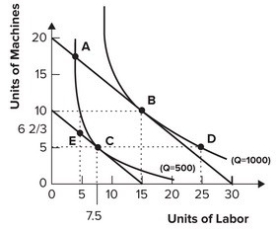
(Multiple Choice)
4.7/5 (71)
(71) Suppose you can produce 50 gourmet pizzas using either one worker and one oven or two workers and one oven.Which input combination is technically efficient?
(Essay)
4.9/5 (93)
(93) Refer to the graph shown. If the seller expects a price of $48: 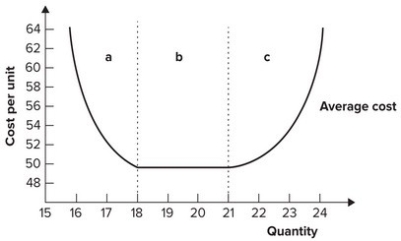
(Multiple Choice)
4.9/5 (87)
(87) Demonstrate graphically the effects of returns to scale on the Long Run Average Total Cost (LRATC)curve and explain verbally the concepts of economies of scale,constant return to scale,and diseconomies of scale.
(Essay)
4.9/5 (74)
(74) A new fertilizer has been discovered that significantly increases the corn crop yield per acre. As a result, the farmers':
(Multiple Choice)
4.8/5 (88)
(88) The merger between two general merchandise stores, Sears and Kmart, each of which carried some specialty items, most likely produced:
(Multiple Choice)
4.8/5 (78)
(78) Refer to the graph shown. The most economically efficient way to produce 500 units of output is to use: 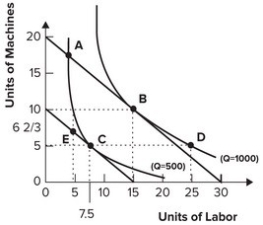
(Multiple Choice)
4.8/5 (86)
(86) Suppose the average total cost of producing semiconductors in a factory of a particular size declines over time as more semiconductors are produced. This drop in average total cost might best be explained by:
(Multiple Choice)
4.9/5 (71)
(71) The short-run average total cost curve is generally assumed to be:
(Multiple Choice)
4.7/5 (92)
(92) At the planned output level, short-run average total cost equals long-run average total cost, but at all other points, short-run average total cost is higher than long-run average total cost.
(True/False)
4.8/5 (83)
(83) An entrepreneur most likely would develop a product if expected average total cost is:
(Multiple Choice)
4.8/5 (81)
(81) Refer to the graph shown. Given the long-run average cost curve, a seller must produce 18 units just to break even if the price the seller expects is roughly: 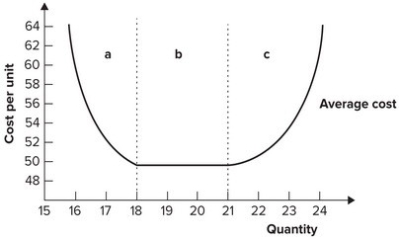
(Multiple Choice)
4.9/5 (86)
(86) Economies of scale account for what part of a long-run average total cost curve?
(Multiple Choice)
5.0/5 (85)
(85) If technological innovation occurs when a firm is experiencing diseconomies of scale:
(Multiple Choice)
4.9/5 (80)
(80) ABC Co. produces only gadgets, and XYZ Co. produces both gadgets and widgets. If ABC Co. produces gadgets at the same average total cost as XYZ Co. , economies of:
(Multiple Choice)
4.8/5 (80)
(80) The SRATC and LRATC curves are both typically U-shaped for different reasons.Explain why.
(Essay)
4.7/5 (75)
(75) 
Filters
- Essay(0)
- Multiple Choice(0)
- Short Answer(0)
- True False(0)
- Matching(0)