



 Chat with AI
Exam 12: Production and Cost Analysis II

Exam 1: Economics and Economic Reasoning158 Questions
Exam 2: The Production Possibility Model, Trade, and Globalization133 Questions
Exam 3: Economic Institutions163 Questions
Exam 4: Supply and Demand182 Questions
Exam 5: Using Supply and Demand163 Questions
Exam 6: Describing Supply and Demand: Elasticities216 Questions
Exam 7: Taxation and Government Intervention201 Questions
Exam 8: Market Failure Versus Government Failure197 Questions
Exam 9: Comparative Advantage, Exchange Rates, and Globalization118 Questions
Exam 10: International Trade Policy99 Questions
Exam 11: Production and Cost Analysis I194 Questions
Exam 12: Production and Cost Analysis II152 Questions
Exam 13: Perfect Competition170 Questions
Exam 14: Monopoly and Monopolistic Competition274 Questions
Exam 15: Oligopoly and Antitrust Policy142 Questions
Exam 16: Real-World Competition and Technology108 Questions
Exam 17: Work and the Labor Market150 Questions
Exam 18: Who Gets What the Distribution of Income131 Questions
Exam 19: The Logic of Individual Choice: the Foundation of Supply and Demand170 Questions
Exam 20: Game Theory, Strategic Decision Making, and Behavioral Economics103 Questions
Exam 21: Thinking Like a Modern Economist97 Questions
Exam 22: Behavioral Economics and Modern Economic Policy126 Questions
Exam 23: Microeconomic Policy, Economic Reasoning, and Beyond134 Questions
Exam 24: Economic Growth, Business Cycles, and Unemployment124 Questions
Exam 25: Measuring and Describing the Aggregate Economy229 Questions
Exam 26: The Keynesian Short-Run Policy Model: Demand-Side Policies220 Questions
Exam 27: The Classical Long-Run Policy Model: Growth and Supply-Side Policies133 Questions
Exam 28: The Financial Sector and the Economy214 Questions
Exam 29: Monetary Policy243 Questions
Exam 30: Financial Crises, Panics, and Unconventional Monetary Policy109 Questions
Exam 31: Deficits and Debt: the Austerity Debate150 Questions
Exam 32: The Fiscal Policy Dilemma119 Questions
Exam 33: Jobs and Unemployment78 Questions
Exam 34: Inflation, Deflation, and Macro Policy175 Questions
Exam 35: International Financial Policy211 Questions
Exam 36: Macro Policy in a Global Setting134 Questions
Exam 37: Structural Stagnation and Globalization125 Questions
Exam 38: Macro Policy in Developing Countries142 Questions
Select questions type


The reason for the merger of two businesses that sell unrelated goods but can share business practices and sales forces might best be explained by:
(Multiple Choice)
4.9/5  (95)
(95) Refer to the graph shown. If a firm expected to produce 900 units when it built its plant but now desires to reduce its output to 600 units in the short run, it will use the plant size represented by: 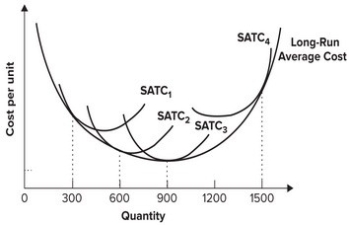
(Multiple Choice)
4.8/5 (67)
(67) Refer to the graph shown. A firm can produce the same amount of output at points: 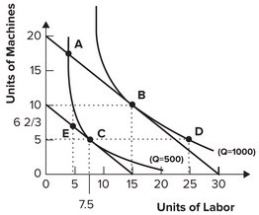
(Multiple Choice)
4.9/5 (82)
(82) An economically efficient method of production produces a given level of output at the lowest possible cost.
(True/False)
4.8/5 (95)
(95) "For-benefit" corporations are created to pursue multiple goals, such as profitability, social responsibility, and value for the broader society. These firms provide examples of:
(Multiple Choice)
4.8/5 (77)
(77) The Edge Corporation manufactures gas powered water pumps.Each pump can be produced in two hours using either of two production processes: with one worker and 10 tools or with 2 workers and 6 tools.Each worker earns $12.00 per hour and each tool has an implicit rental rate of $1.50 per hour.Could both combinations of inputs be technically efficient? What is the economically efficient input combination? Explain.
(Essay)
5.0/5 (90)
(90) At one time, sea lions were depleting the stock of steelhead trout. One idea to scare sea lions away from the Washington coast was to launch fake killer whales, which are predators of sea lions. The cost of making the first whale is $16,000 ($5,000 for materials and $11,000 for the mold). The mold can be reused to make additional whales, and so additional whales cost $5,000 each. Based on these numbers, the production of fake killer whales exhibits:
(Multiple Choice)
4.8/5 (85)
(85) Refer to the graph shown. If the firm's total cost is $375, labor must cost: 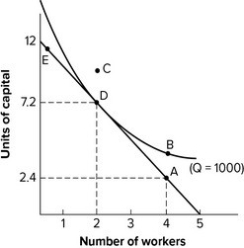
(Multiple Choice)
4.9/5 (88)
(88) If a machine cost $50,000 initially and is expected to last for 20 years but is worth $60,000 after one year because it is in short supply, an accountant most likely would say that:
(Multiple Choice)
4.8/5 (83)
(83) The law of diminishing marginal productivity does not apply in the long run because:
(Multiple Choice)
4.8/5 (82)
(82) Some children in Siliguri, India, work as low-wage professional rock breakers. The rocks they break with a hammer are used in buildings and roads. In terms of the idea of efficiency, having children break rocks with hammers:
(Multiple Choice)
4.9/5 (81)
(81) Economies of scale do not exist in the presence of indivisible setup costs.
(True/False)
4.9/5 (76)
(76) Refer to the graph shown. A firm that produces 900 units of output using the plant size associated with SATC2 minimizes: 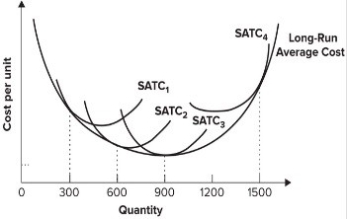
(Multiple Choice)
4.8/5 (85)
(85) Refer to the graph shown. If the seller expects a price of $52, the minimum amount the firm must produce to be profitable is: 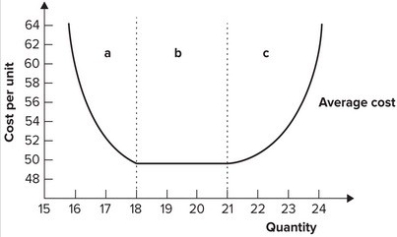
(Multiple Choice)
5.0/5 (91)
(91) Are diminishing marginal productivity and diseconomies of scale the same thing? Explain why or why not.
(Essay)
4.8/5 (79)
(79) At one time, sea lions were depleting the stock of steelhead trout. One idea to scare sea lions away from the Washington coast was to launch fake killer whales, which are predators of sea lions. The cost of making the first whale is $16,000 ($5,000 for materials and $11,000 for the mold). The mold can be reused to make additional whales, and so additional whales cost $5,000 each. Based on these numbers, the average total cost of making five fake killer whales would be:
(Multiple Choice)
4.8/5 (72)
(72) 
Filters
- Essay(0)
- Multiple Choice(0)
- Short Answer(0)
- True False(0)
- Matching(0)