



 Chat with AI
Exam 12: Production and Cost Analysis II

Exam 1: Economics and Economic Reasoning158 Questions
Exam 2: The Production Possibility Model, Trade, and Globalization133 Questions
Exam 3: Economic Institutions163 Questions
Exam 4: Supply and Demand182 Questions
Exam 5: Using Supply and Demand163 Questions
Exam 6: Describing Supply and Demand: Elasticities216 Questions
Exam 7: Taxation and Government Intervention201 Questions
Exam 8: Market Failure Versus Government Failure197 Questions
Exam 9: Comparative Advantage, Exchange Rates, and Globalization118 Questions
Exam 10: International Trade Policy99 Questions
Exam 11: Production and Cost Analysis I194 Questions
Exam 12: Production and Cost Analysis II152 Questions
Exam 13: Perfect Competition170 Questions
Exam 14: Monopoly and Monopolistic Competition274 Questions
Exam 15: Oligopoly and Antitrust Policy142 Questions
Exam 16: Real-World Competition and Technology108 Questions
Exam 17: Work and the Labor Market150 Questions
Exam 18: Who Gets What the Distribution of Income131 Questions
Exam 19: The Logic of Individual Choice: the Foundation of Supply and Demand170 Questions
Exam 20: Game Theory, Strategic Decision Making, and Behavioral Economics103 Questions
Exam 21: Thinking Like a Modern Economist97 Questions
Exam 22: Behavioral Economics and Modern Economic Policy126 Questions
Exam 23: Microeconomic Policy, Economic Reasoning, and Beyond134 Questions
Exam 24: Economic Growth, Business Cycles, and Unemployment124 Questions
Exam 25: Measuring and Describing the Aggregate Economy229 Questions
Exam 26: The Keynesian Short-Run Policy Model: Demand-Side Policies220 Questions
Exam 27: The Classical Long-Run Policy Model: Growth and Supply-Side Policies133 Questions
Exam 28: The Financial Sector and the Economy214 Questions
Exam 29: Monetary Policy243 Questions
Exam 30: Financial Crises, Panics, and Unconventional Monetary Policy109 Questions
Exam 31: Deficits and Debt: the Austerity Debate150 Questions
Exam 32: The Fiscal Policy Dilemma119 Questions
Exam 33: Jobs and Unemployment78 Questions
Exam 34: Inflation, Deflation, and Macro Policy175 Questions
Exam 35: International Financial Policy211 Questions
Exam 36: Macro Policy in a Global Setting134 Questions
Exam 37: Structural Stagnation and Globalization125 Questions
Exam 38: Macro Policy in Developing Countries142 Questions
Select questions type


Refer to the graph shown. If labor costs $10 per unit and machines cost $15 per unit, the economically efficient cost of producing 500 units of output is: 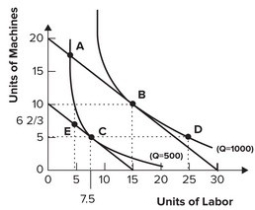
(Multiple Choice)
4.8/5  (80)
(80) Refer to the graph shown. The cheapest way to produce 1,000 units of output is with: 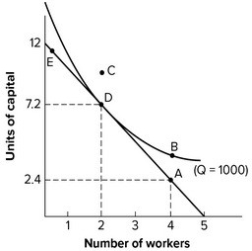
(Multiple Choice)
4.9/5 (81)
(81) Refer to the graph shown. If labor costs $10 per unit and machines cost $15 per unit, the economically efficient cost of producing 1,000 units of output is: 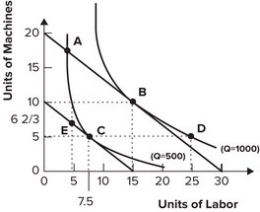
(Multiple Choice)
4.9/5 (89)
(89) An entrepreneur is willing to bring a supply of goods to the market if expected:
(Multiple Choice)
4.9/5 (86)
(86) The long-run average cost of producing 12 units of output is $54; the long-run average cost of producing 13 units is $56. These numbers illustrate:
(Multiple Choice)
4.8/5 (83)
(83) Suppose a factory that produces toasters experiences a decline in its average total cost with no change in its output level. This decline might be explained by:
(Multiple Choice)
4.8/5 (82)
(82) At one time sea lions were depleting the stock of steelhead trout. One idea to scare sea lions away from the Washington coast was to launch fake killer whales, which are predators of sea lions. The cost of making the first whale is $16,000 ($5,000 for materials and $11,000 for the mold). The mold can be reused to make additional whales, and so additional whales cost $5,000 each. Based on these numbers, the total cost of making two fake killer whales would be:
(Multiple Choice)
4.9/5 (90)
(90) Refer to the graph shown. The least-cost method of producing 1,000 units of output is shown at point: 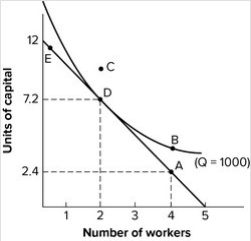
(Multiple Choice)
4.9/5 (93)
(93) Which of the following is most likely to be an example of economies of scale?
(Multiple Choice)
4.7/5 (74)
(74) A firm can use 5 workers and 10 machines, 7 workers and 9 machines, or 8 workers and 9 machines to produce four cars. If each worker costs $200 and each machine is rented for $50, the economically efficient input combination is:
(Multiple Choice)
4.9/5 (95)
(95) If a firm is able to lower total costs by specializing in marketing and distribution while outsourcing production, it is taking advantage of:
(Multiple Choice)
4.9/5 (82)
(82) Refer to the graph shown. The shift from SATC1 to SATC2 reflects: 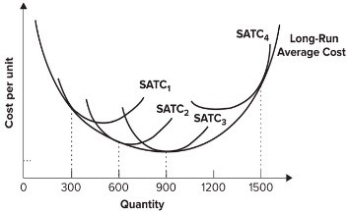
(Multiple Choice)
4.9/5 (83)
(83) Using 100 workers and 10 machines, a firm can produce 10,000 units of output; using 250 workers and 25 machines, the firm produces 21,000 units of output. These facts are best explained by:
(Multiple Choice)
5.0/5 (69)
(69) Refer to the graph shown. The marginal rate of substitution at point B is: 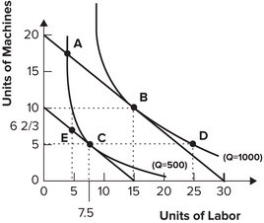
(Multiple Choice)
4.9/5 (73)
(73) Refer to the graph shown. The output range in region b is associated with: 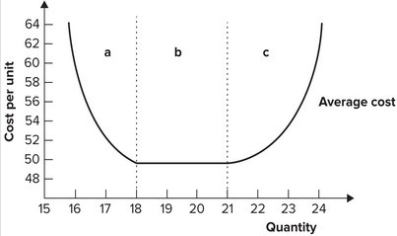
(Multiple Choice)
4.8/5 (83)
(83) Suppose you can manufacture a Blu-ray player using 5 people and 1 machine or using 1 person and 3 machines.Is it possible that both input combinations are technically efficient? What information would be needed to determine which input combination is economically efficient?
(Essay)
4.7/5 (85)
(85) 
Filters
- Essay(0)
- Multiple Choice(0)
- Short Answer(0)
- True False(0)
- Matching(0)