



 Chat with AI
Exam 12: Production and Cost Analysis II

Exam 1: Economics and Economic Reasoning158 Questions
Exam 2: The Production Possibility Model, Trade, and Globalization133 Questions
Exam 3: Economic Institutions163 Questions
Exam 4: Supply and Demand182 Questions
Exam 5: Using Supply and Demand163 Questions
Exam 6: Describing Supply and Demand: Elasticities216 Questions
Exam 7: Taxation and Government Intervention201 Questions
Exam 8: Market Failure Versus Government Failure197 Questions
Exam 9: Comparative Advantage, Exchange Rates, and Globalization118 Questions
Exam 10: International Trade Policy99 Questions
Exam 11: Production and Cost Analysis I194 Questions
Exam 12: Production and Cost Analysis II152 Questions
Exam 13: Perfect Competition170 Questions
Exam 14: Monopoly and Monopolistic Competition274 Questions
Exam 15: Oligopoly and Antitrust Policy142 Questions
Exam 16: Real-World Competition and Technology108 Questions
Exam 17: Work and the Labor Market150 Questions
Exam 18: Who Gets What the Distribution of Income131 Questions
Exam 19: The Logic of Individual Choice: the Foundation of Supply and Demand170 Questions
Exam 20: Game Theory, Strategic Decision Making, and Behavioral Economics103 Questions
Exam 21: Thinking Like a Modern Economist97 Questions
Exam 22: Behavioral Economics and Modern Economic Policy126 Questions
Exam 23: Microeconomic Policy, Economic Reasoning, and Beyond134 Questions
Exam 24: Economic Growth, Business Cycles, and Unemployment124 Questions
Exam 25: Measuring and Describing the Aggregate Economy229 Questions
Exam 26: The Keynesian Short-Run Policy Model: Demand-Side Policies220 Questions
Exam 27: The Classical Long-Run Policy Model: Growth and Supply-Side Policies133 Questions
Exam 28: The Financial Sector and the Economy214 Questions
Exam 29: Monetary Policy243 Questions
Exam 30: Financial Crises, Panics, and Unconventional Monetary Policy109 Questions
Exam 31: Deficits and Debt: the Austerity Debate150 Questions
Exam 32: The Fiscal Policy Dilemma119 Questions
Exam 33: Jobs and Unemployment78 Questions
Exam 34: Inflation, Deflation, and Macro Policy175 Questions
Exam 35: International Financial Policy211 Questions
Exam 36: Macro Policy in a Global Setting134 Questions
Exam 37: Structural Stagnation and Globalization125 Questions
Exam 38: Macro Policy in Developing Countries142 Questions
Select questions type


Refer to the graph shown. If the firm wants to produce 900 units of output, it should use the plant size represented by: 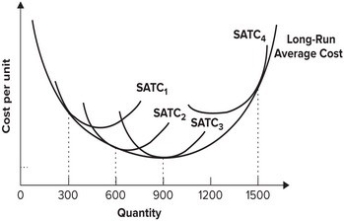
(Multiple Choice)
4.8/5  (74)
(74) If a firm is operating at the point of tangency between an isoquant and an isocost line, its production is:
(Multiple Choice)
4.9/5 (78)
(78) A social entrepreneur's central motivation in creating "for-benefit" corporations is to achieve social, not just economic, ends.
(True/False)
4.7/5 (84)
(84) Refer to the graph shown. A firm that produces 900 units of output using the plant size associated with SATC3 minimizes: 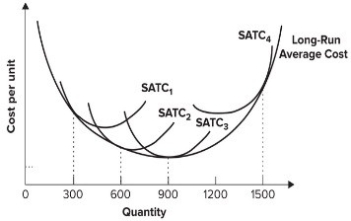
(Multiple Choice)
4.8/5 (83)
(83) What concept is important in determining the shape of short run cost curves (marginal cost,average cost)but plays no role in determining the shape of long-run cost curves? What are the most important factors in determining the shape of the long-run cost curves? Explain.
(Essay)
4.9/5 (92)
(92) According to the text, globalization has led to greater U.S. specialization in:
(Multiple Choice)
4.9/5 (70)
(70) Which of the following is most likely an example of diseconomies of scale?
(Multiple Choice)
4.8/5 (88)
(88) When the number of mega-producers of hobs that operated at a lower average cost than smaller producers rose, the number of hogs slaughtered rose to record levels. What economic concept does this describe?
(Multiple Choice)
4.9/5 (79)
(79) As an employee of the Grelb Corporation (a manufacturer of gas powered generators)you have been asked to determine the nature of their long-run cost structure.Some cost data has been collected for you and appears in the table below. Quantity of generators Total costs of labor Total costs of tools Total Costs Average Total Costs 11 \ 192 \ 127 12 200 136 13 206 145 14 210 150 15 220 155 16 240 160 17 255 170 18 280 188 19 320 212 20 365 235 (a)Fill in the missing values in the table.
(b)Determine the range of output levels over which there exists economies and diseconomies of scale.
(c)Graph the firm's average total cost curve and
(d)Describe how your answer to part (b)above relates to the shape of this curve.
(Essay)
4.8/5 (70)
(70) A firm's average cost increases as it increases its output by expanding its plant and hiring additional workers (its only inputs to production). The firm's owner blames the increase in per-unit costs on the law of diminishing marginal productivity. The owner's reasoning is:
(Multiple Choice)
4.9/5 (89)
(89) Why is it that a technically efficient method of producing may not be an economically efficient method of production?
(Essay)
4.8/5 (86)
(86) 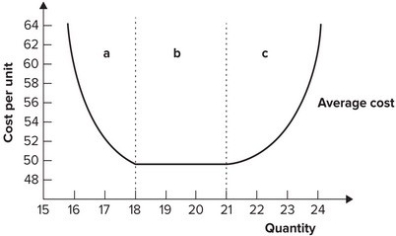
You have decided to produce and market a new basketball sneaker.What decisions do you need to make besides how many shoes to produce?
(Essay)
5.0/5 (72)
(72) Which of the following is an accurate statement about the envelope relationship?
(Multiple Choice)
4.9/5 (74)
(74) Since capital is relatively scarce in India, the economically efficient method of producing food would probably:
(Multiple Choice)
4.9/5 (76)
(76) The production techniques available to real-world firms are constantly changing because of learning by doing and technological change.
(True/False)
4.8/5 (76)
(76) 
Filters
- Essay(0)
- Multiple Choice(0)
- Short Answer(0)
- True False(0)
- Matching(0)