



 Chat with AI
Exam 17: Processes of Evolution

Exam 1: The Science of Biology68 Questions
Exam 2: Lifes Chemical Basis79 Questions
Exam 3: Molecules of Life56 Questions
Exam 4: Cell Structure64 Questions
Exam 5: Ground Rules of Metabolism58 Questions
Exam 6: Where It Starts-Photosynthesis87 Questions
Exam 7: Releasing Chemical Energy80 Questions
Exam 8: DNA Structure and Function75 Questions
Exam 9: From DNA to Protein65 Questions
Exam 10: Control of Gene Expression61 Questions
Exam 11: How Cells Reproduce75 Questions
Exam 12: Meiosis and Sexual Reproduction68 Questions
Exam 13: Patterns in Inherited Traits54 Questions
Exam 14: Human Inheritance41 Questions
Exam 15: Biotechnology71 Questions
Exam 16: Evidence of Evolution69 Questions
Exam 17: Processes of Evolution83 Questions
Exam 18: Lifes Origin and Early Evolution49 Questions
Exam 19: Viruses, Bacteria, and Archaea42 Questions
Exam 20: The Protists56 Questions
Exam 21: Plant Evolution55 Questions
Exam 22: Fungi50 Questions
Exam 23: Animals I: Major Invertebrate Groups72 Questions
Exam 24: Animals Ii: the Chordates76 Questions
Exam 25: Plant Tissues67 Questions
Exam 26: Plant Nutrition and Transport67 Questions
Exam 27: Plant Reproduction and Development71 Questions
Exam 28: Animal Tissues and Organ Systems78 Questions
Exam 29: Neural Control80 Questions
Exam 30: Sensory Perception62 Questions
Exam 31: Endocrine Control65 Questions
Exam 32: Structural Support and Movement52 Questions
Exam 33: Circulation66 Questions
Exam 34: Immunity57 Questions
Exam 35: Respiration63 Questions
Exam 36: Digestion and Human Nutrition57 Questions
Exam 37: Maintaining the Internal Environment63 Questions
Exam 38: Reproduction and Development88 Questions
Exam 39: Animal Behavior73 Questions
Exam 40: Population Ecology55 Questions
Exam 41: Community Ecology73 Questions
Exam 42: Ecosystems52 Questions
Exam 43: The Biosphere74 Questions
Exam 44: Human Effects on the Biosphere73 Questions
Select questions type


A group that contains an ancestor in which a derived trait evolved and all of its descendants is called a ____.
(Multiple Choice)
4.8/5  (77)
(77) Hardy-Weinberg equilibrium is most likely to be maintained ____.
(Multiple Choice)
4.9/5 (81)
(81) A population of mice shifting from light-colored coats to darker coats is displaying the effects of ____ selection.
(Multiple Choice)
4.9/5 (76)
(76) Match the event with the most appropriate term.
-a flowering plant that produces a polyploid cell that can self-fertilize and produce a new species
(Multiple Choice)
4.9/5 (70)
(70) 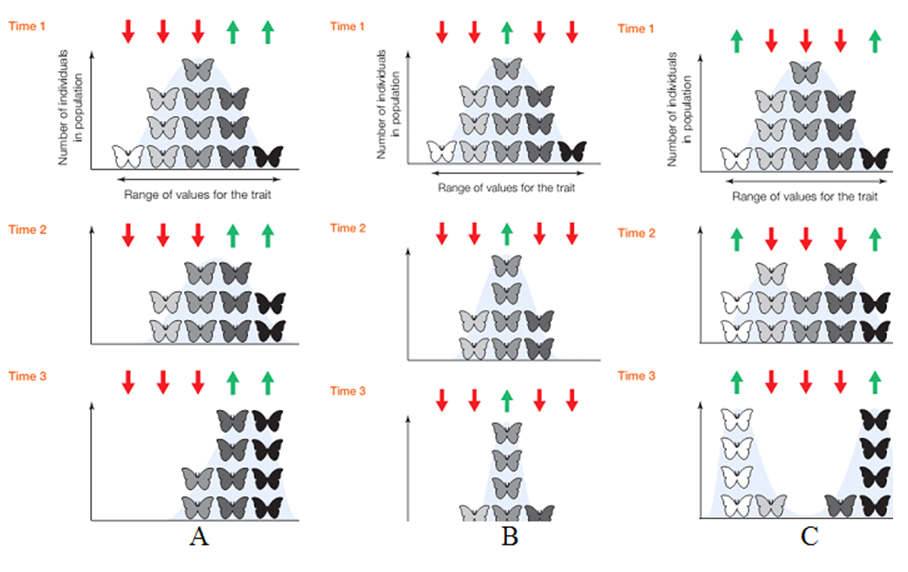 -?The illustration labeled "A" shows selection against ____.
 (Multiple Choice)
4.9/5 (75)
(75) Match the event with the most appropriate term.
-more white-coated hares appeared compared to brown-coated hares during an ice age
(Multiple Choice)
4.9/5 (79)
(79) Match the event with the most appropriate term.
-hard shells that allow reptiles to lay eggs on land
(Multiple Choice)
4.9/5 (73)
(73) When fish release their gametes into open water for fertilization, ____ isolation usually prevents the fusion of egg and sperm from different species.
(Multiple Choice)
4.8/5 (71)
(71) The speciation of cichlid fishes of the same African crater lake is an example of ____.
(Multiple Choice)
4.8/5 (80)
(80) The persistence of malaria and sickle-cell anemia within a population best illustrates ____.
(Multiple Choice)
4.8/5 (71)
(71) Hawaiian honeycreepers illustrate the diversity that often flourishes due to ____.
(Multiple Choice)
4.9/5 (83)
(83) The rise of pesticide-resistant insects in agricultural fields is a prime example of ____ selection.
(Multiple Choice)
4.8/5 (81)
(81) 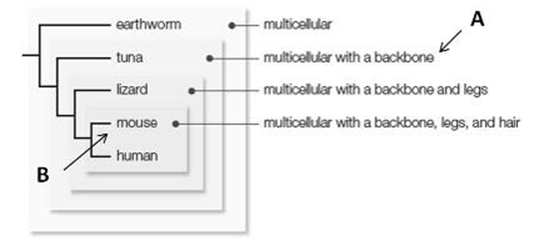 -What would the backbone character (A) be called in the phylogenic study of the accompanying figure?
 (Multiple Choice)
4.9/5 (76)
(76) One source of trait variations among individuals is the process of fertilization, in which when new combinations of maternal and paternal alleles are produced. What other sources contribute to trait variations within a species?
(Essay)
4.9/5 (79)
(79) When giant velvet walking worms and blind velvet walking worms interbreed, their offspring are rarely observed and the two species continue to maintain separate identities. This is an example of _____ speciation.
(Multiple Choice)
4.7/5 (72)
(72) In order for two groups to be considered separate species, they should not ____.
(Multiple Choice)
4.9/5 (70)
(70) Sometimes, plant species that grow in the same area cannot interbreed because their physical shape has become specialized for different types of pollinators. What type of reproductive isolation is occurring?
(Multiple Choice)
4.8/5 (88)
(88) A method called ____ uses diagrams to group species based on their shared characteristics.
(Multiple Choice)
4.9/5 (84)
(84) 
Filters
- Essay(0)
- Multiple Choice(0)
- Short Answer(0)
- True False(0)
- Matching(0)