



 Chat with AI
Exam 3: The Plasma Membrane and Membrane Potential

Exam 1: Introduction to Physiology and Homeostasis81 Questions
Exam 2: Cell Physiology135 Questions
Exam 3: The Plasma Membrane and Membrane Potential182 Questions
Exam 4: Principles of Neural and Hormonal Communication169 Questions
Exam 5: A--The Central Nervous System202 Questions
Exam 5: B--The Central Nervous System14 Questions
Exam 6: A--The Peripheral Nervous System: Afferent Division; Special Senses196 Questions
Exam 6: B--The Peripheral Nervous System: Afferent Division; Special Senses20 Questions
Exam 7: The Peripheral Nervous System: Efferent Division104 Questions
Exam 8: A--Muscle Physiology199 Questions
Exam 8: B--Muscle Physiology13 Questions
Exam 9: A--Cardiac Physiology159 Questions
Exam 9: B--Cardiac Physiology20 Questions
Exam 10: The Blood Vessels and Blood Pressure213 Questions
Exam 11: The Blood175 Questions
Exam 12: Body Defenses188 Questions
Exam 13: A--The Respiratory System198 Questions
Exam 13: B--The Respiratory System12 Questions
Exam 14: A--The Urinary System217 Questions
Exam 14: B--The Urinary System19 Questions
Exam 15: A--Fluid and Acid-Base Balance190 Questions
Exam 15: B--Fluid and Acid-Base Balance9 Questions
Exam 16: A--The Digestive System236 Questions
Exam 16: B--The Digestive System12 Questions
Exam 17: Energy Balance and Temperature Regulation139 Questions
Exam 18: A--Principles of Endocrinology: the Central Endocrine Glands204 Questions
Exam 18: B--Principles of Endocrinology: the Central Endocrine Glands6 Questions
Exam 19: A--The Peripheral Endocrine Glands196 Questions
Exam 19: B--The Peripheral Endocrine Glands6 Questions
Exam 20: A--The Reproductive System235 Questions
Exam 20: B--The Reproductive System5 Questions
Select questions type


Complete each of the following statments.
Secondary active transport in which two substances pass through the membrane in the same direction is called ____________________.
(Short Answer)
4.9/5  (74)
(74) Complete each of the following statments.
Surrounding a blood cell with a 0.5% NaCl solution would cause the cell to ____________________, because this NaCl solution is ____________________ to the cell.
(Short Answer)
4.7/5 (88)
(88) At resting membrane potential, sodium and potassium ions are no longer moving across the membrane.
(True/False)
4.9/5 (81)
(81) Describe what would happen to red blood cells if a person received a transfusion of distilled (pure) water.
(Essay)
4.9/5 (86)
(86) Na+ ions can move from the ECF into the ICF by passing through secondary active transport carriers, simple diffusion channels, and the sodium-potassium pumps.
(True/False)
4.8/5 (69)
(69) According to Fick's law of diffusion, which of the following changes would decrease the rate of net diffusion of "X" across a membrane?
(Multiple Choice)
4.7/5 (82)
(82) Complete each of the following statments.
A solutions containing the same concentration of solute particles as human cells is said to be ____________________ to the cell.
(Short Answer)
4.9/5 (74)
(74) Gap junctions contain carrier proteins that transport ions from one cell into another cell.
(True/False)
4.8/5 (88)
(88) Use the figure above to answer the corresponding questions.
Which protein could represent the GLUT protein in the membrane of an intestinal cell?
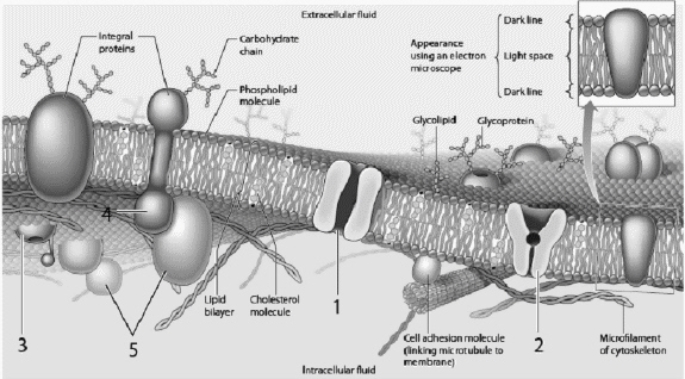 c.
d.a. 1
b. 2
c. 3
d. 4
e. 5
c.
d.a. 1
b. 2
c. 3
d. 4
e. 5 (Short Answer)
4.9/5 (70)
(70) According to the Nernst equation, the equilibrium potential for a given ion decreases as the difference in concentration of the ion outside and inside the cell increases.
(True/False)
4.8/5 (70)
(70) Complete each of the following statments.
A solution containing ____________________ mOsm of solute is isotonic to human cells.
(Short Answer)
4.9/5 (78)
(78) Complete each of the following statments.
"Kiss" sites are associated with cell-to-cell connections called ____________________.
(Short Answer)
4.8/5 (77)
(77) Complete each of the following statments.
The two types of ____________________ transport include active transport and ____________________.
(Short Answer)
4.8/5 (85)
(85) Cadherins are docking-marker acceptors to which secretory vesicles bind prior to exocytosis.
(True/False)
4.9/5 (78)
(78) Cell X has a resting potential of -80 mV. If a ____ opens and causes the potential to change 10 mV, the resulting potential will be ____.
(Multiple Choice)
5.0/5 (81)
(81) Complete each of the following statments.
Cell connections called ____________________ force materials to pass through cells and not between them.
(Short Answer)
4.9/5 (83)
(83) 
Filters
- Essay(0)
- Multiple Choice(0)
- Short Answer(0)
- True False(0)
- Matching(0)