



 Chat with AI
Exam 3: The Plasma Membrane and Membrane Potential

Exam 1: Introduction to Physiology and Homeostasis81 Questions
Exam 2: Cell Physiology135 Questions
Exam 3: The Plasma Membrane and Membrane Potential182 Questions
Exam 4: Principles of Neural and Hormonal Communication169 Questions
Exam 5: A--The Central Nervous System202 Questions
Exam 5: B--The Central Nervous System14 Questions
Exam 6: A--The Peripheral Nervous System: Afferent Division; Special Senses196 Questions
Exam 6: B--The Peripheral Nervous System: Afferent Division; Special Senses20 Questions
Exam 7: The Peripheral Nervous System: Efferent Division104 Questions
Exam 8: A--Muscle Physiology199 Questions
Exam 8: B--Muscle Physiology13 Questions
Exam 9: A--Cardiac Physiology159 Questions
Exam 9: B--Cardiac Physiology20 Questions
Exam 10: The Blood Vessels and Blood Pressure213 Questions
Exam 11: The Blood175 Questions
Exam 12: Body Defenses188 Questions
Exam 13: A--The Respiratory System198 Questions
Exam 13: B--The Respiratory System12 Questions
Exam 14: A--The Urinary System217 Questions
Exam 14: B--The Urinary System19 Questions
Exam 15: A--Fluid and Acid-Base Balance190 Questions
Exam 15: B--Fluid and Acid-Base Balance9 Questions
Exam 16: A--The Digestive System236 Questions
Exam 16: B--The Digestive System12 Questions
Exam 17: Energy Balance and Temperature Regulation139 Questions
Exam 18: A--Principles of Endocrinology: the Central Endocrine Glands204 Questions
Exam 18: B--Principles of Endocrinology: the Central Endocrine Glands6 Questions
Exam 19: A--The Peripheral Endocrine Glands196 Questions
Exam 19: B--The Peripheral Endocrine Glands6 Questions
Exam 20: A--The Reproductive System235 Questions
Exam 20: B--The Reproductive System5 Questions
Select questions type


Describe the transport of glucose from the intestinal lumen into the intestinal cells and mention how Na+-K+ pumps make this process possible.
(Essay)
4.7/5  (87)
(87) With secondary active transport, sodium ions move along a concentration gradient but against an electrical gradient.
(True/False)
4.9/5 (89)
(89) ____ are adhering junctions, ____ are impermeable junctions, and ____ are communicating junctions.
(Multiple Choice)
4.8/5 (75)
(75) If a cell begins to swell after being placed into a salt solution, the salt solution must have a lower osmotic pressure than the cytosol.
(True/False)
4.9/5 (89)
(89) Complete each of the following statments.
Vesicles bind to ____________________ acceptors on the plasma membrane prior to exocytosis
(Short Answer)
4.9/5 (63)
(63) Use the figure above to answer the corresponding questions. Assume the membrane is always permeable to water.
In beaker 2, the solution on the right side of the membrane
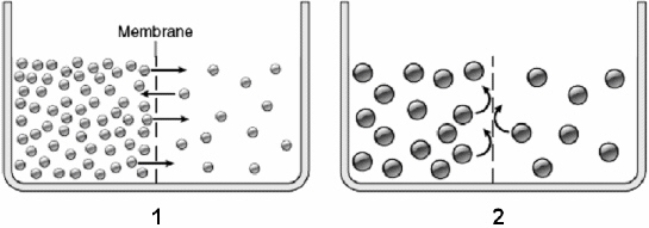 a. has a higher osmolarity than the solution on the left side of the membrane
b. will gain water from the solution on the left side of the membrane
c. has a lower osmotic pressure than the solution on the left side of the membrane
d. has a higher osmolarity than the solution on the left side of the membrane and will gain water from the solution on the left side of the membrane
e. none of these
a. has a higher osmolarity than the solution on the left side of the membrane
b. will gain water from the solution on the left side of the membrane
c. has a lower osmotic pressure than the solution on the left side of the membrane
d. has a higher osmolarity than the solution on the left side of the membrane and will gain water from the solution on the left side of the membrane
e. none of these
(Short Answer)
4.9/5 (72)
(72) Complete each of the following statments.
The ____________________ refers to the maximum amount of a substance that can be transported across the plasma membrane via a carrier in a given time.
(Short Answer)
4.7/5 (68)
(68) Pinocytosis refers to the process of a cell engulfing ECF, and this process increases the cell's surface area.
(True/False)
4.8/5 (98)
(98) Complete each of the following statments.
In active transport, a substance moves from an area of ____________________ concentration to an area of ____________________ concentration.
(Short Answer)
4.9/5 (79)
(79) Leak channels for sodium are closed during the resting potential but open with appropriate stimulation.
(True/False)
4.9/5 (83)
(83) Which of the following statements about the Na+-K+ pump is correct?
(Multiple Choice)
4.8/5 (85)
(85) Complete each of the following statments.
____________________ refers to a separation of opposite charges across the membrane.
(Short Answer)
4.7/5 (97)
(97) Complete each of the following statments.
A transport maximum is associated with carriers that perform ____________________ or ____________________ in the cell membrane.
(Short Answer)
4.8/5 (89)
(89) In the lipid bilayer of the plasma membrane, the hydrophobic tails of the phospholipids orient toward the center of the membrane, away from water.
(True/False)
4.8/5 (78)
(78) Complete each of the following statments. Scurvy is the result of a vitamin ____________________ deficiency and results in abnormal formation of the protein called ____________________.
(Short Answer)
4.8/5 (84)
(84) Under normal conditions, the movement of potassium into a cell always requires the splitting of ATP.
(True/False)
4.8/5 (78)
(78) 
Filters
- Essay(0)
- Multiple Choice(0)
- Short Answer(0)
- True False(0)
- Matching(0)