



 Chat with AI
Exam 3: The Plasma Membrane and Membrane Potential

Exam 1: Introduction to Physiology and Homeostasis81 Questions
Exam 2: Cell Physiology135 Questions
Exam 3: The Plasma Membrane and Membrane Potential182 Questions
Exam 4: Principles of Neural and Hormonal Communication169 Questions
Exam 5: A--The Central Nervous System202 Questions
Exam 5: B--The Central Nervous System14 Questions
Exam 6: A--The Peripheral Nervous System: Afferent Division; Special Senses196 Questions
Exam 6: B--The Peripheral Nervous System: Afferent Division; Special Senses20 Questions
Exam 7: The Peripheral Nervous System: Efferent Division104 Questions
Exam 8: A--Muscle Physiology199 Questions
Exam 8: B--Muscle Physiology13 Questions
Exam 9: A--Cardiac Physiology159 Questions
Exam 9: B--Cardiac Physiology20 Questions
Exam 10: The Blood Vessels and Blood Pressure213 Questions
Exam 11: The Blood175 Questions
Exam 12: Body Defenses188 Questions
Exam 13: A--The Respiratory System198 Questions
Exam 13: B--The Respiratory System12 Questions
Exam 14: A--The Urinary System217 Questions
Exam 14: B--The Urinary System19 Questions
Exam 15: A--Fluid and Acid-Base Balance190 Questions
Exam 15: B--Fluid and Acid-Base Balance9 Questions
Exam 16: A--The Digestive System236 Questions
Exam 16: B--The Digestive System12 Questions
Exam 17: Energy Balance and Temperature Regulation139 Questions
Exam 18: A--Principles of Endocrinology: the Central Endocrine Glands204 Questions
Exam 18: B--Principles of Endocrinology: the Central Endocrine Glands6 Questions
Exam 19: A--The Peripheral Endocrine Glands196 Questions
Exam 19: B--The Peripheral Endocrine Glands6 Questions
Exam 20: A--The Reproductive System235 Questions
Exam 20: B--The Reproductive System5 Questions
Select questions type


Which of the following solutions has a lower osmotic pressure than a human cell's cytosol?

Free
(Multiple Choice)
4.9/5  (81)
(81) Correct Answer: Verified
B
Complete each of the following statments.
The SGLT carrier moves ____________________ molecules uphill against a concentration gradient while moving ____________________ ions down a concentration gradient.
Free
(Short Answer)
4.8/5 (72)
(72) Correct Answer:Verified
Verifiedglucose, Na+
Because of the presence of tight junctions, passage of materials across an epithelial barrier must take place between the cells, not through them.
(True/False)
4.7/5 (77)
(77) At the equilibrium potential for K+, the concentration and electrical gradients for K+ are in opposition to each other and exactly balance each other so there is no net movement of K+.
(True/False)
4.8/5 (75)
(75) Complete each of the following statments.
Ions pass into or out of the cell through protein ____________________ and ____________________ in the plasma membrane.
(Short Answer)
4.7/5 (83)
(83) Complete each of the following statments.
Membrane carbohydrates in the plasma membrane combine with other molecules to form glycoproteins and ____________________.
(Short Answer)
4.9/5 (86)
(86) Complete each of the following statments.
The ____________________ equation equates the equilibrium potential for an ion with the ion's concentration difference outside and inside the cell.
(Short Answer)
4.8/5 (78)
(78) Most gases and small ions are highly soluble in lipids and can, therefore, pass easily between phospholipid molecules in the plasma membrane.
(True/False)
5.0/5 (69)
(69) Complete each of the following statments.
____________________ is responsible for maintaining the fluid nature of the plasma membrane in human cells.
(Short Answer)
5.0/5 (82)
(82) Match the term to the correct description.
Correct Answer:Verified
VerifiedPremises:
Responses:
(Matching)
4.9/5 (86)
(86) Use the figure above to answer the corresponding questions. Assume the membrane is always permeable to water.
In beaker 2, the solution on the right side of the membrane
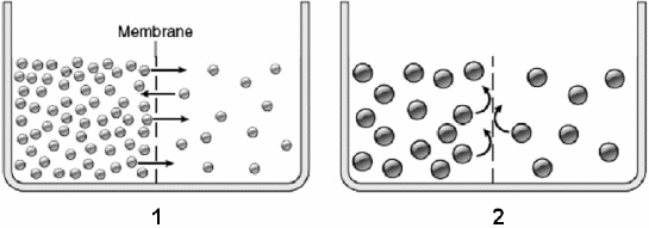 a. could eventually have the same number of red solute particles as the solution on the left side of the membrane
b. could eventually have the same concentration of red particles as the solution on the left side of the membrane
c. currently has a higher osmotic pressure than the solution on the left side of the membrane
d. is currently gaining water
e. all of these
a. could eventually have the same number of red solute particles as the solution on the left side of the membrane
b. could eventually have the same concentration of red particles as the solution on the left side of the membrane
c. currently has a higher osmotic pressure than the solution on the left side of the membrane
d. is currently gaining water
e. all of these
(Short Answer)
4.8/5 (75)
(75) Complete each of the following statments.
A deficiency in channels that allow ____________________ ions to pass through cell membranes is responsible for cystic fibrosis.
(Short Answer)
4.9/5 (95)
(95) Potassium ions are attracted toward a more positively charged area along an electrical gradient, while chloride ions are attracted toward a more negatively charged area.
(True/False)
4.9/5 (79)
(79) Identify the incorrect statement about the plasma membrane.
(Multiple Choice)
4.9/5 (78)
(78) Complete each of the following statments.
Cell adhesion proteins include ____________________ and ____________________.
(Short Answer)
4.8/5 (77)
(77) 
Filters
- Essay(0)
- Multiple Choice(0)
- Short Answer(0)
- True False(0)
- Matching(0)