



 Chat with AI
Exam 3: The Plasma Membrane and Membrane Potential

Exam 1: Introduction to Physiology and Homeostasis81 Questions
Exam 2: Cell Physiology135 Questions
Exam 3: The Plasma Membrane and Membrane Potential182 Questions
Exam 4: Principles of Neural and Hormonal Communication169 Questions
Exam 5: A--The Central Nervous System202 Questions
Exam 5: B--The Central Nervous System14 Questions
Exam 6: A--The Peripheral Nervous System: Afferent Division; Special Senses196 Questions
Exam 6: B--The Peripheral Nervous System: Afferent Division; Special Senses20 Questions
Exam 7: The Peripheral Nervous System: Efferent Division104 Questions
Exam 8: A--Muscle Physiology199 Questions
Exam 8: B--Muscle Physiology13 Questions
Exam 9: A--Cardiac Physiology159 Questions
Exam 9: B--Cardiac Physiology20 Questions
Exam 10: The Blood Vessels and Blood Pressure213 Questions
Exam 11: The Blood175 Questions
Exam 12: Body Defenses188 Questions
Exam 13: A--The Respiratory System198 Questions
Exam 13: B--The Respiratory System12 Questions
Exam 14: A--The Urinary System217 Questions
Exam 14: B--The Urinary System19 Questions
Exam 15: A--Fluid and Acid-Base Balance190 Questions
Exam 15: B--Fluid and Acid-Base Balance9 Questions
Exam 16: A--The Digestive System236 Questions
Exam 16: B--The Digestive System12 Questions
Exam 17: Energy Balance and Temperature Regulation139 Questions
Exam 18: A--Principles of Endocrinology: the Central Endocrine Glands204 Questions
Exam 18: B--Principles of Endocrinology: the Central Endocrine Glands6 Questions
Exam 19: A--The Peripheral Endocrine Glands196 Questions
Exam 19: B--The Peripheral Endocrine Glands6 Questions
Exam 20: A--The Reproductive System235 Questions
Exam 20: B--The Reproductive System5 Questions
Select questions type


Complete each of the following statments.
The three characteristics that determine the kind and amount of material that can be moved across a membrane by carrier-mediated transport are ____________________, ____________________, and ____________________.
(Short Answer)
4.9/5  (88)
(88) Use the figure above to answer the corresponding questions.
Which protein might require ATP in order to transport a particle through the membrane?
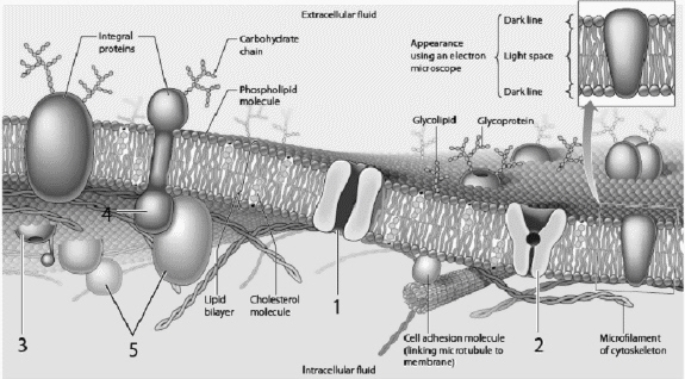 a. 1
b. 2
c. 3
d. 4
e. 5
a. 1
b. 2
c. 3
d. 4
e. 5 (Short Answer)
4.7/5 (92)
(92) In a plasma membrane, simple diffusion of various substances can occur
(Multiple Choice)
5.0/5 (74)
(74) Most of a membrane potential is established by the passive movement of different cations into and out of a cell.
(True/False)
4.8/5 (77)
(77) The resting membrane potential of a typical nerve cell is ____ mV.
(Multiple Choice)
4.9/5 (80)
(80) Complete each of the following statments.
At the equilibrium potential for an ion, its ____________________ gradient is exactly counterbalanced by its ____________________ gradient.
(Short Answer)
4.8/5 (78)
(78) Describe the concentration gradients associated with the resting membrane potential.
(Essay)
4.9/5 (73)
(73) Complete each of the following statments.
The GLUT carrier moves glucose molecules ____________________ their concentration gradient while moving ____________________ ions down their concentration gradient.
(Short Answer)
4.8/5 (89)
(89) Complete each of the following statments.
____________________ are cell connections that utilize CAMs to hold adjacent cells together while being anchor to intermediate filaments of each cell's cytoskeleton.
(Short Answer)
4.7/5 (73)
(73) Complete each of the following statments.
The ____________________ pump moves two ____________________ ions into the cell for every three ____________________ ions it moves out the cell.
(Short Answer)
4.9/5 (77)
(77) If a human cell is placed into solution X, containing water and a nonpenetrating solute, then
(Multiple Choice)
4.9/5 (73)
(73) At equilibrium, when no net diffusion of Na+ or K+ is occurring through the membrane, Na+-K+ pumps do not have to pump Na+ or K+.
(True/False)
4.8/5 (86)
(86) Which of the following can diffuse between a membrane's phospholipids into the cytosol?
(Multiple Choice)
5.0/5 (89)
(89) The rate of diffusion for water-soluble substances through a membrane decreases as
(Multiple Choice)
4.9/5 (76)
(76) Calcium and sodium ions are in a higher concentration in the ECF than in the cytosol, whereas potassium and chloride ions are in a higher concentration in the cytosol.
(True/False)
4.8/5 (93)
(93) What is primarily responsible for the development of a resting membrane potential?
(Multiple Choice)
4.9/5 (82)
(82) 
Filters
- Essay(0)
- Multiple Choice(0)
- Short Answer(0)
- True False(0)
- Matching(0)