



 Chat with AI
Exam 3: The Plasma Membrane and Membrane Potential

Exam 1: Introduction to Physiology and Homeostasis81 Questions
Exam 2: Cell Physiology135 Questions
Exam 3: The Plasma Membrane and Membrane Potential182 Questions
Exam 4: Principles of Neural and Hormonal Communication169 Questions
Exam 5: A--The Central Nervous System202 Questions
Exam 5: B--The Central Nervous System14 Questions
Exam 6: A--The Peripheral Nervous System: Afferent Division; Special Senses196 Questions
Exam 6: B--The Peripheral Nervous System: Afferent Division; Special Senses20 Questions
Exam 7: The Peripheral Nervous System: Efferent Division104 Questions
Exam 8: A--Muscle Physiology199 Questions
Exam 8: B--Muscle Physiology13 Questions
Exam 9: A--Cardiac Physiology159 Questions
Exam 9: B--Cardiac Physiology20 Questions
Exam 10: The Blood Vessels and Blood Pressure213 Questions
Exam 11: The Blood175 Questions
Exam 12: Body Defenses188 Questions
Exam 13: A--The Respiratory System198 Questions
Exam 13: B--The Respiratory System12 Questions
Exam 14: A--The Urinary System217 Questions
Exam 14: B--The Urinary System19 Questions
Exam 15: A--Fluid and Acid-Base Balance190 Questions
Exam 15: B--Fluid and Acid-Base Balance9 Questions
Exam 16: A--The Digestive System236 Questions
Exam 16: B--The Digestive System12 Questions
Exam 17: Energy Balance and Temperature Regulation139 Questions
Exam 18: A--Principles of Endocrinology: the Central Endocrine Glands204 Questions
Exam 18: B--Principles of Endocrinology: the Central Endocrine Glands6 Questions
Exam 19: A--The Peripheral Endocrine Glands196 Questions
Exam 19: B--The Peripheral Endocrine Glands6 Questions
Exam 20: A--The Reproductive System235 Questions
Exam 20: B--The Reproductive System5 Questions
Select questions type


Complete each of the following statments.
____________________ is a rubber-like protein found in tissues in organs such as the lungs.
(Short Answer)
4.8/5  (75)
(75) Sodium-potassium pumps indirectly provide the energy source for SGLT carriers in intestinal cells.
(True/False)
4.8/5 (90)
(90) Solution 1 has two solutes (A and B) and an osmotic pressure of 250 mOsm. Solution 2 has only one solute (C) and an osmotic pressure of 300 mOsm. If a membrane between these solutions is permeable to only water and B, then
(Multiple Choice)
5.0/5 (71)
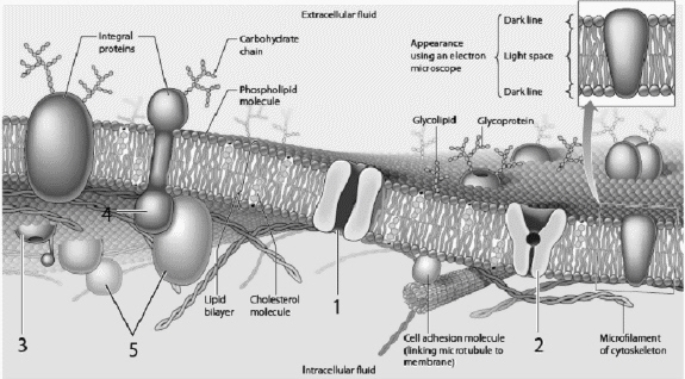
(71) Use the figure above to answer the corresponding questions.
Which protein might be an ATPase?
 a. 1
b. 2
c. 3
d. 4
e. 5
a. 1
b. 2
c. 3
d. 4
e. 5 (Short Answer)
4.8/5 (86)
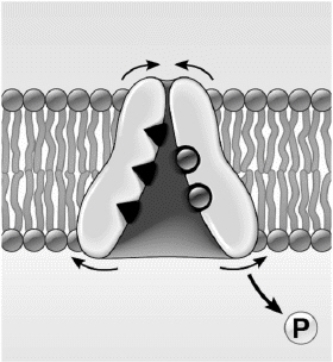
(86) Use the figure above to answer the corresponding questions.
In this figure, the carrier is
 a. transporting Na+ ions into the ECF
b. transporting K+ ions into the ICF
c. about to become phosphorylated.
d. performing secondary active transport
e. transporting K+ ions into the ICF and performing secondary active transport
a. transporting Na+ ions into the ECF
b. transporting K+ ions into the ICF
c. about to become phosphorylated.
d. performing secondary active transport
e. transporting K+ ions into the ICF and performing secondary active transport
(Short Answer)
4.8/5 (83)
(83) Complete each of the following statments.
In many cells, the hormone called ____________________ promotes the insertion of glucose carriers into the plasma membranes.
(Short Answer)
4.9/5 (71)
(71) Complete each of the following statments.
____________________ are cell-to-cell connections through which materials can pass from the cytosol of one cell into the cytosol of an adjacent cell.
(Short Answer)
4.9/5 (83)
(83) The dark lines in the trilaminar appearance of the plasma membrane are likely caused by the preferential staining of the hydrophobic, nonpolar regions of the membrane constituents.
(True/False)
4.9/5 (76)
(76) Indicate which characteristic of a mediated-transport system is referred to in each item by filling in the blank using the following answer code.
1. Carrier can handle substance X but not substance Y . specificity \_\_\_ 2. In the presence of substance Z there is a decreased rate of entry of substance X competition \_\_\_ 3. The concentration of substance outside the cell continues to increase but the rate of substance X's transport into the cell remains constant. saturation \_\_\_
(Essay)
4.7/5 (73)
(73) Net sodium movement into the cell occurs passively, whereas net sodium movement out of the cell occurs actively.
(True/False)
5.0/5 (89)
(89) Which of the following is not associated with an extracellular chemical binding with a membrane-bound receptor?
(Multiple Choice)
4.9/5 (67)
(67) Placing pure water around cells causes the cells to swell because the cytosol has a lower osmotic pressure than the pure water.
(True/False)
4.8/5 (85)
(85) If an electrical gradient is present for a given substance, the substance may be able to get through the membrane without going through a carrier or channel.
(True/False)
4.8/5 (84)
(84) Describe the effects of the concentration and electrical gradients on the movement of Na+ and K+ ions through the membrane.
(Essay)
4.7/5 (70)
(70) Exocytosis of secretory products from neuron terminals is triggered by the entry of ____ into the ____.
(Multiple Choice)
4.9/5 (81)
(81) Opening a sodium channel during the resting potential would cause sodium ions to move along an electrical gradient and along a concentration gradient.
(True/False)
4.9/5 (74)
(74) 
Filters
- Essay(0)
- Multiple Choice(0)
- Short Answer(0)
- True False(0)
- Matching(0)