



 Chat with AI
Exam 3: The Plasma Membrane and Membrane Potential

Exam 1: Introduction to Physiology and Homeostasis81 Questions
Exam 2: Cell Physiology135 Questions
Exam 3: The Plasma Membrane and Membrane Potential182 Questions
Exam 4: Principles of Neural and Hormonal Communication169 Questions
Exam 5: A--The Central Nervous System202 Questions
Exam 5: B--The Central Nervous System14 Questions
Exam 6: A--The Peripheral Nervous System: Afferent Division; Special Senses196 Questions
Exam 6: B--The Peripheral Nervous System: Afferent Division; Special Senses20 Questions
Exam 7: The Peripheral Nervous System: Efferent Division104 Questions
Exam 8: A--Muscle Physiology199 Questions
Exam 8: B--Muscle Physiology13 Questions
Exam 9: A--Cardiac Physiology159 Questions
Exam 9: B--Cardiac Physiology20 Questions
Exam 10: The Blood Vessels and Blood Pressure213 Questions
Exam 11: The Blood175 Questions
Exam 12: Body Defenses188 Questions
Exam 13: A--The Respiratory System198 Questions
Exam 13: B--The Respiratory System12 Questions
Exam 14: A--The Urinary System217 Questions
Exam 14: B--The Urinary System19 Questions
Exam 15: A--Fluid and Acid-Base Balance190 Questions
Exam 15: B--Fluid and Acid-Base Balance9 Questions
Exam 16: A--The Digestive System236 Questions
Exam 16: B--The Digestive System12 Questions
Exam 17: Energy Balance and Temperature Regulation139 Questions
Exam 18: A--Principles of Endocrinology: the Central Endocrine Glands204 Questions
Exam 18: B--Principles of Endocrinology: the Central Endocrine Glands6 Questions
Exam 19: A--The Peripheral Endocrine Glands196 Questions
Exam 19: B--The Peripheral Endocrine Glands6 Questions
Exam 20: A--The Reproductive System235 Questions
Exam 20: B--The Reproductive System5 Questions
Select questions type


Opening a gated channel that allows Na+ to diffuse through the plasma membrane would cause the membrane potential to increase.
(True/False)
4.9/5  (77)
(77) Fibronectin is a strong carbohydrate in the extracellular matrix of connective tissues that holds adjacent cells together.
(True/False)
4.8/5 (78)
(78) Carriers that perform facilitated diffusion or secondary active transport of glucose do not split ATP.
(True/False)
4.7/5 (82)
(82) Complete each of the following statments.
In facilitated diffusion, particles move from a(n) ____________________ concentration to a(n) ____________________ concentration.
(Short Answer)
5.0/5 (83)
(83) Which of the following is not a function of membrane proteins?
(Multiple Choice)
4.8/5 (69)
(69) Some carrier molecules do not require energy to accomplish transport of a substance across the membrane.
(True/False)
4.8/5 (76)
(76) Use the figure above to answer the corresponding questions.
Which protein could be associated with active movement of a substance through the membrane?
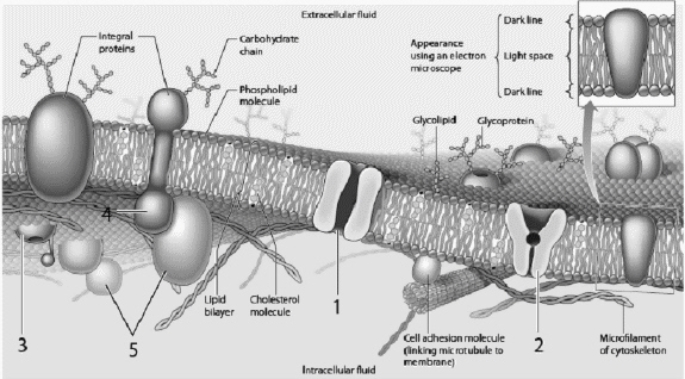 a. 1
b. 2
c. 3
d. 4
e. 5
a. 1
b. 2
c. 3
d. 4
e. 5 (Short Answer)
4.8/5 (89)
(89) Which of the following is not a function of membrane proteins?
(Multiple Choice)
4.9/5 (68)
(68) Which of the following is not part of the extracellular matrix?
(Multiple Choice)
4.9/5 (77)
(77) Complete each of the following statments.
____________________ refers to the transfer of a phosphate group from ATP to a protein, thereby bringing about a change in the shape and function of the protein.
(Short Answer)
4.9/5 (78)
(78) Receptor sites on the outer surface of the plasma membrane are made of
(Multiple Choice)
4.7/5 (80)
(80) Use the figure above to answer the corresponding questions.
Which step will come immediately after the carrier releases the ions shown in this figure?
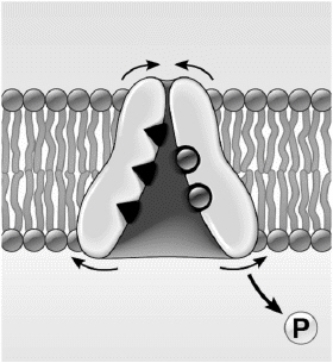 a. The carrier will become phosphorylated.
b. The carrier will pick up ions from the ECF.
c. The carrier will pick up ions from the ICF.
d. The carrier will split ATP.
e. The carrier will become phosphorylated and The carrier will split ATP.
a. The carrier will become phosphorylated.
b. The carrier will pick up ions from the ECF.
c. The carrier will pick up ions from the ICF.
d. The carrier will split ATP.
e. The carrier will become phosphorylated and The carrier will split ATP.
(Short Answer)
4.8/5 (85)
(85) Connexons are carbohydrate building blocks of gap junctions that allow ions to pass from the cytosol of one cell into the cytosol of an adjacent cell.
(True/False)
4.9/5 (75)
(75) Molecules greater than 0.8 nm in diameter are unable to pass from the ECF into the cytosol unless there is a carrier for the molecule.
(True/False)
4.9/5 (82)
(82) According to the fluid mosaic model, the plasma membrane consists primarily of a bilayer of mobile phospholipid molecules studded with an ever-changing mosaic pattern of proteins.
(True/False)
4.9/5 (79)
(79) Because a solution of lower solute concentration has a higher concentration of water, it exerts a lower osmotic pressure than does a solution with a higher solute concentration.
(True/False)
5.0/5 (92)
(92) The hydrophobic interior of the lipid bilayer of the plasma membrane blocks the passage of water-soluble substances.
(True/False)
4.9/5 (76)
(76) 
Filters
- Essay(0)
- Multiple Choice(0)
- Short Answer(0)
- True False(0)
- Matching(0)