



 Chat with AI
Exam 15: B--Fluid and Acid-Base Balance

Exam 1: Introduction to Physiology and Homeostasis81 Questions
Exam 2: Cell Physiology135 Questions
Exam 3: The Plasma Membrane and Membrane Potential182 Questions
Exam 4: Principles of Neural and Hormonal Communication169 Questions
Exam 5: A--The Central Nervous System202 Questions
Exam 5: B--The Central Nervous System14 Questions
Exam 6: A--The Peripheral Nervous System: Afferent Division; Special Senses196 Questions
Exam 6: B--The Peripheral Nervous System: Afferent Division; Special Senses20 Questions
Exam 7: The Peripheral Nervous System: Efferent Division104 Questions
Exam 8: A--Muscle Physiology199 Questions
Exam 8: B--Muscle Physiology13 Questions
Exam 9: A--Cardiac Physiology159 Questions
Exam 9: B--Cardiac Physiology20 Questions
Exam 10: The Blood Vessels and Blood Pressure213 Questions
Exam 11: The Blood175 Questions
Exam 12: Body Defenses188 Questions
Exam 13: A--The Respiratory System198 Questions
Exam 13: B--The Respiratory System12 Questions
Exam 14: A--The Urinary System217 Questions
Exam 14: B--The Urinary System19 Questions
Exam 15: A--Fluid and Acid-Base Balance190 Questions
Exam 15: B--Fluid and Acid-Base Balance9 Questions
Exam 16: A--The Digestive System236 Questions
Exam 16: B--The Digestive System12 Questions
Exam 17: Energy Balance and Temperature Regulation139 Questions
Exam 18: A--Principles of Endocrinology: the Central Endocrine Glands204 Questions
Exam 18: B--Principles of Endocrinology: the Central Endocrine Glands6 Questions
Exam 19: A--The Peripheral Endocrine Glands196 Questions
Exam 19: B--The Peripheral Endocrine Glands6 Questions
Exam 20: A--The Reproductive System235 Questions
Exam 20: B--The Reproductive System5 Questions
Select questions type


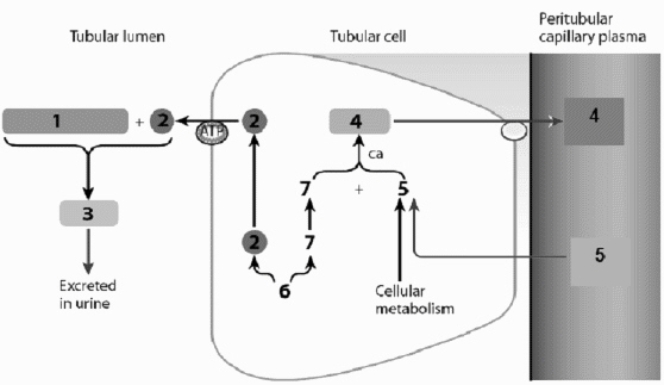
Use this figure to answer the corresponding questions.
Which numbers identify substances that can act directly as bases in the body to increase a fluid's pH? ____________________

Free
(Short Answer)
4.8/5  (84)
(84) Correct Answer: Verified
1, 4, 6, 7
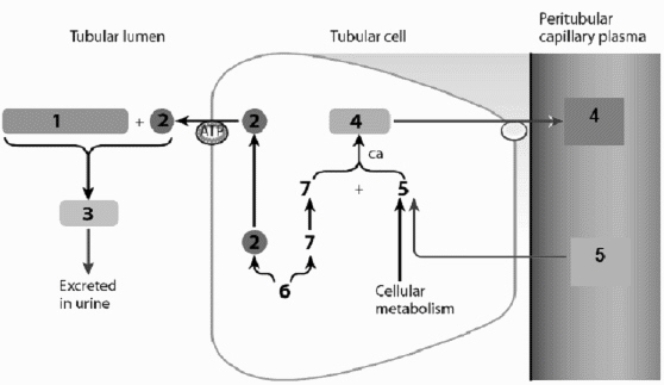
Use this figure to answer the corresponding questions.
In this figure ____________________ is labeled number ____ and is being reabsorbed, while ____________________ labeled number ____ is being secreted.
Free
(Essay)
4.8/5 (85)
(85) Correct Answer:Verified
VerifiedH+, 2, HCO3-, 4
Use this figure to answer the corresponding questions.
This figure depicts the process
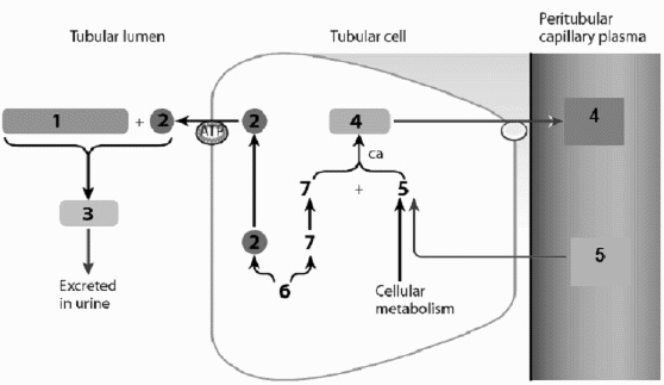 a. of bicarbonate secretion in the kidneys
b. that helpsraise the blood's
c. that is the kichey's response to alkalosi
d. of reabsorption in the kidneys
e. none of these
a. of bicarbonate secretion in the kidneys
b. that helpsraise the blood's
c. that is the kichey's response to alkalosi
d. of reabsorption in the kidneys
e. none of these Free
(Short Answer)
4.9/5 (75)
(75) Correct Answer:Verified
VerifiedB
Compare and contrast uncompensated and compensated respiratory acidosis.
(Essay)
4.8/5 (82)
(82) Define chemical buffer system and describe specifically how the body's four chemical buffer systems help maintain homeostasis.
(Essay)
4.9/5 (65)
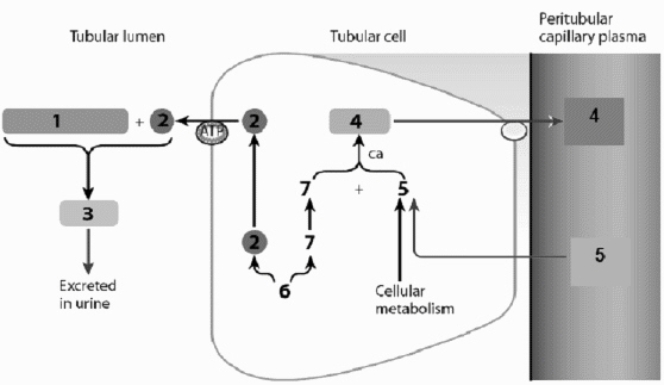
(65) Use this figure to answer the corresponding questions.
Identify the number(s) for bicarbonate ions: ____________________.
(Short Answer)
4.8/5 (83)
(83) Often patients experiencing sympathetically induced hyperventilation are told to breath in a paper bag. Why?
(Essay)
4.9/5 (76)
(76) Describe how sodium and blood pressure balance are interconnected. Mention the renin-angiotensin-aldosterone system and ANP in your answer.
(Essay)
4.9/5 (86)
(86) 
Filters
- Essay(0)
- Multiple Choice(0)
- Short Answer(0)
- True False(0)
- Matching(0)