



 Chat with AI
Exam 3: The Plasma Membrane and Membrane Potential

Exam 1: Introduction to Physiology and Homeostasis81 Questions
Exam 2: Cell Physiology135 Questions
Exam 3: The Plasma Membrane and Membrane Potential182 Questions
Exam 4: Principles of Neural and Hormonal Communication169 Questions
Exam 5: A--The Central Nervous System202 Questions
Exam 5: B--The Central Nervous System14 Questions
Exam 6: A--The Peripheral Nervous System: Afferent Division; Special Senses196 Questions
Exam 6: B--The Peripheral Nervous System: Afferent Division; Special Senses20 Questions
Exam 7: The Peripheral Nervous System: Efferent Division104 Questions
Exam 8: A--Muscle Physiology199 Questions
Exam 8: B--Muscle Physiology13 Questions
Exam 9: A--Cardiac Physiology159 Questions
Exam 9: B--Cardiac Physiology20 Questions
Exam 10: The Blood Vessels and Blood Pressure213 Questions
Exam 11: The Blood175 Questions
Exam 12: Body Defenses188 Questions
Exam 13: A--The Respiratory System198 Questions
Exam 13: B--The Respiratory System12 Questions
Exam 14: A--The Urinary System217 Questions
Exam 14: B--The Urinary System19 Questions
Exam 15: A--Fluid and Acid-Base Balance190 Questions
Exam 15: B--Fluid and Acid-Base Balance9 Questions
Exam 16: A--The Digestive System236 Questions
Exam 16: B--The Digestive System12 Questions
Exam 17: Energy Balance and Temperature Regulation139 Questions
Exam 18: A--Principles of Endocrinology: the Central Endocrine Glands204 Questions
Exam 18: B--Principles of Endocrinology: the Central Endocrine Glands6 Questions
Exam 19: A--The Peripheral Endocrine Glands196 Questions
Exam 19: B--The Peripheral Endocrine Glands6 Questions
Exam 20: A--The Reproductive System235 Questions
Exam 20: B--The Reproductive System5 Questions
Select questions type


The carbohydrate found in plasma membranes is believed to be involved in the aggregation of cells to form tissue.
(True/False)
4.9/5  (91)
(91) Complete each of the following statments.
Opening a sodium channel during the resting membrane potential will cause the potential to become less ____________________.
(Short Answer)
4.8/5 (62)
(62) Oxygen gas, cholesterol, and glucose molecules are lipid-soluble, whereas proteins, amino acids, and ions are water-soluble.
(True/False)
4.8/5 (68)
(68) Complete each of the following statments.
Of the lipids in the plasma membrane, ____________________ are most abundant, with lesser amounts of ____________________.
(Short Answer)
5.0/5 (76)
(76) If a typical body cell is placed into a 1% saline solution, the cell
(Multiple Choice)
4.9/5 (83)
(83) Which one of the following requires the cell to expend energy?
(Multiple Choice)
4.9/5 (76)
(76) Use the figure above to answer the corresponding questions. Assume the membrane is always permeable to water.
In beaker 1, the solution on the right side of the membrane
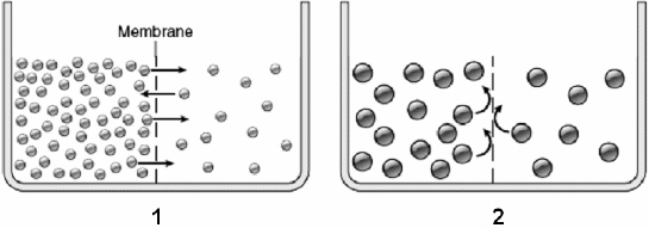 a. could eventually have the same concentration of green solute particles as the solution on the left side of the membrane
b. could eventually have the same osmolarity as the solution on the left side of the membrane
c. currently has a lower osmotic pressure than the solution on the left side of the membrane
d. is currently losing water
e. all of these
a. could eventually have the same concentration of green solute particles as the solution on the left side of the membrane
b. could eventually have the same osmolarity as the solution on the left side of the membrane
c. currently has a lower osmotic pressure than the solution on the left side of the membrane
d. is currently losing water
e. all of these
(Short Answer)
4.8/5 (76)
(76) Phosphorylation of a carrier can alter the affinity of its binding sites, accompanied by a change in its conformation.
(True/False)
4.8/5 (80)
(80) Two ATP molecules could provide energy for a sodium-potassium pump to move ____ ions out of the cell for every ____ ions it moves into the cell.
(Multiple Choice)
4.7/5 (68)
(68) Complete each of the following statments.
In ____________________ diffusion, water-soluble materials move through specific channels in the cell membrane.
(Short Answer)
4.7/5 (92)
(92) Some cell adhesion molecules are peripheral proteins and some are integral proteins.
(True/False)
4.9/5 (76)
(76) All of the following transport certain substances from regions of high concentration to low concentration except
(Multiple Choice)
4.9/5 (77)
(77) Use the figure above to answer the corresponding questions. Assume the membrane is always permeable to water.
In beaker 1, the solution on the right side of the membrane
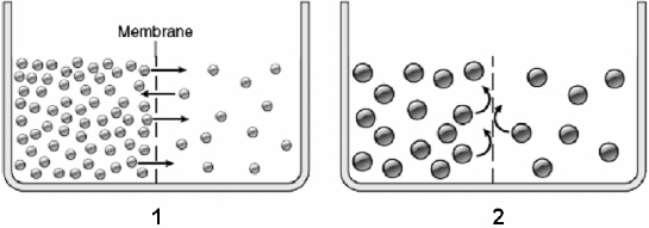 a. has a lower osmolarity than the solution on the left side of the membrane
b. will gain water from the solution on the left side of the membrane
c. has a higher osmotic pressure than the solution on the left side of the membrane
d. has a lower osmolarity than the solution on the left side of the membrane and will gain water from the solution on the left side of the membrane
e. will gain water from the solution on the left side of the membrane and has a higher osmotic pressure than the solution on the left side of the membrane
a. has a lower osmolarity than the solution on the left side of the membrane
b. will gain water from the solution on the left side of the membrane
c. has a higher osmotic pressure than the solution on the left side of the membrane
d. has a lower osmolarity than the solution on the left side of the membrane and will gain water from the solution on the left side of the membrane
e. will gain water from the solution on the left side of the membrane and has a higher osmotic pressure than the solution on the left side of the membrane
(Short Answer)
4.7/5 (83)
(83) Large, anionic intracellular proteins (A-) cannot pass through carriers because A- proteins are
(Multiple Choice)
4.9/5 (74)
(74) Osmosis does not occur if the concentration gradients for water and solutes are absent in a system.
(True/False)
4.9/5 (75)
(75) 
Filters
- Essay(0)
- Multiple Choice(0)
- Short Answer(0)
- True False(0)
- Matching(0)