



 Chat with AI
Exam 25: DNA Metabolism

Exam 1: The Foundations of Biochemistry109 Questions
Exam 2: Water87 Questions
Exam 3: Amino Acids, Peptides, and Proteins112 Questions
Exam 4: The Three-Dimensional Structure of Proteins100 Questions
Exam 5: Protein Function101 Questions
Exam 6: Enzymes106 Questions
Exam 7: Carbohydrates and Glycobiology109 Questions
Exam 8: Nucleotides and Nucleic Acids98 Questions
Exam 9: DNA-Based Information Technologies102 Questions
Exam 10: Lipids102 Questions
Exam 11: Biological Membranes and Transport105 Questions
Exam 12: Biosignaling98 Questions
Exam 13: Bioenergetics and Biochemical Reaction Types105 Questions
Exam 14: Glycolysis, Gluconeogenesis, and the Pentose Phosphate Pathway112 Questions
Exam 15: Principles of Metabolic Regulation101 Questions
Exam 16: The Citric Acid Cycle105 Questions
Exam 17: Fatty Acid Catabolism97 Questions
Exam 18: Amino Acid Oxidation and the Production of Urea98 Questions
Exam 19: Oxidative Phosphorylation and Photophosphorylation96 Questions
Exam 20: Carbohydrate Biosynthesis in Plants and Bacteria94 Questions
Exam 21: Lipid Biosynthesis100 Questions
Exam 22: Biosynthesis of Amino Acids, Nucleotides, and Related Molecules98 Questions
Exam 23: Hormonal Regulation and Integration of Mammalian Metabolism100 Questions
Exam 24: Genes and Chromosomes99 Questions
Exam 25: DNA Metabolism101 Questions
Exam 26: RNA Metabolism101 Questions
Exam 27: Protein Metabolism99 Questions
Exam 28: Regulation of Gene Expression99 Questions
Select questions type


Describe briefly how equilibrium density gradient centrifugation was used to demonstrate that DNA replication in E. coli is semiconservative.
(Essay)
4.8/5  (61)
(61) The protein MGMT (O6-methylguanine DNA methyltransferase) is involved in DNA repair. Outline the reaction that is carried out by this protein. Why it is INCORRECT to describe this protein as an enzyme?
(Essay)
4.9/5 (76)
(76) Which compound is NOT a protein that binds to the origin of replication of E. coli (oriC)?
(Multiple Choice)
4.9/5 (68)
(68) Name the three possible outcomes or consequences (at the DNA level) of a site-specific recombination event. For each of these, explain concisely (in one sentence) how the relative location and orientation of the recombination sites determines the outcome of the recombination event. Do not describe specific examples of site-specific recombination systems.
(Essay)
4.8/5 (71)
(71) A suitable substrate for DNA polymerase is shown below. Label the primer and template, and indicate which end of each strand must be 3' or 5'. 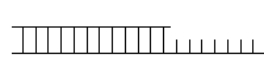 To observe DNA synthesis on this substrate in vitro, what additional reaction components must be added?
 (Not Answered)
This question doesn't have any answer yet
If DNA replication was conservative, what would be observed after two rounds of the Meselson and Stahl experiment?
(Multiple Choice)
4.7/5 (87)
(87) Which statement regarding the regulation of initiation in E. coli is CORRECT?
(Multiple Choice)
4.9/5 (77)
(77) What is the role of the chi sequence in recombination DNA repair?
(Multiple Choice)
4.9/5 (69)
(69) In homologous genetic recombination, RecA protein is involved in:
(Multiple Choice)
4.9/5 (61)
(61) Which mechanism is used to repair a thymidine dimer in DNA?
(Multiple Choice)
4.7/5 (84)
(84) DNA synthesis on the lagging strand in E. coli is a complex process known to involve several proteins. Initiation of a new chain is catalyzed by the enzyme (a) _____, and elongation is catalyzed by the enzyme (b) _____. Synthesis is discontinuous, yielding short segments called (c) _____, which are eventually joined by the enzyme (d) _____, which requires the cofactor (e) _____.
(Short Answer)
4.9/5 (76)
(76) Which factor does NOT consume energy by breaking phosphoanhydride bonds?
(Multiple Choice)
4.8/5 (90)
(90) Which mechanism is used to repair a chemically modified base in DNA?
(Multiple Choice)
4.7/5 (90)
(90) Which statement is FALSE regarding the repair of 1-methyladenine in DNA to adenine?
(Multiple Choice)
4.9/5 (75)
(75) Describe the process of nucleotide-excision repair of lesions like pyrimidine dimers in E. coli.
(Essay)
4.9/5 (74)
(74) The proofreading function of DNA polymerase does NOT involve:
(Multiple Choice)
4.8/5 (60)
(60) 
Filters
- Essay(0)
- Multiple Choice(0)
- Short Answer(0)
- True False(0)
- Matching(0)