



 Chat with AI
Exam 25: DNA Metabolism

Exam 1: The Foundations of Biochemistry109 Questions
Exam 2: Water87 Questions
Exam 3: Amino Acids, Peptides, and Proteins112 Questions
Exam 4: The Three-Dimensional Structure of Proteins100 Questions
Exam 5: Protein Function101 Questions
Exam 6: Enzymes106 Questions
Exam 7: Carbohydrates and Glycobiology109 Questions
Exam 8: Nucleotides and Nucleic Acids98 Questions
Exam 9: DNA-Based Information Technologies102 Questions
Exam 10: Lipids102 Questions
Exam 11: Biological Membranes and Transport105 Questions
Exam 12: Biosignaling98 Questions
Exam 13: Bioenergetics and Biochemical Reaction Types105 Questions
Exam 14: Glycolysis, Gluconeogenesis, and the Pentose Phosphate Pathway112 Questions
Exam 15: Principles of Metabolic Regulation101 Questions
Exam 16: The Citric Acid Cycle105 Questions
Exam 17: Fatty Acid Catabolism97 Questions
Exam 18: Amino Acid Oxidation and the Production of Urea98 Questions
Exam 19: Oxidative Phosphorylation and Photophosphorylation96 Questions
Exam 20: Carbohydrate Biosynthesis in Plants and Bacteria94 Questions
Exam 21: Lipid Biosynthesis100 Questions
Exam 22: Biosynthesis of Amino Acids, Nucleotides, and Related Molecules98 Questions
Exam 23: Hormonal Regulation and Integration of Mammalian Metabolism100 Questions
Exam 24: Genes and Chromosomes99 Questions
Exam 25: DNA Metabolism101 Questions
Exam 26: RNA Metabolism101 Questions
Exam 27: Protein Metabolism99 Questions
Exam 28: Regulation of Gene Expression99 Questions
Select questions type


Which feature is NOT applicable to homologous recombination during meiosis?
(Multiple Choice)
4.9/5  (74)
(74) Which compound is NOT required for initiation of DNA replication in E. coli?
(Multiple Choice)
4.9/5 (80)
(80) The RNA primase in the E. coli Pol III replisome is one of the most highly error-prone polymerases known. Explain why this does not affect the accuracy of DNA replication in E. coli.
(Short Answer)
4.8/5 (87)
(87) How many rounds of replication would result in a 1:1 distribution of hybrid to new DNA helices in the Meselson and Stahl experiment?
(Multiple Choice)
4.8/5 (87)
(87) When a DNA molecule is described as replicating bidirectionally, that means that it has two:
(Multiple Choice)
4.9/5 (77)
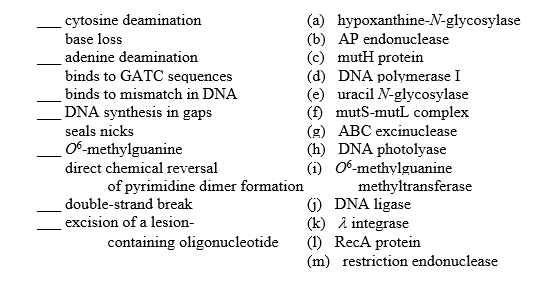
(77) Match the damage type or repair step at the left with a related enzyme at right. Only one answer will be the most direct for each.
(Essay)
4.9/5 (89)
(89) Which statement does NOT describe a feature of site-specific recombination?
(Multiple Choice)
4.8/5 (82)
(82) It is possible to mutate E. coli DNA Pol I so that it no longer has any exonuclease activity. What would be a potential result of this change?
(Multiple Choice)
4.8/5 (76)
(76) In contrast to bacteria, eukaryotic chromosomes need multiple DNA replication origins because:
(Multiple Choice)
4.7/5 (99)
(99) In the Ames test, the clear region of no growth near the center of the plate (where the compound of interest is placed) typically indicates that the compound is:
(Multiple Choice)
4.8/5 (84)
(84) In the bacterial cell, what are catenated chromosomes, when do they arise, and how does the cell resolve the problem posed by their structure?
(Essay)
4.8/5 (70)
(70) Which statement is TRUE regarding the process catalyzed by the bacteriophage integrase?
(Multiple Choice)
4.9/5 (74)
(74) All known DNA polymerases catalyze synthesis only in the 5' 3' direction. Nevertheless, during semiconservative DNA replication in the cell, they are able to catalyze the synthesis of both daughter chains, which would appear to require synthesis in the 3' 5' direction. Explain the process that occurs in the cell that allows for synthesis of both daughter chains by DNA polymerase.
(Short Answer)
4.7/5 (82)
(82) What distinguishes the two mechanistic pathways for transposition in bacteria, and what is a cointegrate?
(Essay)
4.9/5 (76)
(76) Which statement about enzymes that interact with DNA is TRUE?
(Multiple Choice)
4.8/5 (94)
(94) 
Filters
- Essay(0)
- Multiple Choice(0)
- Short Answer(0)
- True False(0)
- Matching(0)