



 Chat with AI
Exam 16: Monopoly

Exam 1: Economics: The World Around You90 Questions
Exam 2: Choice, Opportunity Costs, and Specialization94 Questions
Exam 3: Markets, Demand and Supply, and the Price System97 Questions
Exam 5: The Market System and the Private and Public Sector97 Questions
Exam 4: Elasticity: Demand and Supply126 Questions
Exam 6: National Income Accounting104 Questions
Exam 7: an Introduction to the Foreign Exchange Market and the Balance of Payments90 Questions
Exam 8: Consumer Choice132 Questions
Exam 9: Supply: The Costs of Doing Business106 Questions
Exam 10: Unemployment and Inflation129 Questions
Exam 11: Macroeconomic Equilibrium: Aggregate Demand and Supply122 Questions
Exam 12: Profit Maximization122 Questions
Exam 13: Aggregate Expenditures115 Questions
Exam 14: Perfect Competition135 Questions
Exam 15: Income and Expenditures Equilibrium134 Questions
Exam 16: Monopoly118 Questions
Exam 17: Fiscal Policy93 Questions
Exam 18: Monopolistic Competition and Oligopoly111 Questions
Exam 19: Antitrust and Regulation100 Questions
Exam 10: Money and Banking125 Questions
Exam 21: Market Failures, Government Failures, and Rent Seeking121 Questions
Exam 22: Monetary Policy141 Questions
Exam 23: Macroeconomic Policy: Tradeoffs, Expectations, Credibility, and Sources of Business Cycles112 Questions
Exam 24: Resource Markets112 Questions
Exam 25: Macroeconomic Viewpoints: New Keynesian, Monetarist, and New Classical99 Questions
Exam 26: The Labor Market114 Questions
Exam 27: Capital Markets100 Questions
Exam 28: Economic Growth99 Questions
Exam 29: Development Economics104 Questions
Exam 30: the Land Market and Natural Resources55 Questions
Exam 31: Aging, Social Security and Health Care88 Questions
Exam 32: Globalization84 Questions
Exam 33: Elasticity: Demand and Supply126 Questions
Exam 34: Income Distribution, Poverty and Government Policy115 Questions
Exam 35: World Trade Equilibrium112 Questions
Exam 36: Consumer Choice132 Questions
Exam 37: International Trade Restrictions109 Questions
Exam 38: World Trade Equilibrium112 Questions
Exam 39: Exchange Rates and Financial Links Between Countries132 Questions
Exam 40: International Trade Restrictions109 Questions
Exam 41: Supply: the Costs of Doing Business106 Questions
Exam 42: Exchange Rates and Financial Links Between Countries132 Questions
Exam 43: Profit Maximization122 Questions
Exam 44: Perfect Competition135 Questions
Exam 45: Monopoly118 Questions
Exam 46: Monopolistic Competition and Oligopoly111 Questions
Exam 47: Antitrust and Regulation100 Questions
Exam 48: Market Failures, Government Failures, and Rent Seeking121 Questions
Exam 49: Resource Markets112 Questions
Exam 50: The Labor Market114 Questions
Exam 51: Capital Markets100 Questions
Exam 52: The Land Market and Natural Resources55 Questions
Exam 53: Aging, Social Security and Health Care87 Questions
Exam 54: Income Distribution, Poverty and Government Policy115 Questions
Exam 55: World Trade Equilibrium112 Questions
Exam 56: International Trade Restrictions109 Questions
Exam 57: Exchange Rates and Financial Links Between Countries132 Questions
Select questions type


Which of the following is not a necessary condition for price discrimination?
(Multiple Choice)
4.8/5  (70)
(70) The following table shows the units of the output sold at different price levels by Gizmo's Inc. Table 10.1
 According to Table 10.1, at what level of output is marginal revenue equal to $14?
 (Multiple Choice)
4.8/5 (92)
(92) If at the profit-maximizing level of output, a monopolist's average-total-cost curve lies above its demand curve, then:
(Multiple Choice)
4.9/5 (74)
(74) If the monopolist's price happens to be greater than the average-variable cost but less than the average total cost, in the short run the monopolist will:
(Multiple Choice)
4.7/5 (85)
(85) Which of the following will be the best example of a monopoly firm?
(Multiple Choice)
4.9/5 (82)
(82) The table given below shows the price, marginal revenue and marginal cost of a monopolist at different levels of the output.The firm does not incur a fixed cost of production. Table 10.4
 In Table 10.4, assume that total fixed costs are $20.What is the maximum profit the firm can earn at equilibrium?
 (Multiple Choice)
4.9/5 (76)
(76) The following table shows the units of the output sold at different price levels by Gizmo's Inc. Table 10.1
 According to Table 10.1, Gizmo's cannot be:
 (Multiple Choice)
4.8/5 (80)
(80) A monopoly is a market model in which just one firm sells a product with no close substitutes.
(True/False)
4.9/5 (67)
(67) A monopolist's supply curve cannot be derived directly from its marginal cost curve as in the case of a competitive firm.
(True/False)
4.9/5 (80)
(80) A clothing store can sell two shirts for $20 each or three shirts for $18 each.At a quantity of three shirts sold, marginal revenue is _____.
(Multiple Choice)
4.9/5 (69)
(69) By discriminating between the consumers, the monopolist actually takes away a portion of the consumer surplus.
(True/False)
4.8/5 (81)
(81) The following figure shows revenue and cost curves of a monopolist. Figure 10.8 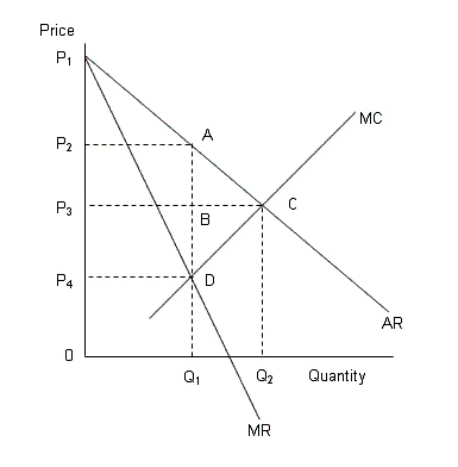 AR: Average revenue curve
MR: Marginal revenue curve
MC: Marginal cost curve
According to Figure 10.7, what will be the price charged by a perfectly competitive firm?
AR: Average revenue curve
MR: Marginal revenue curve
MC: Marginal cost curve
According to Figure 10.7, what will be the price charged by a perfectly competitive firm? (Multiple Choice)
4.9/5 (73)
(73) The figure given below shows the demand curve faced by a firm. Figure 10.1  Refer to Figure 10.1 and calculate the revenue lost when the firm lowers the price of its product from $8 to $4.
 (Multiple Choice)
4.9/5 (86)
(86) For a monopolist with a linear demand curve, total revenue is maximum when:
(Multiple Choice)
4.9/5 (86)
(86) The table given below shows the price, marginal revenue and marginal cost of a monopolist at different levels of the output.The firm does not incur a fixed cost of production. Table 10.4
 Refer to Table 10.4.Assuming that the monopolist is maximizing profits, the price the monopolist will charge is _____.
 (Multiple Choice)
4.9/5 (80)
(80) A monopolist's demand curve is less elastic than a perfect competitor's demand curve.
(True/False)
4.7/5 (94)
(94) 
Filters
- Essay(0)
- Multiple Choice(0)
- Short Answer(0)
- True False(0)
- Matching(0)