



 Chat with AI
Exam 21: Market Failures, Government Failures, and Rent Seeking

Exam 1: Economics: The World Around You90 Questions
Exam 2: Choice, Opportunity Costs, and Specialization94 Questions
Exam 3: Markets, Demand and Supply, and the Price System97 Questions
Exam 5: The Market System and the Private and Public Sector97 Questions
Exam 4: Elasticity: Demand and Supply126 Questions
Exam 6: National Income Accounting104 Questions
Exam 7: an Introduction to the Foreign Exchange Market and the Balance of Payments90 Questions
Exam 8: Consumer Choice132 Questions
Exam 9: Supply: The Costs of Doing Business106 Questions
Exam 10: Unemployment and Inflation129 Questions
Exam 11: Macroeconomic Equilibrium: Aggregate Demand and Supply122 Questions
Exam 12: Profit Maximization122 Questions
Exam 13: Aggregate Expenditures115 Questions
Exam 14: Perfect Competition135 Questions
Exam 15: Income and Expenditures Equilibrium134 Questions
Exam 16: Monopoly118 Questions
Exam 17: Fiscal Policy93 Questions
Exam 18: Monopolistic Competition and Oligopoly111 Questions
Exam 19: Antitrust and Regulation100 Questions
Exam 10: Money and Banking125 Questions
Exam 21: Market Failures, Government Failures, and Rent Seeking121 Questions
Exam 22: Monetary Policy141 Questions
Exam 23: Macroeconomic Policy: Tradeoffs, Expectations, Credibility, and Sources of Business Cycles112 Questions
Exam 24: Resource Markets112 Questions
Exam 25: Macroeconomic Viewpoints: New Keynesian, Monetarist, and New Classical99 Questions
Exam 26: The Labor Market114 Questions
Exam 27: Capital Markets100 Questions
Exam 28: Economic Growth99 Questions
Exam 29: Development Economics104 Questions
Exam 30: the Land Market and Natural Resources55 Questions
Exam 31: Aging, Social Security and Health Care88 Questions
Exam 32: Globalization84 Questions
Exam 33: Elasticity: Demand and Supply126 Questions
Exam 34: Income Distribution, Poverty and Government Policy115 Questions
Exam 35: World Trade Equilibrium112 Questions
Exam 36: Consumer Choice132 Questions
Exam 37: International Trade Restrictions109 Questions
Exam 38: World Trade Equilibrium112 Questions
Exam 39: Exchange Rates and Financial Links Between Countries132 Questions
Exam 40: International Trade Restrictions109 Questions
Exam 41: Supply: the Costs of Doing Business106 Questions
Exam 42: Exchange Rates and Financial Links Between Countries132 Questions
Exam 43: Profit Maximization122 Questions
Exam 44: Perfect Competition135 Questions
Exam 45: Monopoly118 Questions
Exam 46: Monopolistic Competition and Oligopoly111 Questions
Exam 47: Antitrust and Regulation100 Questions
Exam 48: Market Failures, Government Failures, and Rent Seeking121 Questions
Exam 49: Resource Markets112 Questions
Exam 50: The Labor Market114 Questions
Exam 51: Capital Markets100 Questions
Exam 52: The Land Market and Natural Resources55 Questions
Exam 53: Aging, Social Security and Health Care87 Questions
Exam 54: Income Distribution, Poverty and Government Policy115 Questions
Exam 55: World Trade Equilibrium112 Questions
Exam 56: International Trade Restrictions109 Questions
Exam 57: Exchange Rates and Financial Links Between Countries132 Questions
Select questions type


Private property rights help to ensure an efficient use of resources, because owners of the resources must bear the costs of inefficient use.
(True/False)
4.9/5  (84)
(84) The figure below shows the demand and supply curves in the market for elementary education. Figure 13.1
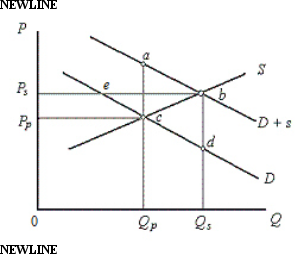 In the figure,
D: Private demand curve for elementary education
D + s: Demand curve which includes public benefits
S: Supply curve of education
Price and Quantity have been taken on vertical and horizontal axes respectively.
In Figure 13.1, D represents the private demand for education, and D+s represents the demand including the public benefits of education.According to the figure, the optimal subsidy is equal to:
In the figure,
D: Private demand curve for elementary education
D + s: Demand curve which includes public benefits
S: Supply curve of education
Price and Quantity have been taken on vertical and horizontal axes respectively.
In Figure 13.1, D represents the private demand for education, and D+s represents the demand including the public benefits of education.According to the figure, the optimal subsidy is equal to: (Multiple Choice)
4.8/5 (67)
(67) When the benefits of an activity are received by those who are not directly involved in it:
(Multiple Choice)
4.9/5 (84)
(84) James insured his car with a renowned insurance company that checked his driving skills and verified his accident records before insuring his car.After paying two premiums for this insurance, James took to drinking and driving.This action of James is likely to create:
(Multiple Choice)
4.8/5 (74)
(74) After John discovered he had a serious illness, he immediately purchased health insurance without disclosing his illness to the insurance company.This is an example of adverse selection.
(True/False)
4.9/5 (68)
(68) Which of the following is not a problem with a public good?
(Multiple Choice)
4.8/5 (78)
(78) The Austrian school of economists stressed on the efficiency of the markets on the pretext that:
(Multiple Choice)
4.9/5 (61)
(61) Wikipedia and other projects utilizing wiki technology, represent an example of:
(Multiple Choice)
4.8/5 (91)
(91) Production becomes more efficient if a common property is turned into a private property.
(True/False)
4.9/5 (63)
(63) The figure given below shows the demand and supply curves of automobiles. Figure 13.3 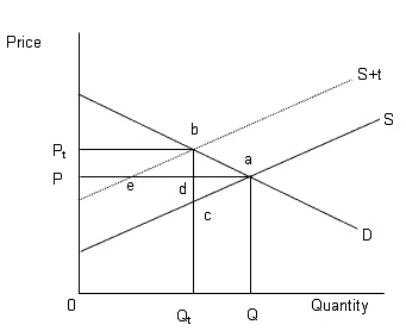 In the figure,
D: Demand curve of automobiles
S: Supply of automobiles prior to the tax
S+t: Supply of automobiles after the tax
In Figure 13.3, the amount of tax levied by the government is equal to:
In the figure,
D: Demand curve of automobiles
S: Supply of automobiles prior to the tax
S+t: Supply of automobiles after the tax
In Figure 13.3, the amount of tax levied by the government is equal to: (Multiple Choice)
4.9/5 (79)
(79) Both the principles of rivalry and mutual excludability apply for club goods.
(True/False)
4.8/5 (88)
(88) Why does an existing less efficient technology drive out a new more efficient technology?
(Multiple Choice)
4.8/5 (71)
(71) When a good is subsidized by the government, the amount of the good produced or consumed declines.
(True/False)
4.8/5 (85)
(85) Which of the following is an example of the command approach to regulation?
(Multiple Choice)
5.0/5 (74)
(74) If the value of a network to a single user is $1 for each other user on the network, then a network of size 100 has a value of:
(Multiple Choice)
4.9/5 (84)
(84) According to the Coase theorem, high transaction costs necessarily call for government action.
(True/False)
4.8/5 (86)
(86) When resources are commonly owned, there are incentives in place to ensure that the resources are used efficiently.
(True/False)
4.9/5 (84)
(84) Which of the following wouldhelp to minimize adverse selection?
(Multiple Choice)
4.8/5 (79)
(79) 
Filters
- Essay(0)
- Multiple Choice(0)
- Short Answer(0)
- True False(0)
- Matching(0)