



 Chat with AI
Exam 21: Market Failures, Government Failures, and Rent Seeking

Exam 1: Economics: The World Around You90 Questions
Exam 2: Choice, Opportunity Costs, and Specialization94 Questions
Exam 3: Markets, Demand and Supply, and the Price System97 Questions
Exam 5: The Market System and the Private and Public Sector97 Questions
Exam 4: Elasticity: Demand and Supply126 Questions
Exam 6: National Income Accounting104 Questions
Exam 7: an Introduction to the Foreign Exchange Market and the Balance of Payments90 Questions
Exam 8: Consumer Choice132 Questions
Exam 9: Supply: The Costs of Doing Business106 Questions
Exam 10: Unemployment and Inflation129 Questions
Exam 11: Macroeconomic Equilibrium: Aggregate Demand and Supply122 Questions
Exam 12: Profit Maximization122 Questions
Exam 13: Aggregate Expenditures115 Questions
Exam 14: Perfect Competition135 Questions
Exam 15: Income and Expenditures Equilibrium134 Questions
Exam 16: Monopoly118 Questions
Exam 17: Fiscal Policy93 Questions
Exam 18: Monopolistic Competition and Oligopoly111 Questions
Exam 19: Antitrust and Regulation100 Questions
Exam 10: Money and Banking125 Questions
Exam 21: Market Failures, Government Failures, and Rent Seeking121 Questions
Exam 22: Monetary Policy141 Questions
Exam 23: Macroeconomic Policy: Tradeoffs, Expectations, Credibility, and Sources of Business Cycles112 Questions
Exam 24: Resource Markets112 Questions
Exam 25: Macroeconomic Viewpoints: New Keynesian, Monetarist, and New Classical99 Questions
Exam 26: The Labor Market114 Questions
Exam 27: Capital Markets100 Questions
Exam 28: Economic Growth99 Questions
Exam 29: Development Economics104 Questions
Exam 30: the Land Market and Natural Resources55 Questions
Exam 31: Aging, Social Security and Health Care88 Questions
Exam 32: Globalization84 Questions
Exam 33: Elasticity: Demand and Supply126 Questions
Exam 34: Income Distribution, Poverty and Government Policy115 Questions
Exam 35: World Trade Equilibrium112 Questions
Exam 36: Consumer Choice132 Questions
Exam 37: International Trade Restrictions109 Questions
Exam 38: World Trade Equilibrium112 Questions
Exam 39: Exchange Rates and Financial Links Between Countries132 Questions
Exam 40: International Trade Restrictions109 Questions
Exam 41: Supply: the Costs of Doing Business106 Questions
Exam 42: Exchange Rates and Financial Links Between Countries132 Questions
Exam 43: Profit Maximization122 Questions
Exam 44: Perfect Competition135 Questions
Exam 45: Monopoly118 Questions
Exam 46: Monopolistic Competition and Oligopoly111 Questions
Exam 47: Antitrust and Regulation100 Questions
Exam 48: Market Failures, Government Failures, and Rent Seeking121 Questions
Exam 49: Resource Markets112 Questions
Exam 50: The Labor Market114 Questions
Exam 51: Capital Markets100 Questions
Exam 52: The Land Market and Natural Resources55 Questions
Exam 53: Aging, Social Security and Health Care87 Questions
Exam 54: Income Distribution, Poverty and Government Policy115 Questions
Exam 55: World Trade Equilibrium112 Questions
Exam 56: International Trade Restrictions109 Questions
Exam 57: Exchange Rates and Financial Links Between Countries132 Questions
Select questions type


The figure given below shows the demand and supply curves of automobiles. Figure 13.3 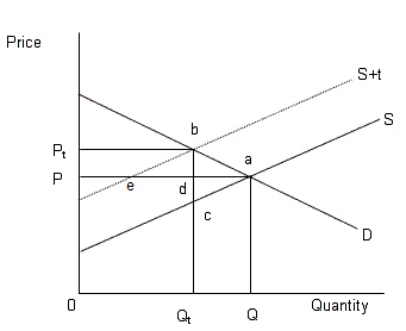 In the figure,
D: Demand curve of automobiles
S: Supply of automobiles prior to the tax
S+t: Supply of automobiles after the tax
Figure 13.3 represents a situation of:
In the figure,
D: Demand curve of automobiles
S: Supply of automobiles prior to the tax
S+t: Supply of automobiles after the tax
Figure 13.3 represents a situation of: (Multiple Choice)
4.8/5  (61)
(61) A market failure occurs when the market outcome is not the socially efficient outcome.
(True/False)
4.9/5 (74)
(74) When all costs and benefits of a transaction are borne by the participants of that transaction:
(Multiple Choice)
4.8/5 (94)
(94) When a firm increases its short-run supplies only by hiring more labor, other inputs remaining unchanged, eventually:
(Multiple Choice)
4.7/5 (69)
(69) One reason that some whales were hunted close to extinction is that no one can claim ownership of a whale until it is killed.If property rights to the whale population were established:
(Multiple Choice)
4.9/5 (76)
(76) When social costs of producing or consuming a good exceed private costs:
(Multiple Choice)
5.0/5 (77)
(77) The Coase theorem states that when transactions costs are low, then:
(Multiple Choice)
4.8/5 (85)
(85) Which of the following is an example of government failure?
(Multiple Choice)
4.7/5 (92)
(92) When there exists a negative externality in case of a particular good and that is not reflected in the price:
(Multiple Choice)
4.8/5 (78)
(78) Laws that require children to be inoculated against certain diseases before they enter kindergarten are examples of the command approach.
(True/False)
4.8/5 (68)
(68) The cost borne by an individual user to switch to another network is less if the network which he is using is large.
(True/False)
4.8/5 (69)
(69) Moral hazard is the term used to describe the situation in which:
(Multiple Choice)
5.0/5 (91)
(91) The following table shows the costs and benefit of producing a commodity. Table 13.1
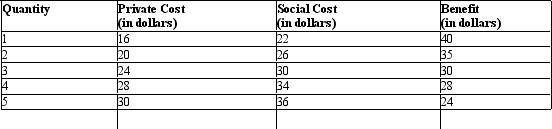 According to Table 13.1, the external cost of producing 5 units of the output is:
 (Multiple Choice)
4.8/5 (72)
(72) One of the reasons that communism failed in the Soviet Union is that, under communism:
(Multiple Choice)
4.7/5 (78)
(78) Which of the following is a measure taken by the government to internalize the externalities?
(Multiple Choice)
4.8/5 (73)
(73) Under a marketable pollution permit system, property rights to an externality are created so that a more efficient allocation of resources will result.
(True/False)
4.8/5 (75)
(75) The Clean Air Act of 1972 required some companies to install the "best available" pollution control technologies.This was an example of:
(Multiple Choice)
4.9/5 (77)
(77) When a good commodity is driven out of the market by a bad commodity it is called:
(Multiple Choice)
5.0/5 (70)
(70) 
Filters
- Essay(0)
- Multiple Choice(0)
- Short Answer(0)
- True False(0)
- Matching(0)