



 Chat with AI
Exam 22: Monetary Policy

Exam 1: Economics: The World Around You90 Questions
Exam 2: Choice, Opportunity Costs, and Specialization94 Questions
Exam 3: Markets, Demand and Supply, and the Price System97 Questions
Exam 5: The Market System and the Private and Public Sector97 Questions
Exam 4: Elasticity: Demand and Supply126 Questions
Exam 6: National Income Accounting104 Questions
Exam 7: an Introduction to the Foreign Exchange Market and the Balance of Payments90 Questions
Exam 8: Consumer Choice132 Questions
Exam 9: Supply: The Costs of Doing Business106 Questions
Exam 10: Unemployment and Inflation129 Questions
Exam 11: Macroeconomic Equilibrium: Aggregate Demand and Supply122 Questions
Exam 12: Profit Maximization122 Questions
Exam 13: Aggregate Expenditures115 Questions
Exam 14: Perfect Competition135 Questions
Exam 15: Income and Expenditures Equilibrium134 Questions
Exam 16: Monopoly118 Questions
Exam 17: Fiscal Policy93 Questions
Exam 18: Monopolistic Competition and Oligopoly111 Questions
Exam 19: Antitrust and Regulation100 Questions
Exam 10: Money and Banking125 Questions
Exam 21: Market Failures, Government Failures, and Rent Seeking121 Questions
Exam 22: Monetary Policy141 Questions
Exam 23: Macroeconomic Policy: Tradeoffs, Expectations, Credibility, and Sources of Business Cycles112 Questions
Exam 24: Resource Markets112 Questions
Exam 25: Macroeconomic Viewpoints: New Keynesian, Monetarist, and New Classical99 Questions
Exam 26: The Labor Market114 Questions
Exam 27: Capital Markets100 Questions
Exam 28: Economic Growth99 Questions
Exam 29: Development Economics104 Questions
Exam 30: the Land Market and Natural Resources55 Questions
Exam 31: Aging, Social Security and Health Care88 Questions
Exam 32: Globalization84 Questions
Exam 33: Elasticity: Demand and Supply126 Questions
Exam 34: Income Distribution, Poverty and Government Policy115 Questions
Exam 35: World Trade Equilibrium112 Questions
Exam 36: Consumer Choice132 Questions
Exam 37: International Trade Restrictions109 Questions
Exam 38: World Trade Equilibrium112 Questions
Exam 39: Exchange Rates and Financial Links Between Countries132 Questions
Exam 40: International Trade Restrictions109 Questions
Exam 41: Supply: the Costs of Doing Business106 Questions
Exam 42: Exchange Rates and Financial Links Between Countries132 Questions
Exam 43: Profit Maximization122 Questions
Exam 44: Perfect Competition135 Questions
Exam 45: Monopoly118 Questions
Exam 46: Monopolistic Competition and Oligopoly111 Questions
Exam 47: Antitrust and Regulation100 Questions
Exam 48: Market Failures, Government Failures, and Rent Seeking121 Questions
Exam 49: Resource Markets112 Questions
Exam 50: The Labor Market114 Questions
Exam 51: Capital Markets100 Questions
Exam 52: The Land Market and Natural Resources55 Questions
Exam 53: Aging, Social Security and Health Care87 Questions
Exam 54: Income Distribution, Poverty and Government Policy115 Questions
Exam 55: World Trade Equilibrium112 Questions
Exam 56: International Trade Restrictions109 Questions
Exam 57: Exchange Rates and Financial Links Between Countries132 Questions
Select questions type


A change in the interest rate does not affect the quantity of money supplied.This means that:
(Multiple Choice)
4.9/5  (78)
(78) According to the equation of exchange, if the money supply is $800 million, real GDP is $3, 000 million, and nominal GDP is $4, 000 million, then the velocity of money is equal to:
(Multiple Choice)
4.8/5 (75)
(75) In the figure given below panel A represents money market equilibrium, panel B represents investment demand, and panel C represents equilibrium real GDP. Figure 13.3 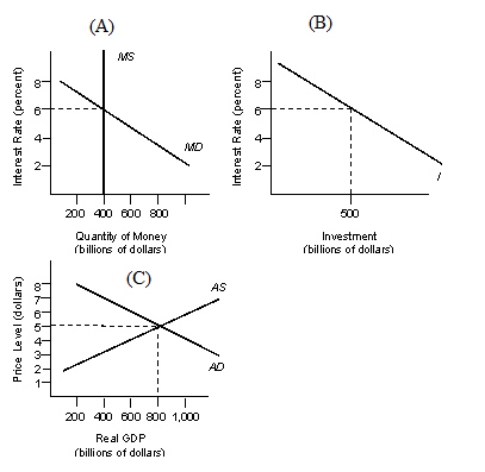 Refer to Figure 13.3.Starting from the equilibrium illustrated in the graphs, if the Federal Reserve purchases government bonds in the open market, then:
 (Multiple Choice)
4.8/5 (81)
(81) If the aggregate supply curve is positively sloped, an increase in the money supply will result in an increase in both equilibrium national income and the equilibrium price level.
(True/False)
5.0/5 (99)
(99) Suppose the U.S.dollar appreciates in value against the Australian dollar, and the Fed intervenes in the foreign exchange market by using U.S.dollars to buy Australian dollars.The Fed could sterilize the expansionary effect of this intervention by:
(Multiple Choice)
4.7/5 (80)
(80) The aggregate demand curve will shift outward and to the right when the Federal Reserve undertakes which of the following monetary policies?
(Multiple Choice)
4.9/5 (79)
(79) When the Fed uses money growth rates as an intermediate target, it implicitly assumes that the velocity of money is constant over time, at least in the short run.
(True/False)
4.9/5 (83)
(83) Which of the following actions of the Fed will increase money supply in the U.S.directly?
(Multiple Choice)
4.7/5 (68)
(68) A leftward shift in the money demand function would result from:
(Multiple Choice)
5.0/5 (77)
(77) The President of which of the following district banks of the Fed is perpetually present on the Federal Open Market Committee?
(Multiple Choice)
4.8/5 (96)
(96) The monetary policy decisions made by the Federal Reserve must be approved by the Congress before they are enacted.
(True/False)
4.8/5 (77)
(77) The table given below shows the assets and liabilities of the National Bank.Assume that this is the only bank in the economy. Table 13.2
 Refer to Table 13.2.If the reserve requirement is 10 percent, calculate the maximum amount of loanable funds available with the bank.
 (Multiple Choice)
4.7/5 (78)
(78) Which of the following is most likely to lead to an increase in the demand for U.S.dollars in the foreign exchange market?
(Multiple Choice)
4.9/5 (75)
(75) An increase in the money supply will lead to an increase in equilibrium real GDP only if:
(Multiple Choice)
5.0/5 (66)
(66) 
Filters
- Essay(0)
- Multiple Choice(0)
- Short Answer(0)
- True False(0)
- Matching(0)