



 Chat with AI
Exam 22: Monetary Policy

Exam 1: Economics: The World Around You90 Questions
Exam 2: Choice, Opportunity Costs, and Specialization94 Questions
Exam 3: Markets, Demand and Supply, and the Price System97 Questions
Exam 5: The Market System and the Private and Public Sector97 Questions
Exam 4: Elasticity: Demand and Supply126 Questions
Exam 6: National Income Accounting104 Questions
Exam 7: an Introduction to the Foreign Exchange Market and the Balance of Payments90 Questions
Exam 8: Consumer Choice132 Questions
Exam 9: Supply: The Costs of Doing Business106 Questions
Exam 10: Unemployment and Inflation129 Questions
Exam 11: Macroeconomic Equilibrium: Aggregate Demand and Supply122 Questions
Exam 12: Profit Maximization122 Questions
Exam 13: Aggregate Expenditures115 Questions
Exam 14: Perfect Competition135 Questions
Exam 15: Income and Expenditures Equilibrium134 Questions
Exam 16: Monopoly118 Questions
Exam 17: Fiscal Policy93 Questions
Exam 18: Monopolistic Competition and Oligopoly111 Questions
Exam 19: Antitrust and Regulation100 Questions
Exam 10: Money and Banking125 Questions
Exam 21: Market Failures, Government Failures, and Rent Seeking121 Questions
Exam 22: Monetary Policy141 Questions
Exam 23: Macroeconomic Policy: Tradeoffs, Expectations, Credibility, and Sources of Business Cycles112 Questions
Exam 24: Resource Markets112 Questions
Exam 25: Macroeconomic Viewpoints: New Keynesian, Monetarist, and New Classical99 Questions
Exam 26: The Labor Market114 Questions
Exam 27: Capital Markets100 Questions
Exam 28: Economic Growth99 Questions
Exam 29: Development Economics104 Questions
Exam 30: the Land Market and Natural Resources55 Questions
Exam 31: Aging, Social Security and Health Care88 Questions
Exam 32: Globalization84 Questions
Exam 33: Elasticity: Demand and Supply126 Questions
Exam 34: Income Distribution, Poverty and Government Policy115 Questions
Exam 35: World Trade Equilibrium112 Questions
Exam 36: Consumer Choice132 Questions
Exam 37: International Trade Restrictions109 Questions
Exam 38: World Trade Equilibrium112 Questions
Exam 39: Exchange Rates and Financial Links Between Countries132 Questions
Exam 40: International Trade Restrictions109 Questions
Exam 41: Supply: the Costs of Doing Business106 Questions
Exam 42: Exchange Rates and Financial Links Between Countries132 Questions
Exam 43: Profit Maximization122 Questions
Exam 44: Perfect Competition135 Questions
Exam 45: Monopoly118 Questions
Exam 46: Monopolistic Competition and Oligopoly111 Questions
Exam 47: Antitrust and Regulation100 Questions
Exam 48: Market Failures, Government Failures, and Rent Seeking121 Questions
Exam 49: Resource Markets112 Questions
Exam 50: The Labor Market114 Questions
Exam 51: Capital Markets100 Questions
Exam 52: The Land Market and Natural Resources55 Questions
Exam 53: Aging, Social Security and Health Care87 Questions
Exam 54: Income Distribution, Poverty and Government Policy115 Questions
Exam 55: World Trade Equilibrium112 Questions
Exam 56: International Trade Restrictions109 Questions
Exam 57: Exchange Rates and Financial Links Between Countries132 Questions
Select questions type


The table given below shows the assets and liabilities of the National Bank.Assume that this is the only bank in the economy. Table 13.2
 Refer to Table 13.2.If the reserve requirement is 10 percent, how much can the whole banking system expand the money supply?
 (Multiple Choice)
4.9/5  (73)
(73) Other things equal, when the Fed raises the reserve requirement, the banking system's excess reserves will fall, the deposit expansion multiplier will decline, and the money supply will decrease.
(True/False)
4.9/5 (80)
(80) All members of the Federal Board of Governors are appointed by the president and confirmed by the Senate.
(True/False)
4.8/5 (81)
(81) The interest rate that banks pay for borrowing overnight from other banks is called:
(Multiple Choice)
4.9/5 (86)
(86) Scenario 13.2 Assume the following conditions hold.
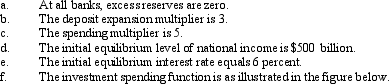 Now the Federal Reserve engages in an open market operation by purchasing $1 billion worth of government bonds from private bond dealers, who then deposit the $1 billion in the banks.This acts to lower the equilibrium interest rate by 2 percent.
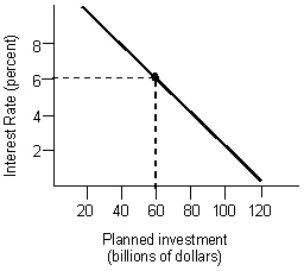 Refer to Scenario 13.1.What is the ultimate change in the money supply following the open market operation by the Fed?
Now the Federal Reserve engages in an open market operation by purchasing $1 billion worth of government bonds from private bond dealers, who then deposit the $1 billion in the banks.This acts to lower the equilibrium interest rate by 2 percent. Refer to Scenario 13.1.What is the ultimate change in the money supply following the open market operation by the Fed? (Multiple Choice)
4.9/5 (86)
(86) Table 13.1  Refer to Table 13.1.Given a reserve requirement of 8 percent, what is the increase in required reserves when the government purchases $400 worth of government securities?
 (Multiple Choice)
4.9/5 (84)
(84) The figure given below depicts the equilibrium in the foreign exchange market. Figure 13.1  Refer to Figure 13.1.Which of the following is most likely to cause equilibrium to change from point A to point D?
 (Multiple Choice)
4.7/5 (72)
(72) The Fed can enhance liquidity in the U.S.economy by increasing the federal funds rate.
(True/False)
4.8/5 (83)
(83) If the money supply is $80 billion, the velocity of money is 5, and real GDP is $320 billion, then the price level equals:
(Multiple Choice)
4.8/5 (83)
(83) When the government raises spending to promote economic growth, the Fed sells government bonds on the open market.This implies that the Federal Reserve and the federal government are following different policy goals.
(True/False)
5.0/5 (77)
(77) During the Christmas holiday season, the Fed increases the supply of currency to:
(Multiple Choice)
4.8/5 (69)
(69) The table given below shows the assets and liabilities of the National Bank.Assume that this is the only bank in the economy. Table 13.2
 Refer to Table 13.2.If the Fed increased the reserve requirement from 10 percent to 25 percent, the money supply in the whole banking system could now potentially:
 (Multiple Choice)
4.9/5 (80)
(80) Each district bank of the Fed comprises of nine board of directors of which three are appointed by the:
(Multiple Choice)
4.8/5 (69)
(69) The figure given below depicts the equilibrium in the foreign exchange market. Figure 13.1  Refer to Figure 13.1.If the current equilibrium exchange rate is E1 what action would the Fed have to take to achieve a target exchange rate of E2?
 (Multiple Choice)
4.8/5 (80)
(80) There is an inverse relationship between the interest rate and the quantity of money demanded.
(True/False)
4.8/5 (89)
(89) The supply of the U.S.dollar on the foreign exchange market is generated by:
(Multiple Choice)
4.9/5 (78)
(78) The figure given below depicts the equilibrium exchange rate between the U.S dollar and the Mexican peso. Figure 13.2  Refer to Figure 13.2.Assume that the exchange rate is fixed at MXP 11 = $1 and the free market equilibrium rate is MXP 10 = $1.This means that at MXP 11 = $1,
 (Multiple Choice)
4.8/5 (77)
(77) Which of the following will be observed if the Fed raises the reserve requirement?
(Multiple Choice)
4.9/5 (76)
(76) 
Filters
- Essay(0)
- Multiple Choice(0)
- Short Answer(0)
- True False(0)
- Matching(0)