



 Chat with AI
Exam 26: The Labor Market

Exam 1: Economics: The World Around You90 Questions
Exam 2: Choice, Opportunity Costs, and Specialization94 Questions
Exam 3: Markets, Demand and Supply, and the Price System97 Questions
Exam 5: The Market System and the Private and Public Sector97 Questions
Exam 4: Elasticity: Demand and Supply126 Questions
Exam 6: National Income Accounting104 Questions
Exam 7: an Introduction to the Foreign Exchange Market and the Balance of Payments90 Questions
Exam 8: Consumer Choice132 Questions
Exam 9: Supply: The Costs of Doing Business106 Questions
Exam 10: Unemployment and Inflation129 Questions
Exam 11: Macroeconomic Equilibrium: Aggregate Demand and Supply122 Questions
Exam 12: Profit Maximization122 Questions
Exam 13: Aggregate Expenditures115 Questions
Exam 14: Perfect Competition135 Questions
Exam 15: Income and Expenditures Equilibrium134 Questions
Exam 16: Monopoly118 Questions
Exam 17: Fiscal Policy93 Questions
Exam 18: Monopolistic Competition and Oligopoly111 Questions
Exam 19: Antitrust and Regulation100 Questions
Exam 10: Money and Banking125 Questions
Exam 21: Market Failures, Government Failures, and Rent Seeking121 Questions
Exam 22: Monetary Policy141 Questions
Exam 23: Macroeconomic Policy: Tradeoffs, Expectations, Credibility, and Sources of Business Cycles112 Questions
Exam 24: Resource Markets112 Questions
Exam 25: Macroeconomic Viewpoints: New Keynesian, Monetarist, and New Classical99 Questions
Exam 26: The Labor Market114 Questions
Exam 27: Capital Markets100 Questions
Exam 28: Economic Growth99 Questions
Exam 29: Development Economics104 Questions
Exam 30: the Land Market and Natural Resources55 Questions
Exam 31: Aging, Social Security and Health Care88 Questions
Exam 32: Globalization84 Questions
Exam 33: Elasticity: Demand and Supply126 Questions
Exam 34: Income Distribution, Poverty and Government Policy115 Questions
Exam 35: World Trade Equilibrium112 Questions
Exam 36: Consumer Choice132 Questions
Exam 37: International Trade Restrictions109 Questions
Exam 38: World Trade Equilibrium112 Questions
Exam 39: Exchange Rates and Financial Links Between Countries132 Questions
Exam 40: International Trade Restrictions109 Questions
Exam 41: Supply: the Costs of Doing Business106 Questions
Exam 42: Exchange Rates and Financial Links Between Countries132 Questions
Exam 43: Profit Maximization122 Questions
Exam 44: Perfect Competition135 Questions
Exam 45: Monopoly118 Questions
Exam 46: Monopolistic Competition and Oligopoly111 Questions
Exam 47: Antitrust and Regulation100 Questions
Exam 48: Market Failures, Government Failures, and Rent Seeking121 Questions
Exam 49: Resource Markets112 Questions
Exam 50: The Labor Market114 Questions
Exam 51: Capital Markets100 Questions
Exam 52: The Land Market and Natural Resources55 Questions
Exam 53: Aging, Social Security and Health Care87 Questions
Exam 54: Income Distribution, Poverty and Government Policy115 Questions
Exam 55: World Trade Equilibrium112 Questions
Exam 56: International Trade Restrictions109 Questions
Exam 57: Exchange Rates and Financial Links Between Countries132 Questions
Select questions type


An example of human capital is the purchase of a computer to help accountants.
(True/False)
4.8/5  (79)
(79) The figure given below shows the income-leisure trade off of an individual. Figure 15.6 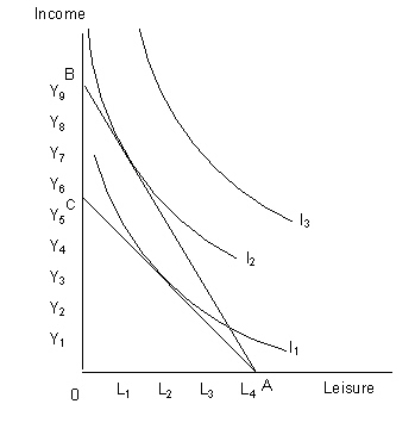 AB and AC: Income constraints of the individual
I1, I2, and I3 curves show the income leisure choices of the individual.
Which of the following factors is likely to be responsible for the inward rotation of the income constraint from AB to AC in Figure 15.6?
AB and AC: Income constraints of the individual
I1, I2, and I3 curves show the income leisure choices of the individual.
Which of the following factors is likely to be responsible for the inward rotation of the income constraint from AB to AC in Figure 15.6? (Multiple Choice)
4.8/5 (76)
(76) Why do skilled workers earn relatively higher wages than unskilled workers?
(Multiple Choice)
4.9/5 (74)
(74) The ratio of the median income of college-to high school-educated workers is called the _____.
(Multiple Choice)
4.7/5 (69)
(69) The idea of comparable worth implies that wages are to be determined by the job characteristics and not merely by the interaction of demand and supply.
(True/False)
5.0/5 (80)
(80) Which of the following is a reason that some economists do not agree with the concept of a labor-leisure tradeoff?
(Multiple Choice)
4.8/5 (73)
(73) Statistical discrimination is legal under the disparate impact standard but illegal under the treatment standard.
(True/False)
4.8/5 (78)
(78) Illegal immigrants to the U.S.usually charge higher wages than their American counterparts.
(True/False)
4.8/5 (69)
(69) A firm employing secretaries and steelworkers should ideally pay equal wages to both the groups of workers irrespective of the type of job each group does.
(True/False)
4.8/5 (87)
(87) It has been proved empirically that marriage and children lowers a woman's ability to earn as much as a man.
(True/False)
4.9/5 (77)
(77) Which of the following is not a reason for the wage differential between females and males?
(Multiple Choice)
4.8/5 (93)
(93) When people are separated into different jobs on the basis of sex, it is referred to as:
(Multiple Choice)
4.9/5 (78)
(78) Proponents of comparable worth justifies it on the ground that:
(Multiple Choice)
5.0/5 (89)
(89) One of the major impacts of restricting immigration is that the:
(Multiple Choice)
4.9/5 (81)
(81) Supporters of comparable worth claim that market correctly allocates the workers in their best paid works.
(True/False)
4.9/5 (74)
(74) The Civil Rights Act of 1964 in the United States led to _____.
(Multiple Choice)
4.8/5 (83)
(83) Why are a large number of IT jobs being outsourced to China and India?
(Multiple Choice)
4.9/5 (78)
(78) Which of the following statements best defines the economics of the so-called superstar effect in the labor market?
(Multiple Choice)
4.8/5 (95)
(95) People leave their home country and go to another country to live primarily because they seek a higher quality of life.
(True/False)
4.8/5 (65)
(65) The principal argument against comparable worth is that the demand and supply of labor in the labor market allocates workers to where they are needed the most.
(True/False)
4.8/5 (74)
(74) 
Filters
- Essay(0)
- Multiple Choice(0)
- Short Answer(0)
- True False(0)
- Matching(0)