



 Chat with AI
Exam 26: The Labor Market

Exam 1: Economics: The World Around You90 Questions
Exam 2: Choice, Opportunity Costs, and Specialization94 Questions
Exam 3: Markets, Demand and Supply, and the Price System97 Questions
Exam 5: The Market System and the Private and Public Sector97 Questions
Exam 4: Elasticity: Demand and Supply126 Questions
Exam 6: National Income Accounting104 Questions
Exam 7: an Introduction to the Foreign Exchange Market and the Balance of Payments90 Questions
Exam 8: Consumer Choice132 Questions
Exam 9: Supply: The Costs of Doing Business106 Questions
Exam 10: Unemployment and Inflation129 Questions
Exam 11: Macroeconomic Equilibrium: Aggregate Demand and Supply122 Questions
Exam 12: Profit Maximization122 Questions
Exam 13: Aggregate Expenditures115 Questions
Exam 14: Perfect Competition135 Questions
Exam 15: Income and Expenditures Equilibrium134 Questions
Exam 16: Monopoly118 Questions
Exam 17: Fiscal Policy93 Questions
Exam 18: Monopolistic Competition and Oligopoly111 Questions
Exam 19: Antitrust and Regulation100 Questions
Exam 10: Money and Banking125 Questions
Exam 21: Market Failures, Government Failures, and Rent Seeking121 Questions
Exam 22: Monetary Policy141 Questions
Exam 23: Macroeconomic Policy: Tradeoffs, Expectations, Credibility, and Sources of Business Cycles112 Questions
Exam 24: Resource Markets112 Questions
Exam 25: Macroeconomic Viewpoints: New Keynesian, Monetarist, and New Classical99 Questions
Exam 26: The Labor Market114 Questions
Exam 27: Capital Markets100 Questions
Exam 28: Economic Growth99 Questions
Exam 29: Development Economics104 Questions
Exam 30: the Land Market and Natural Resources55 Questions
Exam 31: Aging, Social Security and Health Care88 Questions
Exam 32: Globalization84 Questions
Exam 33: Elasticity: Demand and Supply126 Questions
Exam 34: Income Distribution, Poverty and Government Policy115 Questions
Exam 35: World Trade Equilibrium112 Questions
Exam 36: Consumer Choice132 Questions
Exam 37: International Trade Restrictions109 Questions
Exam 38: World Trade Equilibrium112 Questions
Exam 39: Exchange Rates and Financial Links Between Countries132 Questions
Exam 40: International Trade Restrictions109 Questions
Exam 41: Supply: the Costs of Doing Business106 Questions
Exam 42: Exchange Rates and Financial Links Between Countries132 Questions
Exam 43: Profit Maximization122 Questions
Exam 44: Perfect Competition135 Questions
Exam 45: Monopoly118 Questions
Exam 46: Monopolistic Competition and Oligopoly111 Questions
Exam 47: Antitrust and Regulation100 Questions
Exam 48: Market Failures, Government Failures, and Rent Seeking121 Questions
Exam 49: Resource Markets112 Questions
Exam 50: The Labor Market114 Questions
Exam 51: Capital Markets100 Questions
Exam 52: The Land Market and Natural Resources55 Questions
Exam 53: Aging, Social Security and Health Care87 Questions
Exam 54: Income Distribution, Poverty and Government Policy115 Questions
Exam 55: World Trade Equilibrium112 Questions
Exam 56: International Trade Restrictions109 Questions
Exam 57: Exchange Rates and Financial Links Between Countries132 Questions
Select questions type


According to the U.S.population surveys conducted by the census, since 1980 the total foreign-born population as a percentage of the total U.S.population:
(Multiple Choice)
4.7/5  (77)
(77) The following figures show the demand (D)and supply (S)curves of micro and macro economists. Figure 15.7 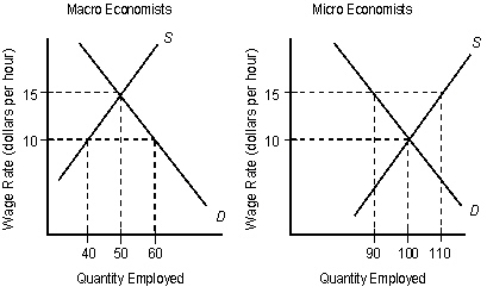 In Figure 15.7, assume that the wage rates of the micro and the macro economists are determined by the aggregate demand and supply curves.The levels of employment for micro- and macro economists are _____ and _____ respectively:
 (Multiple Choice)
4.8/5 (81)
(81) Why is the market supply curve of labor positively sloped though individual supply curves are backward-bending beyond a certain wage rate?
(Multiple Choice)
4.8/5 (78)
(78) If the minimum wage is set above the equilibrium wage by the government, there is an excess supply of labor in the market.
(True/False)
4.7/5 (76)
(76) Which of the following is an instance of employer prejudice that leads to wage differential?
(Multiple Choice)
4.8/5 (75)
(75) Border enforcement if effective would raise the number of illegal immigrants into the United States.
(True/False)
4.8/5 (81)
(81) Why does the labor market have more than one equilibrium wage rate?
(Multiple Choice)
4.9/5 (79)
(79) The policy of comparable worth has been more successful in the public sector than in the private sector.
(True/False)
4.9/5 (90)
(90) Offshoring does not affect the percentage of U.S.workers employed in manufacturing.
(True/False)
4.7/5 (82)
(82) In a perfectly competitive labor market, the minimum wage policy adopted by the government raises employment.
(True/False)
4.9/5 (76)
(76) The U.S.government has time and again raised the minimum wage to:
(Multiple Choice)
4.7/5 (77)
(77) All of the following are reasons for immigration to a foreign country, except that:
(Multiple Choice)
4.9/5 (82)
(82) According to Figure 15.4, one of the possible outcomes of such offshoring is that:
(Multiple Choice)
4.8/5 (71)
(71) Which of the following professionals is likely to receive higher compensatory wages?
(Multiple Choice)
4.9/5 (88)
(88) When people prefer to obtain medical, or legal services from white males, although they charge high prices for their services, it is termed as:
(Multiple Choice)
5.0/5 (81)
(81) When women and members of other minority groups are forced into occupations where they are unable to obtain the human capital necessary to compete for high paying jobs, it is termed as statistical discrimination.
(True/False)
4.9/5 (74)
(74) 
Filters
- Essay(0)
- Multiple Choice(0)
- Short Answer(0)
- True False(0)
- Matching(0)