



 Chat with AI
Exam 48: Market Failures, Government Failures, and Rent Seeking

Exam 1: Economics: The World Around You90 Questions
Exam 2: Choice, Opportunity Costs, and Specialization94 Questions
Exam 3: Markets, Demand and Supply, and the Price System97 Questions
Exam 5: The Market System and the Private and Public Sector97 Questions
Exam 4: Elasticity: Demand and Supply126 Questions
Exam 6: National Income Accounting104 Questions
Exam 7: an Introduction to the Foreign Exchange Market and the Balance of Payments90 Questions
Exam 8: Consumer Choice132 Questions
Exam 9: Supply: The Costs of Doing Business106 Questions
Exam 10: Unemployment and Inflation129 Questions
Exam 11: Macroeconomic Equilibrium: Aggregate Demand and Supply122 Questions
Exam 12: Profit Maximization122 Questions
Exam 13: Aggregate Expenditures115 Questions
Exam 14: Perfect Competition135 Questions
Exam 15: Income and Expenditures Equilibrium134 Questions
Exam 16: Monopoly118 Questions
Exam 17: Fiscal Policy93 Questions
Exam 18: Monopolistic Competition and Oligopoly111 Questions
Exam 19: Antitrust and Regulation100 Questions
Exam 10: Money and Banking125 Questions
Exam 21: Market Failures, Government Failures, and Rent Seeking121 Questions
Exam 22: Monetary Policy141 Questions
Exam 23: Macroeconomic Policy: Tradeoffs, Expectations, Credibility, and Sources of Business Cycles112 Questions
Exam 24: Resource Markets112 Questions
Exam 25: Macroeconomic Viewpoints: New Keynesian, Monetarist, and New Classical99 Questions
Exam 26: The Labor Market114 Questions
Exam 27: Capital Markets100 Questions
Exam 28: Economic Growth99 Questions
Exam 29: Development Economics104 Questions
Exam 30: the Land Market and Natural Resources55 Questions
Exam 31: Aging, Social Security and Health Care88 Questions
Exam 32: Globalization84 Questions
Exam 33: Elasticity: Demand and Supply126 Questions
Exam 34: Income Distribution, Poverty and Government Policy115 Questions
Exam 35: World Trade Equilibrium112 Questions
Exam 36: Consumer Choice132 Questions
Exam 37: International Trade Restrictions109 Questions
Exam 38: World Trade Equilibrium112 Questions
Exam 39: Exchange Rates and Financial Links Between Countries132 Questions
Exam 40: International Trade Restrictions109 Questions
Exam 41: Supply: the Costs of Doing Business106 Questions
Exam 42: Exchange Rates and Financial Links Between Countries132 Questions
Exam 43: Profit Maximization122 Questions
Exam 44: Perfect Competition135 Questions
Exam 45: Monopoly118 Questions
Exam 46: Monopolistic Competition and Oligopoly111 Questions
Exam 47: Antitrust and Regulation100 Questions
Exam 48: Market Failures, Government Failures, and Rent Seeking121 Questions
Exam 49: Resource Markets112 Questions
Exam 50: The Labor Market114 Questions
Exam 51: Capital Markets100 Questions
Exam 52: The Land Market and Natural Resources55 Questions
Exam 53: Aging, Social Security and Health Care87 Questions
Exam 54: Income Distribution, Poverty and Government Policy115 Questions
Exam 55: World Trade Equilibrium112 Questions
Exam 56: International Trade Restrictions109 Questions
Exam 57: Exchange Rates and Financial Links Between Countries132 Questions
Select questions type


The major problem with common ownership is that, too much of the commonly owned is consumed, and not enough is produced.
(True/False)
4.7/5  (64)
(64) Overfishing along the coastline of Helsking village led the government to impose a fee on the boats used for fishing.The fisherman were charged $50 on each boat they sent out for fishing.The following table shows the total pounds of fish caught per hour and the number of boats used for fishing. Table 13.2
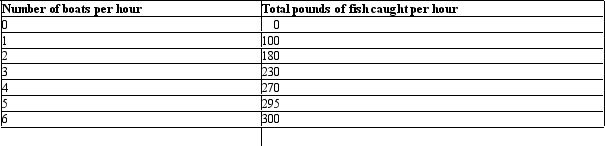 Refer to Table 13.2.Suppose fish sells for $1 per pound.If each fisherman decides whether or not to fish based on the average catch, what is the profit that each fisherman earns?
 (Multiple Choice)
4.8/5 (87)
(87) The figure given below shows the demand and supply curves of automobiles. Figure 13.3 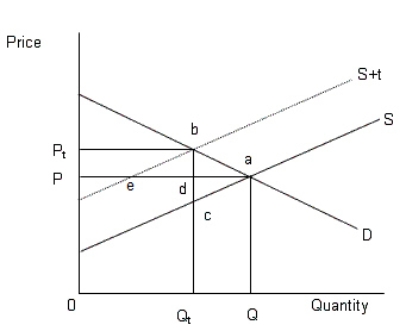 In the figure,
D: Demand curve of automobiles
S: Supply of automobiles prior to the tax
S+t: Supply of automobiles after the tax
Figure 13.3 represents a situation of:
In the figure,
D: Demand curve of automobiles
S: Supply of automobiles prior to the tax
S+t: Supply of automobiles after the tax
Figure 13.3 represents a situation of: (Multiple Choice)
4.9/5 (81)
(81) Education is a good example of a positive externality because the benefits of an education accrue not only to the individual but also to society as a whole.
(True/False)
4.9/5 (75)
(75) In order to reduce the possibility of adverse selection banks should raise their interest rates charged on the loans.
(True/False)
4.8/5 (80)
(80) The figure given below shows the demand and supply curves of steel.Sp is the private supply curve, and Ss is the social supply curve that includes both private costs and external costs. Figure 13.2 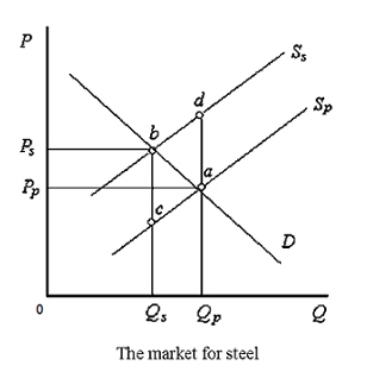 In Figure 13.2, external costs are equal to _____.
 (Multiple Choice)
4.9/5 (81)
(81) Benefits granted to powerful special interest groups in return for political support are known as rents.
(True/False)
4.9/5 (78)
(78) When all costs and benefits of a transaction are borne by the participants of that transaction:
(Multiple Choice)
4.9/5 (76)
(76) According to the Coase theorem, high transaction costs necessarily call for government action.
(True/False)
4.9/5 (78)
(78) The figure given below shows the demand for permits and the maximum permissible level of pollution. Figure 13.4 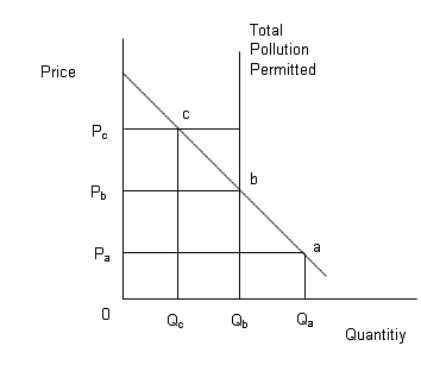 In the figure,
The downward sloping line is the demand curve of permits;
The vertical line denotes the maximum permissible limit of pollution.
In Figure 13.4, if the government sells Qb permits to pollute at a price of Pb each, then:
In the figure,
The downward sloping line is the demand curve of permits;
The vertical line denotes the maximum permissible limit of pollution.
In Figure 13.4, if the government sells Qb permits to pollute at a price of Pb each, then: (Multiple Choice)
4.8/5 (71)
(71) _____ occurs when unobservable qualities are valued incorrectly because of a lack of information.
(Multiple Choice)
4.8/5 (84)
(84) Under a marketable permit system, if the government reduces the quantity of permits, the price of each permit will increase.
(True/False)
4.7/5 (92)
(92) The figure given below shows the demand and supply curves of steel.Sp is the private supply curve, and Ss is the social supply curve that includes both private costs and external costs. Figure 13.2 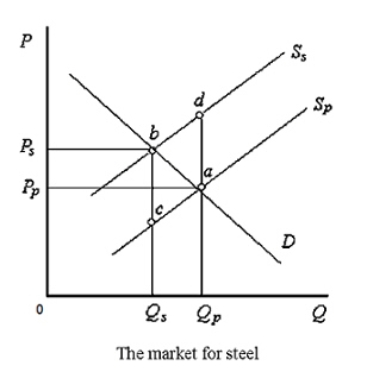 According to Figure 13.2:
 (Multiple Choice)
4.8/5 (89)
(89) The owner of a good has the right to decide how that good is used and to restrict others from using that good.This idea is known as:
(Multiple Choice)
4.9/5 (82)
(82) When the government tries to control pollution through cap and trade, it _____.
(Multiple Choice)
4.9/5 (77)
(77) When there exists a negative externality in case of a particular good and that is not reflected in the price:
(Multiple Choice)
4.7/5 (74)
(74) One of the reasons that communism failed in the Soviet Union is that, under communism:
(Multiple Choice)
4.7/5 (96)
(96) 
Filters
- Essay(0)
- Multiple Choice(0)
- Short Answer(0)
- True False(0)
- Matching(0)