



 Chat with AI
Exam 48: Market Failures, Government Failures, and Rent Seeking

Exam 1: Economics: The World Around You90 Questions
Exam 2: Choice, Opportunity Costs, and Specialization94 Questions
Exam 3: Markets, Demand and Supply, and the Price System97 Questions
Exam 5: The Market System and the Private and Public Sector97 Questions
Exam 4: Elasticity: Demand and Supply126 Questions
Exam 6: National Income Accounting104 Questions
Exam 7: an Introduction to the Foreign Exchange Market and the Balance of Payments90 Questions
Exam 8: Consumer Choice132 Questions
Exam 9: Supply: The Costs of Doing Business106 Questions
Exam 10: Unemployment and Inflation129 Questions
Exam 11: Macroeconomic Equilibrium: Aggregate Demand and Supply122 Questions
Exam 12: Profit Maximization122 Questions
Exam 13: Aggregate Expenditures115 Questions
Exam 14: Perfect Competition135 Questions
Exam 15: Income and Expenditures Equilibrium134 Questions
Exam 16: Monopoly118 Questions
Exam 17: Fiscal Policy93 Questions
Exam 18: Monopolistic Competition and Oligopoly111 Questions
Exam 19: Antitrust and Regulation100 Questions
Exam 10: Money and Banking125 Questions
Exam 21: Market Failures, Government Failures, and Rent Seeking121 Questions
Exam 22: Monetary Policy141 Questions
Exam 23: Macroeconomic Policy: Tradeoffs, Expectations, Credibility, and Sources of Business Cycles112 Questions
Exam 24: Resource Markets112 Questions
Exam 25: Macroeconomic Viewpoints: New Keynesian, Monetarist, and New Classical99 Questions
Exam 26: The Labor Market114 Questions
Exam 27: Capital Markets100 Questions
Exam 28: Economic Growth99 Questions
Exam 29: Development Economics104 Questions
Exam 30: the Land Market and Natural Resources55 Questions
Exam 31: Aging, Social Security and Health Care88 Questions
Exam 32: Globalization84 Questions
Exam 33: Elasticity: Demand and Supply126 Questions
Exam 34: Income Distribution, Poverty and Government Policy115 Questions
Exam 35: World Trade Equilibrium112 Questions
Exam 36: Consumer Choice132 Questions
Exam 37: International Trade Restrictions109 Questions
Exam 38: World Trade Equilibrium112 Questions
Exam 39: Exchange Rates and Financial Links Between Countries132 Questions
Exam 40: International Trade Restrictions109 Questions
Exam 41: Supply: the Costs of Doing Business106 Questions
Exam 42: Exchange Rates and Financial Links Between Countries132 Questions
Exam 43: Profit Maximization122 Questions
Exam 44: Perfect Competition135 Questions
Exam 45: Monopoly118 Questions
Exam 46: Monopolistic Competition and Oligopoly111 Questions
Exam 47: Antitrust and Regulation100 Questions
Exam 48: Market Failures, Government Failures, and Rent Seeking121 Questions
Exam 49: Resource Markets112 Questions
Exam 50: The Labor Market114 Questions
Exam 51: Capital Markets100 Questions
Exam 52: The Land Market and Natural Resources55 Questions
Exam 53: Aging, Social Security and Health Care87 Questions
Exam 54: Income Distribution, Poverty and Government Policy115 Questions
Exam 55: World Trade Equilibrium112 Questions
Exam 56: International Trade Restrictions109 Questions
Exam 57: Exchange Rates and Financial Links Between Countries132 Questions
Select questions type


When the people creating an externality are made to pay for the externality by the government, the externality is said to be internalized.
(True/False)
4.9/5  (73)
(73) When the benefits of an activity are received by those who are not directly involved in it:
(Multiple Choice)
4.9/5 (88)
(88) The figure below shows the demand and supply curves in the market for elementary education. Figure 13.1
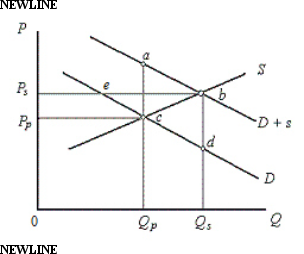 In the figure,
D: Private demand curve for elementary education
D + s: Demand curve which includes public benefits
S: Supply curve of education
Price and Quantity have been taken on vertical and horizontal axes respectively.
According to Figure 13.1, the outcome of an unregulated, unsubsidized market would be:
In the figure,
D: Private demand curve for elementary education
D + s: Demand curve which includes public benefits
S: Supply curve of education
Price and Quantity have been taken on vertical and horizontal axes respectively.
According to Figure 13.1, the outcome of an unregulated, unsubsidized market would be: (Multiple Choice)
4.9/5 (82)
(82) One cause of market failure may be the absence of clearly defined property rights.
(True/False)
4.7/5 (80)
(80) Problems of moral hazard and adverse selection occur most frequently when excessive information exists in markets.
(True/False)
4.8/5 (81)
(81) The figure given below shows the demand for permits and the maximum permissible level of pollution. Figure 13.4 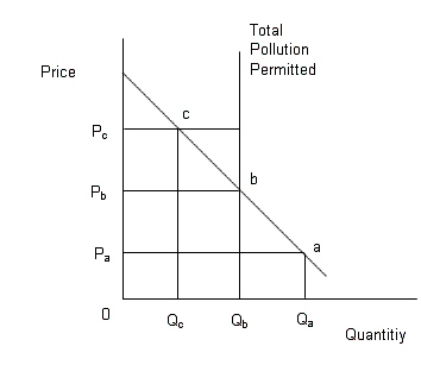 In the figure,
The downward sloping line is the demand curve of permits;
The vertical line denotes the maximum permissible limit of pollution.
Refer to Figure 13.4.Suppose the government wishes to reduce pollution to a quantity of Qb.If it sells marketable pollution permits at a quantity of Qb then:
In the figure,
The downward sloping line is the demand curve of permits;
The vertical line denotes the maximum permissible limit of pollution.
Refer to Figure 13.4.Suppose the government wishes to reduce pollution to a quantity of Qb.If it sells marketable pollution permits at a quantity of Qb then: (Multiple Choice)
4.8/5 (79)
(79) The Austrian school of economists stressed on the efficiency of the markets on the pretext that:
(Multiple Choice)
4.9/5 (71)
(71) The following table shows the costs and benefit of producing a commodity. Table 13.1
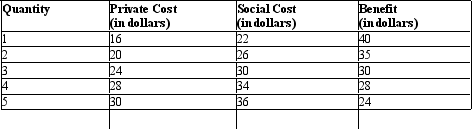 In Table 13.1, what level of tax per unit would be appropriate to internalize the externality?
 (Multiple Choice)
4.7/5 (81)
(81) When consumers have perfect information about the quality of the products they purchase, the problem of adverse selection is likely to arise.
(True/False)
4.9/5 (79)
(79) When a good is subsidized by the government, the amount of the good produced or consumed declines.
(True/False)
4.8/5 (89)
(89) Overfishing along the coastline of Helsking village led the government to impose a fee on the boats used for fishing.The fisherman were charged $50 on each boat they sent out for fishing.The following table shows the total pounds of fish caught per hour and the number of boats used for fishing. Table 13.2
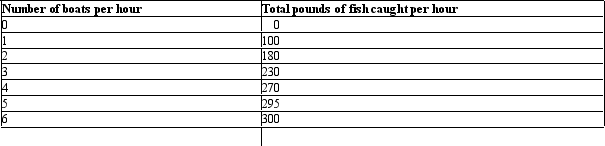 Refer to Table 13.2.Suppose fish sells for $1 per pound.What is the amount of total profit earned when the fishermen use the socially optimal number of boats?
 (Multiple Choice)
4.8/5 (67)
(67) Both the principles of rivalry and mutual excludability apply for club goods.
(True/False)
4.9/5 (71)
(71) The following table shows the costs and benefit of producing a commodity. Table 13.1
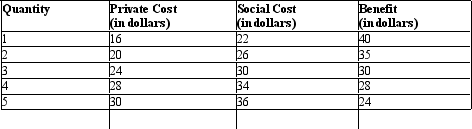 According to Table 13.1, the external cost of producing 5 units of the output is:
 (Multiple Choice)
4.8/5 (84)
(84) One reason that some whales were hunted close to extinction is that no one can claim ownership of a whale until it is killed.If property rights to the whale population were established:
(Multiple Choice)
4.9/5 (74)
(74) A market in which adverse selection occurs is often called a lemons market.
(True/False)
5.0/5 (84)
(84) 
Filters
- Essay(0)
- Multiple Choice(0)
- Short Answer(0)
- True False(0)
- Matching(0)