



 Chat with AI
Exam 50: The Labor Market

Exam 1: Economics: The World Around You90 Questions
Exam 2: Choice, Opportunity Costs, and Specialization94 Questions
Exam 3: Markets, Demand and Supply, and the Price System97 Questions
Exam 5: The Market System and the Private and Public Sector97 Questions
Exam 4: Elasticity: Demand and Supply126 Questions
Exam 6: National Income Accounting104 Questions
Exam 7: an Introduction to the Foreign Exchange Market and the Balance of Payments90 Questions
Exam 8: Consumer Choice132 Questions
Exam 9: Supply: The Costs of Doing Business106 Questions
Exam 10: Unemployment and Inflation129 Questions
Exam 11: Macroeconomic Equilibrium: Aggregate Demand and Supply122 Questions
Exam 12: Profit Maximization122 Questions
Exam 13: Aggregate Expenditures115 Questions
Exam 14: Perfect Competition135 Questions
Exam 15: Income and Expenditures Equilibrium134 Questions
Exam 16: Monopoly118 Questions
Exam 17: Fiscal Policy93 Questions
Exam 18: Monopolistic Competition and Oligopoly111 Questions
Exam 19: Antitrust and Regulation100 Questions
Exam 10: Money and Banking125 Questions
Exam 21: Market Failures, Government Failures, and Rent Seeking121 Questions
Exam 22: Monetary Policy141 Questions
Exam 23: Macroeconomic Policy: Tradeoffs, Expectations, Credibility, and Sources of Business Cycles112 Questions
Exam 24: Resource Markets112 Questions
Exam 25: Macroeconomic Viewpoints: New Keynesian, Monetarist, and New Classical99 Questions
Exam 26: The Labor Market114 Questions
Exam 27: Capital Markets100 Questions
Exam 28: Economic Growth99 Questions
Exam 29: Development Economics104 Questions
Exam 30: the Land Market and Natural Resources55 Questions
Exam 31: Aging, Social Security and Health Care88 Questions
Exam 32: Globalization84 Questions
Exam 33: Elasticity: Demand and Supply126 Questions
Exam 34: Income Distribution, Poverty and Government Policy115 Questions
Exam 35: World Trade Equilibrium112 Questions
Exam 36: Consumer Choice132 Questions
Exam 37: International Trade Restrictions109 Questions
Exam 38: World Trade Equilibrium112 Questions
Exam 39: Exchange Rates and Financial Links Between Countries132 Questions
Exam 40: International Trade Restrictions109 Questions
Exam 41: Supply: the Costs of Doing Business106 Questions
Exam 42: Exchange Rates and Financial Links Between Countries132 Questions
Exam 43: Profit Maximization122 Questions
Exam 44: Perfect Competition135 Questions
Exam 45: Monopoly118 Questions
Exam 46: Monopolistic Competition and Oligopoly111 Questions
Exam 47: Antitrust and Regulation100 Questions
Exam 48: Market Failures, Government Failures, and Rent Seeking121 Questions
Exam 49: Resource Markets112 Questions
Exam 50: The Labor Market114 Questions
Exam 51: Capital Markets100 Questions
Exam 52: The Land Market and Natural Resources55 Questions
Exam 53: Aging, Social Security and Health Care87 Questions
Exam 54: Income Distribution, Poverty and Government Policy115 Questions
Exam 55: World Trade Equilibrium112 Questions
Exam 56: International Trade Restrictions109 Questions
Exam 57: Exchange Rates and Financial Links Between Countries132 Questions
Select questions type


The following figures show the demand and supply of labor in two different types of labor market. Figure 29.5 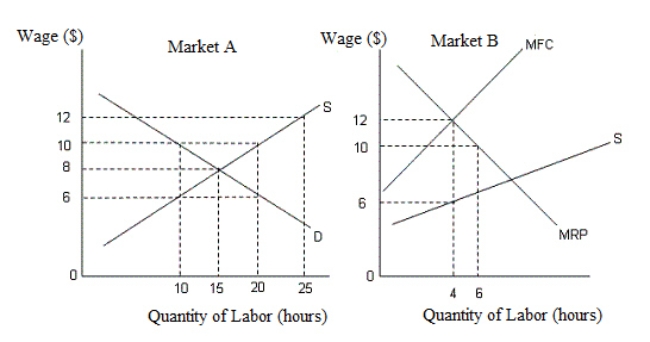 In the figures,
D: Demand curve for labor
S: Supply curve of labor
MRP: Marginal revenue product
MFC: Marginal factor cost
In Figure 29.5, if a minimum wage of $10 is set by the government, then in market B:
In the figures,
D: Demand curve for labor
S: Supply curve of labor
MRP: Marginal revenue product
MFC: Marginal factor cost
In Figure 29.5, if a minimum wage of $10 is set by the government, then in market B: (Multiple Choice)
4.9/5  (87)
(87) Which of the following is not a reason for compensating wage differentials?
(Multiple Choice)
4.8/5 (77)
(77) The Civil Rights Act of 1964 in the United States led to _____.
(Multiple Choice)
4.7/5 (79)
(79) The figure given below shows the income-leisure trade off of an individual. Figure 29.6 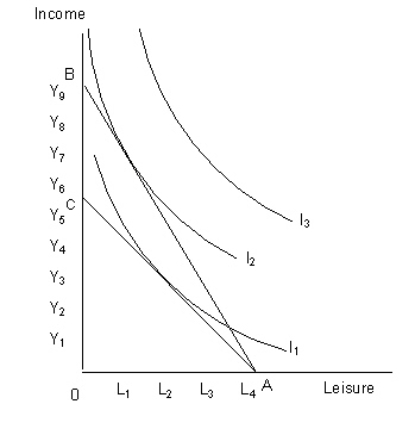 AB and AC: Income constraints of the individual
I1, I2, and I3 curves show the income leisure choices of the individual.
Which of the following factors is likely to be responsible for the inward rotation of the income constraint from AB to AC in Figure 29.6?
AB and AC: Income constraints of the individual
I1, I2, and I3 curves show the income leisure choices of the individual.
Which of the following factors is likely to be responsible for the inward rotation of the income constraint from AB to AC in Figure 29.6? (Multiple Choice)
4.7/5 (80)
(80) From an economist's viewpoint, discrimination occurs if there is a wage differential between two groups when there is no difference in the marginal revenue product of the two groups.
(True/False)
4.9/5 (74)
(74) A firm employing secretaries and steelworkers should ideally pay equal wages to both the groups of workers irrespective of the type of job each group does.
(True/False)
4.8/5 (72)
(72) Proponents of comparable worth justifies it on the ground that:
(Multiple Choice)
4.8/5 (72)
(72) Sometimes the only information that is available with the employers when they hire someone is information that may be imperfectly related to productivity in general and may not apply to a particular person at all.
(True/False)
4.8/5 (75)
(75) The labor-market-supply curve illustrates that, as the wage rate increases, the number of number of hours that each person is willing and able to work rises.
(True/False)
4.9/5 (86)
(86) Why are a large number of IT jobs being outsourced to China and India?
(Multiple Choice)
4.9/5 (89)
(89) A large number of U.S.firms send jobs to low-wage nations as it enables them to:
(Multiple Choice)
4.9/5 (79)
(79) Which of the following statements contradicts the upward-sloping market-supply curve?`
(Multiple Choice)
4.8/5 (75)
(75) Which of the following is a reason that some economists do not agree with the concept of a labor-leisure tradeoff?
(Multiple Choice)
4.8/5 (86)
(86) Statistical discrimination is legal under the disparate impact standard but illegal under the treatment standard.
(True/False)
4.8/5 (72)
(72) Which of the following statements best defines the economics of the so-called superstar effect in the labor market?
(Multiple Choice)
4.9/5 (82)
(82) A college student's choice of a major and an occupation reflects:
(Multiple Choice)
5.0/5 (79)
(79) If the supply of skilled workers is increased such that it is equal to the supply of unskilled workers, we can expect:
(Multiple Choice)
4.7/5 (63)
(63) 
Filters
- Essay(0)
- Multiple Choice(0)
- Short Answer(0)
- True False(0)
- Matching(0)