



 Chat with AI
Exam 50: The Labor Market

Exam 1: Economics: The World Around You90 Questions
Exam 2: Choice, Opportunity Costs, and Specialization94 Questions
Exam 3: Markets, Demand and Supply, and the Price System97 Questions
Exam 5: The Market System and the Private and Public Sector97 Questions
Exam 4: Elasticity: Demand and Supply126 Questions
Exam 6: National Income Accounting104 Questions
Exam 7: an Introduction to the Foreign Exchange Market and the Balance of Payments90 Questions
Exam 8: Consumer Choice132 Questions
Exam 9: Supply: The Costs of Doing Business106 Questions
Exam 10: Unemployment and Inflation129 Questions
Exam 11: Macroeconomic Equilibrium: Aggregate Demand and Supply122 Questions
Exam 12: Profit Maximization122 Questions
Exam 13: Aggregate Expenditures115 Questions
Exam 14: Perfect Competition135 Questions
Exam 15: Income and Expenditures Equilibrium134 Questions
Exam 16: Monopoly118 Questions
Exam 17: Fiscal Policy93 Questions
Exam 18: Monopolistic Competition and Oligopoly111 Questions
Exam 19: Antitrust and Regulation100 Questions
Exam 10: Money and Banking125 Questions
Exam 21: Market Failures, Government Failures, and Rent Seeking121 Questions
Exam 22: Monetary Policy141 Questions
Exam 23: Macroeconomic Policy: Tradeoffs, Expectations, Credibility, and Sources of Business Cycles112 Questions
Exam 24: Resource Markets112 Questions
Exam 25: Macroeconomic Viewpoints: New Keynesian, Monetarist, and New Classical99 Questions
Exam 26: The Labor Market114 Questions
Exam 27: Capital Markets100 Questions
Exam 28: Economic Growth99 Questions
Exam 29: Development Economics104 Questions
Exam 30: the Land Market and Natural Resources55 Questions
Exam 31: Aging, Social Security and Health Care88 Questions
Exam 32: Globalization84 Questions
Exam 33: Elasticity: Demand and Supply126 Questions
Exam 34: Income Distribution, Poverty and Government Policy115 Questions
Exam 35: World Trade Equilibrium112 Questions
Exam 36: Consumer Choice132 Questions
Exam 37: International Trade Restrictions109 Questions
Exam 38: World Trade Equilibrium112 Questions
Exam 39: Exchange Rates and Financial Links Between Countries132 Questions
Exam 40: International Trade Restrictions109 Questions
Exam 41: Supply: the Costs of Doing Business106 Questions
Exam 42: Exchange Rates and Financial Links Between Countries132 Questions
Exam 43: Profit Maximization122 Questions
Exam 44: Perfect Competition135 Questions
Exam 45: Monopoly118 Questions
Exam 46: Monopolistic Competition and Oligopoly111 Questions
Exam 47: Antitrust and Regulation100 Questions
Exam 48: Market Failures, Government Failures, and Rent Seeking121 Questions
Exam 49: Resource Markets112 Questions
Exam 50: The Labor Market114 Questions
Exam 51: Capital Markets100 Questions
Exam 52: The Land Market and Natural Resources55 Questions
Exam 53: Aging, Social Security and Health Care87 Questions
Exam 54: Income Distribution, Poverty and Government Policy115 Questions
Exam 55: World Trade Equilibrium112 Questions
Exam 56: International Trade Restrictions109 Questions
Exam 57: Exchange Rates and Financial Links Between Countries132 Questions
Select questions type


If the quantity demanded for labor is more than the quantity supplied, there will be unemployment.
(True/False)
4.8/5  (83)
(83) Supporters of comparable worth claim that market correctly allocates the workers in their best paid works.
(True/False)
4.9/5 (76)
(76) A compensating wage differential is a wage difference attributable to the difference in the marginal productivity of workers.
(True/False)
4.7/5 (84)
(84) Which of the following best explains the shape of the individual labor-supply curve?
(Multiple Choice)
4.8/5 (79)
(79) The ratio of the median income of college-to high school-educated workers is called the _____.
(Multiple Choice)
4.9/5 (86)
(86) The quantity of labor supplied by a particular wage earner will always increase as long as the wage rate increases.
(True/False)
4.9/5 (96)
(96) It is often profitable for the white-males to accept lower paying positions to avoid working with women.
(True/False)
4.8/5 (79)
(79) The figure given below shows the demand curves (D1 and D2)and supply curves (S1 and S2)of labor in the labor market. Figure: 29.2 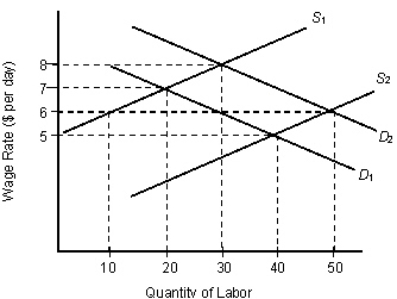 According to Figure 29.2, assume that the market is in an initial equilibrium in which the labor supply is S1 and the labor demand is D1.Then labor supply shifts from S1 to S2 but the wage remains at its previous equilibrium level.Which of the following is true?
 (Multiple Choice)
4.9/5 (77)
(77) People tend to remain in those occupations that require continuous time and financial commitments to remain productive.
(True/False)
4.9/5 (71)
(71) One of the major impacts of restricting immigration is that the:
(Multiple Choice)
4.9/5 (71)
(71) Economic theory suggests that the consumer-prejudice explanation for discrimination means that consumers will have to pay more to be served by employees of a specific group.
(True/False)
4.8/5 (82)
(82) It is said that a wage increase can have two opposing effects.Which of the following captures these two effects?
(Multiple Choice)
4.8/5 (75)
(75) Offshoring does not affect the percentage of U.S.workers employed in manufacturing.
(True/False)
4.8/5 (64)
(64) The policy of comparable worth has been more successful in the public sector than in the private sector.
(True/False)
4.9/5 (78)
(78) Suppose a tax rate of 10 percent applies to all income up to $20, 000 a year, income above $20, 000 up to $50, 000 a year is taxed at a rate of 15%, and income above $50, 000 a year is taxed at 20%.Calculate the absolute amount of tax paid by a person whose annual income is $30, 000.
(Multiple Choice)
4.8/5 (80)
(80) Which of the following determines comparable worth of a particular job?
(Multiple Choice)
4.7/5 (87)
(87) If an employer is a monopsonist, the imposition of a minimum wage set at a level that is less than the marginal revenue product but greater than the wage rate that the monopsonist wants to pay may actually increase the level of employment.
(True/False)
5.0/5 (80)
(80) 
Filters
- Essay(0)
- Multiple Choice(0)
- Short Answer(0)
- True False(0)
- Matching(0)