



 Chat with AI
Exam 54: Income Distribution, Poverty and Government Policy

Exam 1: Economics: The World Around You90 Questions
Exam 2: Choice, Opportunity Costs, and Specialization94 Questions
Exam 3: Markets, Demand and Supply, and the Price System97 Questions
Exam 5: The Market System and the Private and Public Sector97 Questions
Exam 4: Elasticity: Demand and Supply126 Questions
Exam 6: National Income Accounting104 Questions
Exam 7: an Introduction to the Foreign Exchange Market and the Balance of Payments90 Questions
Exam 8: Consumer Choice132 Questions
Exam 9: Supply: The Costs of Doing Business106 Questions
Exam 10: Unemployment and Inflation129 Questions
Exam 11: Macroeconomic Equilibrium: Aggregate Demand and Supply122 Questions
Exam 12: Profit Maximization122 Questions
Exam 13: Aggregate Expenditures115 Questions
Exam 14: Perfect Competition135 Questions
Exam 15: Income and Expenditures Equilibrium134 Questions
Exam 16: Monopoly118 Questions
Exam 17: Fiscal Policy93 Questions
Exam 18: Monopolistic Competition and Oligopoly111 Questions
Exam 19: Antitrust and Regulation100 Questions
Exam 10: Money and Banking125 Questions
Exam 21: Market Failures, Government Failures, and Rent Seeking121 Questions
Exam 22: Monetary Policy141 Questions
Exam 23: Macroeconomic Policy: Tradeoffs, Expectations, Credibility, and Sources of Business Cycles112 Questions
Exam 24: Resource Markets112 Questions
Exam 25: Macroeconomic Viewpoints: New Keynesian, Monetarist, and New Classical99 Questions
Exam 26: The Labor Market114 Questions
Exam 27: Capital Markets100 Questions
Exam 28: Economic Growth99 Questions
Exam 29: Development Economics104 Questions
Exam 30: the Land Market and Natural Resources55 Questions
Exam 31: Aging, Social Security and Health Care88 Questions
Exam 32: Globalization84 Questions
Exam 33: Elasticity: Demand and Supply126 Questions
Exam 34: Income Distribution, Poverty and Government Policy115 Questions
Exam 35: World Trade Equilibrium112 Questions
Exam 36: Consumer Choice132 Questions
Exam 37: International Trade Restrictions109 Questions
Exam 38: World Trade Equilibrium112 Questions
Exam 39: Exchange Rates and Financial Links Between Countries132 Questions
Exam 40: International Trade Restrictions109 Questions
Exam 41: Supply: the Costs of Doing Business106 Questions
Exam 42: Exchange Rates and Financial Links Between Countries132 Questions
Exam 43: Profit Maximization122 Questions
Exam 44: Perfect Competition135 Questions
Exam 45: Monopoly118 Questions
Exam 46: Monopolistic Competition and Oligopoly111 Questions
Exam 47: Antitrust and Regulation100 Questions
Exam 48: Market Failures, Government Failures, and Rent Seeking121 Questions
Exam 49: Resource Markets112 Questions
Exam 50: The Labor Market114 Questions
Exam 51: Capital Markets100 Questions
Exam 52: The Land Market and Natural Resources55 Questions
Exam 53: Aging, Social Security and Health Care87 Questions
Exam 54: Income Distribution, Poverty and Government Policy115 Questions
Exam 55: World Trade Equilibrium112 Questions
Exam 56: International Trade Restrictions109 Questions
Exam 57: Exchange Rates and Financial Links Between Countries132 Questions
Select questions type


Economic stagnation and recession result in unemployment and poverty.
(True/False)
4.9/5  (86)
(86) It has been observed that the most prosperous nations are those which have enjoyed stable democratic governments.This implies there is a link between a history of stable democracy and national well-being.
(True/False)
4.8/5 (77)
(77) Taxes are one method of funding the poverty alleviation programs by the government.Which of the following is an important impact of taxes?
(Multiple Choice)
4.8/5 (76)
(76) Unemployment insurance provided by the U.S.government is usually funded by:
(Multiple Choice)
4.8/5 (83)
(83) When a low-income individual receives a transfer payment, that individual has less of an incentive to forgo leisure time for work time.
(True/False)
4.9/5 (84)
(84) Assume that any given percentage of the population earns an equal percentage of real GDP.This percentage of population will be represented by:
(Multiple Choice)
4.8/5 (73)
(73) If 50 percent of the population receives 20 percent of the total income it can be represented by:
(Multiple Choice)
4.9/5 (69)
(69) The diagram that represents how income is distributed among members of a population is known as a(n):
(Multiple Choice)
4.8/5 (74)
(74) Consumer expenditures do not reflect the standard of people as efficiently as income inequality does.
(True/False)
4.9/5 (76)
(76) The figure below shows two Lorenz curves, Y and Z. Figure 33.1 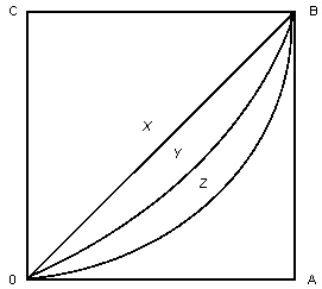 In Figure 33.1, which of the following could occur in the short run given the introduction of a regressive income tax?
 (Multiple Choice)
4.8/5 (85)
(85) Which of the following is a cash transfer received from the government?
(Multiple Choice)
4.7/5 (74)
(74) The welfare programs undertaken by the U.S.government has been universally successful in reducing poverty and fostering economic growth.
(True/False)
4.9/5 (67)
(67) The negative income tax had not gained political acceptability because:
(Multiple Choice)
4.8/5 (77)
(77) In order to ensure that the poor countries experience higher levels of economic growth, private property rights and title to property have to be created.
(True/False)
4.9/5 (75)
(75) Income distribution across the world is highly uneven, hence the corresponding Gini coefficient is very small.
(True/False)
4.8/5 (70)
(70) The table given below shows the absolute tax amounts under five different tax policies for respective income levels. Table 33.2
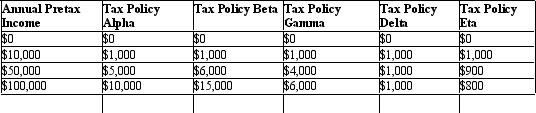 Refer to Table 33.2.The example of a progressive tax is the:
 (Multiple Choice)
4.8/5 (90)
(90) Markets can function efficiently only when the private property rights are completely suspended and every resource in the economy is a commonly owned resource.
(True/False)
4.9/5 (92)
(92) The incentives created by foreign aid are analogous to the incentives created by the welfare systems and so might not be conducive to economic growth.
(True/False)
4.7/5 (80)
(80) 
Filters
- Essay(0)
- Multiple Choice(0)
- Short Answer(0)
- True False(0)
- Matching(0)