



 Chat with AI
Exam 54: Income Distribution, Poverty and Government Policy

Exam 1: Economics: The World Around You90 Questions
Exam 2: Choice, Opportunity Costs, and Specialization94 Questions
Exam 3: Markets, Demand and Supply, and the Price System97 Questions
Exam 5: The Market System and the Private and Public Sector97 Questions
Exam 4: Elasticity: Demand and Supply126 Questions
Exam 6: National Income Accounting104 Questions
Exam 7: an Introduction to the Foreign Exchange Market and the Balance of Payments90 Questions
Exam 8: Consumer Choice132 Questions
Exam 9: Supply: The Costs of Doing Business106 Questions
Exam 10: Unemployment and Inflation129 Questions
Exam 11: Macroeconomic Equilibrium: Aggregate Demand and Supply122 Questions
Exam 12: Profit Maximization122 Questions
Exam 13: Aggregate Expenditures115 Questions
Exam 14: Perfect Competition135 Questions
Exam 15: Income and Expenditures Equilibrium134 Questions
Exam 16: Monopoly118 Questions
Exam 17: Fiscal Policy93 Questions
Exam 18: Monopolistic Competition and Oligopoly111 Questions
Exam 19: Antitrust and Regulation100 Questions
Exam 10: Money and Banking125 Questions
Exam 21: Market Failures, Government Failures, and Rent Seeking121 Questions
Exam 22: Monetary Policy141 Questions
Exam 23: Macroeconomic Policy: Tradeoffs, Expectations, Credibility, and Sources of Business Cycles112 Questions
Exam 24: Resource Markets112 Questions
Exam 25: Macroeconomic Viewpoints: New Keynesian, Monetarist, and New Classical99 Questions
Exam 26: The Labor Market114 Questions
Exam 27: Capital Markets100 Questions
Exam 28: Economic Growth99 Questions
Exam 29: Development Economics104 Questions
Exam 30: the Land Market and Natural Resources55 Questions
Exam 31: Aging, Social Security and Health Care88 Questions
Exam 32: Globalization84 Questions
Exam 33: Elasticity: Demand and Supply126 Questions
Exam 34: Income Distribution, Poverty and Government Policy115 Questions
Exam 35: World Trade Equilibrium112 Questions
Exam 36: Consumer Choice132 Questions
Exam 37: International Trade Restrictions109 Questions
Exam 38: World Trade Equilibrium112 Questions
Exam 39: Exchange Rates and Financial Links Between Countries132 Questions
Exam 40: International Trade Restrictions109 Questions
Exam 41: Supply: the Costs of Doing Business106 Questions
Exam 42: Exchange Rates and Financial Links Between Countries132 Questions
Exam 43: Profit Maximization122 Questions
Exam 44: Perfect Competition135 Questions
Exam 45: Monopoly118 Questions
Exam 46: Monopolistic Competition and Oligopoly111 Questions
Exam 47: Antitrust and Regulation100 Questions
Exam 48: Market Failures, Government Failures, and Rent Seeking121 Questions
Exam 49: Resource Markets112 Questions
Exam 50: The Labor Market114 Questions
Exam 51: Capital Markets100 Questions
Exam 52: The Land Market and Natural Resources55 Questions
Exam 53: Aging, Social Security and Health Care87 Questions
Exam 54: Income Distribution, Poverty and Government Policy115 Questions
Exam 55: World Trade Equilibrium112 Questions
Exam 56: International Trade Restrictions109 Questions
Exam 57: Exchange Rates and Financial Links Between Countries132 Questions
Select questions type


The figure given below shows the Lorenz curves of two countries (Country A and Country B). Figure 33.2
Total income (cumulative percentage) 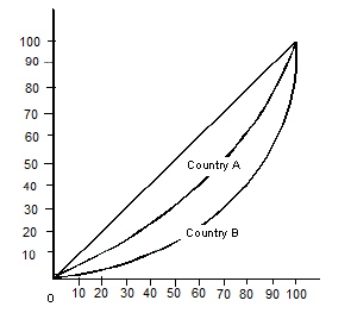 Total population (cumuative percentage)
In Figure 33.2, the richest 20 percent of the population in Country B receive:
Total population (cumuative percentage)
In Figure 33.2, the richest 20 percent of the population in Country B receive: (Multiple Choice)
4.8/5  (82)
(82) The allocations of goods and services from one group in a society to another are called:
(Multiple Choice)
4.7/5 (87)
(87) Experiences of Russia and China prove that, greater the governmental intervention in the market, more equal will be the income distribution in the economy.
(True/False)
4.9/5 (84)
(84) If for each dollar earned, $0.50 is taken out of the transfer received by a family of four, the negative income tax rate is 50 percent.
(True/False)
4.9/5 (64)
(64) The world Lorenz curve coincides with the line of income equality because the average income of the different countries are more or less equal.
(True/False)
4.8/5 (74)
(74) According to the Bureau of Labor Statistics, the distribution of consumption expenditures had a HiLo ratio of 3.8 in 2008 in contrast to the income ratio of 14.1.What can be inferred from the above statement?
(Multiple Choice)
4.9/5 (81)
(81) The figure given below shows the Lorenz curves of two countries (Country A and Country B). Figure 33.2
Total income (cumulative percentage) 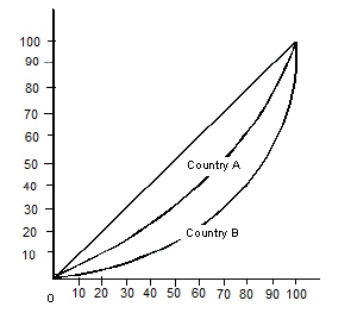 Total population (cumuative percentage)
In Figure 33.2, the poorest 60 percent of the population in Country B receive:
Total population (cumuative percentage)
In Figure 33.2, the poorest 60 percent of the population in Country B receive: (Multiple Choice)
4.9/5 (89)
(89) Unemployment insurance programs provide benefits to permanently unemployed people.
(True/False)
4.8/5 (84)
(84) In Country X, the highest 10 percent of families account for 70 percent of income.In Country Y, the highest 10 percent of families account for 20 percent of income.In this example:
(Multiple Choice)
4.8/5 (79)
(79) The main transfer programs of the U.S.government include each of the following, except:
(Multiple Choice)
4.8/5 (80)
(80) Someone who has the desire to work but has no exceptional abilities and has not acquired the skills necessary for a well-paying job is likely to escape poverty completely.
(True/False)
4.9/5 (80)
(80) The higher the HiLo ratio, the more the top income quintile earns relative to the bottom quintile.
(True/False)
4.9/5 (91)
(91) A proportional tax is a tax whose rate increases as the tax base widens.
(True/False)
4.9/5 (70)
(70) The figure given below shows the Lorenz curves of two countries (Country A and Country B). Figure 33.2
Total income (cumulative percentage) 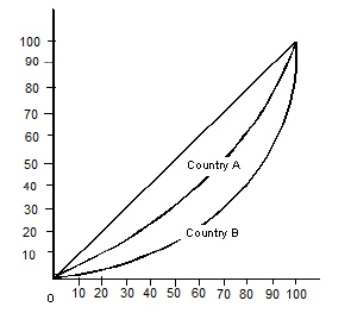 Total population (cumuative percentage)
Refer to Figure 33.2.The richest 20 percent of the population in Country A receive:
Total population (cumuative percentage)
Refer to Figure 33.2.The richest 20 percent of the population in Country A receive: (Multiple Choice)
4.9/5 (85)
(85) It is often found that there is a sufficient mobility within the income distribution such that a person in the lowest quintile of income can move to the higher ones and vice versa.
(True/False)
4.8/5 (74)
(74) If the Gini co-efficient for any economy is 0.85, which of the following statements is true?
(Multiple Choice)
4.7/5 (71)
(71) The horizontal and vertical axes of the Lorenz curve respectively measure:
(Multiple Choice)
4.8/5 (83)
(83) 
Filters
- Essay(0)
- Multiple Choice(0)
- Short Answer(0)
- True False(0)
- Matching(0)