



 Chat with AI
Exam 5: Externalities, environmental Policy, and Public Goods

Exam 1: Economics: Foundations and Models447 Questions
Exam 2: Trade-Offs, comparative Advantage, and the Market System492 Questions
Exam 3: Where Prices Come From: the Interaction of Demand and Supply476 Questions
Exam 4: Economic Efficiency, government Price Setting, and Taxes420 Questions
Exam 5: Externalities, environmental Policy, and Public Goods263 Questions
Exam 6: Elasticity: the Responsiveness of Demand and Supply294 Questions
Exam 7: The Economics of Health Care338 Questions
Exam 8: Firms,the Stock Market,and Corporate Governance522 Questions
Exam 9: Comparative Advantage and the Gains From International Trade377 Questions
Exam 10: Consumer Choice and Behavioral Economics300 Questions
Exam 11: Technology,production,and Costs327 Questions
Exam 12: Firms in Perfectly Competitive Markets296 Questions
Exam 13: Monopolistic Competition: the Competitive Model in a More Realistic Setting272 Questions
Exam 14: Oligopoly: Firms in Less Competitive Markets258 Questions
Exam 15: Monopoly and Antitrust Policy279 Questions
Exam 16: Pricing Strategy261 Questions
Exam 17: The Markets for Labor and Other Factors of Production281 Questions
Exam 18: Public Choice, taxes, and the Distribution of Income258 Questions
Exam 19: Gdp: Measuring Total Production and Income261 Questions
Exam 20: Unemployment and Inflation291 Questions
Exam 21: Economic Growth, the Financial System, and Business Cycles253 Questions
Exam 22: Long-Run Economic Growth: Sources and Policies262 Questions
Exam 23: Aggregate Expenditure and Output in the Short Run301 Questions
Exam 24: Aggregate Demand and Aggregate Supply Analysis286 Questions
Exam 25: Money,banks,and the Federal Reserve System281 Questions
Exam 26: Monetary Policy275 Questions
Exam 27: Fiscal Policy306 Questions
Exam 28: Inflation, unemployment, and Federal Reserve Policy257 Questions
Exam 29: Macroeconomics in an Open Economy278 Questions
Exam 30: The International Financial System258 Questions
Select questions type


Which of the following statements about the economically efficient level of air pollution is correct?
(Multiple Choice)
4.9/5  (97)
(97) 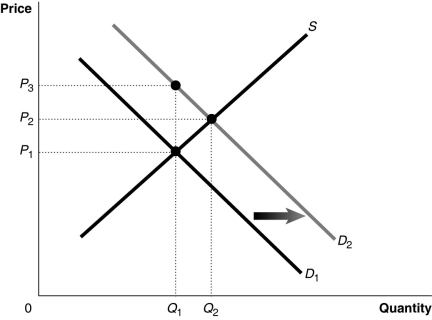 Figure 5-5 shows a market with an externality.The current market equilibrium output of Q1 is not the economically efficient output.The economically efficient output is Q2.
-Refer to Figure 5-5.If,because of an externality,the economically efficient output is Q2 and not the current equilibrium output of Q1,what does D1 represent?
Figure 5-5 shows a market with an externality.The current market equilibrium output of Q1 is not the economically efficient output.The economically efficient output is Q2.
-Refer to Figure 5-5.If,because of an externality,the economically efficient output is Q2 and not the current equilibrium output of Q1,what does D1 represent? (Multiple Choice)
4.9/5 (89)
(89) Global warming refers to the effect of global pollutants such as carbon dioxide on climates on the earth.Climate-induced changes in temperatures affect,among other things,agriculture.Which of the following is a reason why policymakers are still debating if this problem should be addressed and how it should be addressed?
(Multiple Choice)
4.9/5 (79)
(79) What are transactions costs? Why do transactions costs create difficulties in finding a private solution to the problem of pollution?
(Essay)
4.7/5 (78)
(78) The social cost of cutting trees for firewood in a government forest is
(Multiple Choice)
4.8/5 (91)
(91) If you burn your trash in the backyard in spite of regulations against it,then you are
(Multiple Choice)
4.8/5 (88)
(88) Which of the following could be evidence of a market failure?
(Multiple Choice)
4.9/5 (84)
(84) A quasi-public good is similar to a public good in that one person's consumption of the quasi-public good does not reduce the amount available for everyone else.
(True/False)
5.0/5 (88)
(88) If there are no externalities,a competitive market achieves economic efficiency.If there is a negative externality,economic efficiency will not be achieved because
(Multiple Choice)
4.8/5 (81)
(81) Consider the following methods of pollution reduction: a.the government sets a target for maximum emissions
B.the government mandates the installation of specific pollution abatement equipment
C.the government imposes a per unit tax on the good that creates pollution
D.the government gives firms a tax rebate for every unit of pollution abated
Which of the above is an example of a command-and-control approach to reducing pollution?
(Multiple Choice)
4.8/5 (82)
(82) 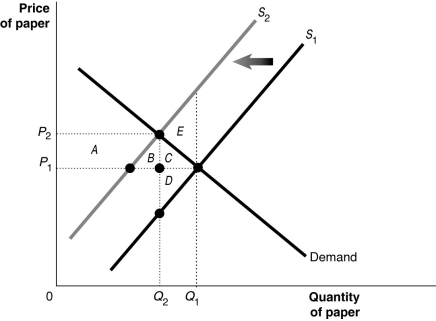 Suppose there are several paper mills producing paper for a market.These mills,located upstream from a fishing village,discharge a large amount of wastewater into the river.The waste material affects the number of fish in the river and the use of the river for recreation and as a public water supply source.Figure 5-4 shows the paper market.Use this Figure to answer the following question(s).
-Refer to Figure 5-4.What does S2 represent?
Suppose there are several paper mills producing paper for a market.These mills,located upstream from a fishing village,discharge a large amount of wastewater into the river.The waste material affects the number of fish in the river and the use of the river for recreation and as a public water supply source.Figure 5-4 shows the paper market.Use this Figure to answer the following question(s).
-Refer to Figure 5-4.What does S2 represent? (Multiple Choice)
4.7/5 (76)
(76) Some policymakers have argued that products like cigarettes,alcohol,and sweetened soda generate negative externalities in consumption.If the government decided to impose a tax on soda,the government will cause
(Multiple Choice)
4.9/5 (88)
(88) What is the rationale behind a marketable emission allowance scheme?
(Multiple Choice)
4.7/5 (67)
(67) Medical research that results in a cure for a serious disease produces positive externalities.What is the impact of this positive externality on economic efficiency?
(Multiple Choice)
4.8/5 (92)
(92) Which of the following activities create a negative externality?
(Multiple Choice)
4.9/5 (62)
(62) Figure 5-3 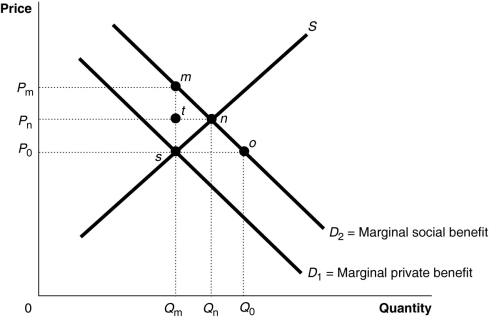 -Refer to Figure 5-3.The efficient output level is
 (Multiple Choice)
4.8/5 (83)
(83) If the marginal benefit of reducing emissions of some air pollutant is less than the marginal cost
(Multiple Choice)
4.9/5 (85)
(85) 
Filters
- Essay(0)
- Multiple Choice(0)
- Short Answer(0)
- True False(0)
- Matching(0)