



 Chat with AI
Exam 5: Externalities, environmental Policy, and Public Goods

Exam 1: Economics: Foundations and Models447 Questions
Exam 2: Trade-Offs, comparative Advantage, and the Market System492 Questions
Exam 3: Where Prices Come From: the Interaction of Demand and Supply476 Questions
Exam 4: Economic Efficiency, government Price Setting, and Taxes420 Questions
Exam 5: Externalities, environmental Policy, and Public Goods263 Questions
Exam 6: Elasticity: the Responsiveness of Demand and Supply294 Questions
Exam 7: The Economics of Health Care338 Questions
Exam 8: Firms,the Stock Market,and Corporate Governance522 Questions
Exam 9: Comparative Advantage and the Gains From International Trade377 Questions
Exam 10: Consumer Choice and Behavioral Economics300 Questions
Exam 11: Technology,production,and Costs327 Questions
Exam 12: Firms in Perfectly Competitive Markets296 Questions
Exam 13: Monopolistic Competition: the Competitive Model in a More Realistic Setting272 Questions
Exam 14: Oligopoly: Firms in Less Competitive Markets258 Questions
Exam 15: Monopoly and Antitrust Policy279 Questions
Exam 16: Pricing Strategy261 Questions
Exam 17: The Markets for Labor and Other Factors of Production281 Questions
Exam 18: Public Choice, taxes, and the Distribution of Income258 Questions
Exam 19: Gdp: Measuring Total Production and Income261 Questions
Exam 20: Unemployment and Inflation291 Questions
Exam 21: Economic Growth, the Financial System, and Business Cycles253 Questions
Exam 22: Long-Run Economic Growth: Sources and Policies262 Questions
Exam 23: Aggregate Expenditure and Output in the Short Run301 Questions
Exam 24: Aggregate Demand and Aggregate Supply Analysis286 Questions
Exam 25: Money,banks,and the Federal Reserve System281 Questions
Exam 26: Monetary Policy275 Questions
Exam 27: Fiscal Policy306 Questions
Exam 28: Inflation, unemployment, and Federal Reserve Policy257 Questions
Exam 29: Macroeconomics in an Open Economy278 Questions
Exam 30: The International Financial System258 Questions
Select questions type


Some environmentalists have criticized tradable emission allowances on the grounds that they give permit holders a license to pollute.Furthermore,environmentalists argue that those who sell their permits receive a monetary benefit from their contribution to polluting the environment.Use economic reasoning to evaluate this criticism.
(Essay)
4.8/5  (87)
(87) Assume that production from an electric utility caused acid rain.If the government imposed a tax on the utility equal to the marginal external cost of the acid rain,the government's action would
(Multiple Choice)
4.8/5 (82)
(82) Figure 5-3 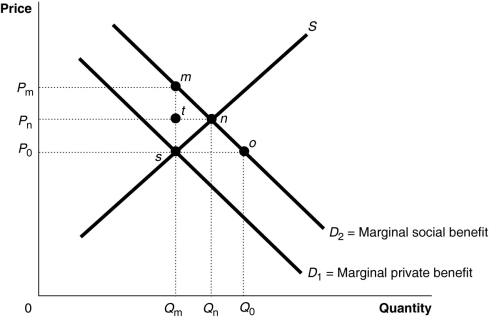 -Refer to Figure 5-3.The size of marginal external benefits can be determined by
 (Multiple Choice)
4.8/5 (92)
(92) Goods can be classified on the basis of whether their consumption is
(Multiple Choice)
4.9/5 (71)
(71) Applying Coase's theorem,if the cost to you from having the airplane seat in front of you reclined is ________ the benefit to the reclining passenger,you should ________.
(Multiple Choice)
4.9/5 (72)
(72)  Amit and Bree are the only two homeowners on an isolated private road.Both agree that installing street lights along the road would be beneficial and want to do so.Figure 5-16 shows their willingness to pay for different quantities of street lights,the market demand for street lights,and the marginal cost of installing the street lights.
-Refer to Figure 5-16.How much is Bree willing to pay per street light to have 4 street lights installed?
Amit and Bree are the only two homeowners on an isolated private road.Both agree that installing street lights along the road would be beneficial and want to do so.Figure 5-16 shows their willingness to pay for different quantities of street lights,the market demand for street lights,and the marginal cost of installing the street lights.
-Refer to Figure 5-16.How much is Bree willing to pay per street light to have 4 street lights installed? (Multiple Choice)
4.9/5 (80)
(80) Figure 5-3
-Refer to Figure 5-3.In the absence of any government intervention,the private market
-Refer to Figure 5-3.In the absence of any government intervention,the private market (Multiple Choice)
4.7/5 (87)
(87) Define the tragedy of the commons.Give three examples of common resources.Briefly explain why common property resources are subject to overuse.
(Essay)
5.0/5 (82)
(82) Ronald Coase is famous for the Coase Theorem,which is based on the premise that there is an economically efficient level of pollution reduction.Many economists believe that the tradable emissions allowance program that has been used to deal with the problem of acid rain has been successful in reducing emissions of sulfur dioxide in an economically efficient manner.Why isn't this program an example of the Coase Theorem?
(Essay)
4.8/5 (87)
(87) State and local governments subsidize college students with grants and low-interest loans.The loans and subsidies are examples of
(Multiple Choice)
4.9/5 (63)
(63)  Figure 5-13 illustrates the market for gasoline before and after the government imposes a tax to bring about the efficient level of gasoline production.
-Refer to Figure 5-13.The market equilibrium quantity of gasoline is ________ million gallons per month.
Figure 5-13 illustrates the market for gasoline before and after the government imposes a tax to bring about the efficient level of gasoline production.
-Refer to Figure 5-13.The market equilibrium quantity of gasoline is ________ million gallons per month. (Multiple Choice)
4.9/5 (78)
(78) Which of the following is a possible solution when a scarce resource is subject to the tragedy of the commons?
(Multiple Choice)
4.9/5 (80)
(80) 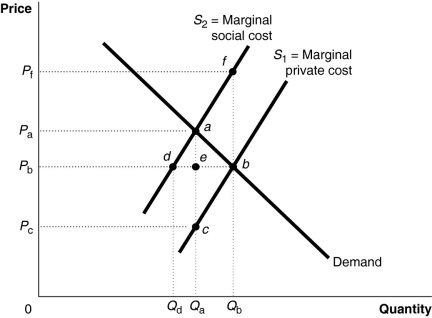 Figure 5-2 shows a market with a negative externality.
-Refer to Figure 5-2.The size of marginal external costs can be determined by
Figure 5-2 shows a market with a negative externality.
-Refer to Figure 5-2.The size of marginal external costs can be determined by (Multiple Choice)
4.9/5 (71)
(71) A negative externality is an example of market failure.The root of the problem lies in the definition and enforcement of property rights.Explain.
(Essay)
4.9/5 (90)
(90) A modern example of the tragedy of the commons is the forests in many poor countries.
(True/False)
4.9/5 (66)
(66) Figure 5-7  -Refer to Figure 5-7.What is the incremental cost of increasing the quantity of pollution reduction from QB to QE units?
 (Multiple Choice)
4.9/5 (81)
(81) Suppose a tax equal to the value of the marginal external cost at the optimal output is imposed on a pollution generating good.All of the following will result from the tax except
(Multiple Choice)
4.9/5 (69)
(69) 
Filters
- Essay(0)
- Multiple Choice(0)
- Short Answer(0)
- True False(0)
- Matching(0)