



 Chat with AI
Exam 5: Externalities, environmental Policy, and Public Goods

Exam 1: Economics: Foundations and Models447 Questions
Exam 2: Trade-Offs, comparative Advantage, and the Market System492 Questions
Exam 3: Where Prices Come From: the Interaction of Demand and Supply476 Questions
Exam 4: Economic Efficiency, government Price Setting, and Taxes420 Questions
Exam 5: Externalities, environmental Policy, and Public Goods263 Questions
Exam 6: Elasticity: the Responsiveness of Demand and Supply294 Questions
Exam 7: The Economics of Health Care338 Questions
Exam 8: Firms,the Stock Market,and Corporate Governance522 Questions
Exam 9: Comparative Advantage and the Gains From International Trade377 Questions
Exam 10: Consumer Choice and Behavioral Economics300 Questions
Exam 11: Technology,production,and Costs327 Questions
Exam 12: Firms in Perfectly Competitive Markets296 Questions
Exam 13: Monopolistic Competition: the Competitive Model in a More Realistic Setting272 Questions
Exam 14: Oligopoly: Firms in Less Competitive Markets258 Questions
Exam 15: Monopoly and Antitrust Policy279 Questions
Exam 16: Pricing Strategy261 Questions
Exam 17: The Markets for Labor and Other Factors of Production281 Questions
Exam 18: Public Choice, taxes, and the Distribution of Income258 Questions
Exam 19: Gdp: Measuring Total Production and Income261 Questions
Exam 20: Unemployment and Inflation291 Questions
Exam 21: Economic Growth, the Financial System, and Business Cycles253 Questions
Exam 22: Long-Run Economic Growth: Sources and Policies262 Questions
Exam 23: Aggregate Expenditure and Output in the Short Run301 Questions
Exam 24: Aggregate Demand and Aggregate Supply Analysis286 Questions
Exam 25: Money,banks,and the Federal Reserve System281 Questions
Exam 26: Monetary Policy275 Questions
Exam 27: Fiscal Policy306 Questions
Exam 28: Inflation, unemployment, and Federal Reserve Policy257 Questions
Exam 29: Macroeconomics in an Open Economy278 Questions
Exam 30: The International Financial System258 Questions
Select questions type


Suppose a negative externality exists in a market.If transactions costs are low and parties are willing to bargain then,according to the Coase theorem
(Multiple Choice)
4.9/5  (72)
(72) Congress passed the Clean Air Act in 1970.Since this act was passed,emissions of the six main air pollutants
(Multiple Choice)
4.8/5 (84)
(84) Which of the following is an example of a nonexcludable product?
(Multiple Choice)
4.8/5 (83)
(83) 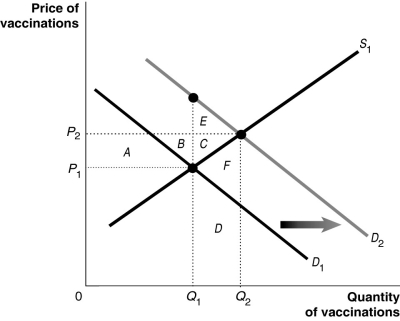 Figure 5-6 shows the market for measles vaccinations,a product whose use generates positive externalities.
-Refer to Figure 5-6.Why is there a deadweight loss?
Figure 5-6 shows the market for measles vaccinations,a product whose use generates positive externalities.
-Refer to Figure 5-6.Why is there a deadweight loss? (Multiple Choice)
4.8/5 (71)
(71) Figure 5-7  -Refer to Figure 5-7.Which of the following statements is true?
 (Multiple Choice)
4.7/5 (85)
(85) Goods differ on the basis of whether their consumption is rival and excludable.Explain the terms "rivalry" and "excludability" as they are used to define goods.List the four categories of goods,and define these categories in terms of rivalry and excludability.
(Essay)
4.9/5 (83)
(83) Figure 5-6 shows the market for measles vaccinations,a product whose use generates positive externalities.
-Refer to Figure 5-6.What is the deadweight loss resulting from producing at the market equilibrium?
Figure 5-6 shows the market for measles vaccinations,a product whose use generates positive externalities.
-Refer to Figure 5-6.What is the deadweight loss resulting from producing at the market equilibrium? (Multiple Choice)
4.8/5 (74)
(74)  Companies producing toilet paper bleach the paper to make it white.The bleach is discharged into rivers and lakes and causes substantial environmental damage.Figure 5-9 illustrates the situation in the toilet paper market.
-Refer to Figure 5-9.Suppose the government wants to use a Pigovian tax to bring about the efficient level of production.What should the value of the tax be?
Companies producing toilet paper bleach the paper to make it white.The bleach is discharged into rivers and lakes and causes substantial environmental damage.Figure 5-9 illustrates the situation in the toilet paper market.
-Refer to Figure 5-9.Suppose the government wants to use a Pigovian tax to bring about the efficient level of production.What should the value of the tax be? (Multiple Choice)
4.9/5 (84)
(84) How does a positive externality in consumption reduce economic efficiency?
(Essay)
4.9/5 (76)
(76) Figure 5-6 shows the market for measles vaccinations,a product whose use generates positive externalities.
-Refer to Figure 5-6.What does D2 represent?
Figure 5-6 shows the market for measles vaccinations,a product whose use generates positive externalities.
-Refer to Figure 5-6.What does D2 represent? (Multiple Choice)
4.8/5 (72)
(72) Compare two situations.(A)A firm is not legally responsible for damages that result from air pollution caused by its production of steel.(B)A firm is legally responsible for damages that result from its production of steel.Ronald Coase argued that if the property rights are assigned and transactions costs are low
(Multiple Choice)
4.9/5 (74)
(74) Because producers do not bear the external cost of pollution
(Multiple Choice)
4.8/5 (64)
(64) Explain how the decision by parents to not immunize their children,hoping that their children will not get sick because other parents have had their children immunized,is an example of free riding.How is this behavior dangerous to the public?
(Essay)
4.8/5 (84)
(84)  Consider a chemical plant that discharges toxic fumes over a nearby community.To reduce the emissions of toxic fumes the firm can install pollution abatement devices.Figure 5-8 shows the marginal benefit and the marginal cost from reducing the toxic fumes emissions.
-Refer to Figure 5-8.Suppose the emissions reduction target is currently established at 8 million tons.What is the area that represents the cost of eliminating an additional 1 million tons?
Consider a chemical plant that discharges toxic fumes over a nearby community.To reduce the emissions of toxic fumes the firm can install pollution abatement devices.Figure 5-8 shows the marginal benefit and the marginal cost from reducing the toxic fumes emissions.
-Refer to Figure 5-8.Suppose the emissions reduction target is currently established at 8 million tons.What is the area that represents the cost of eliminating an additional 1 million tons? (Multiple Choice)
4.9/5 (79)
(79) The marginal social cost of a good or service is the cost borne by the producer.
(True/False)
4.8/5 (83)
(83) When there is a positive externality in a free market,too much of the good is produced and consumed.
(True/False)
4.8/5 (88)
(88) 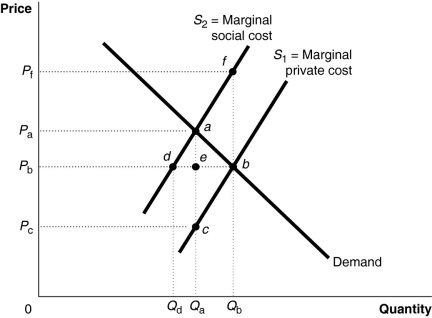 Figure 5-2 shows a market with a negative externality.
-Refer to Figure 5-2.The marginal benefit of the last unit produced is represented by the price
Figure 5-2 shows a market with a negative externality.
-Refer to Figure 5-2.The marginal benefit of the last unit produced is represented by the price (Multiple Choice)
4.9/5 (81)
(81) 
Filters
- Essay(0)
- Multiple Choice(0)
- Short Answer(0)
- True False(0)
- Matching(0)