



 Chat with AI
Exam 5: Externalities, environmental Policy, and Public Goods

Exam 1: Economics: Foundations and Models447 Questions
Exam 2: Trade-Offs, comparative Advantage, and the Market System492 Questions
Exam 3: Where Prices Come From: the Interaction of Demand and Supply476 Questions
Exam 4: Economic Efficiency, government Price Setting, and Taxes420 Questions
Exam 5: Externalities, environmental Policy, and Public Goods263 Questions
Exam 6: Elasticity: the Responsiveness of Demand and Supply294 Questions
Exam 7: The Economics of Health Care338 Questions
Exam 8: Firms,the Stock Market,and Corporate Governance522 Questions
Exam 9: Comparative Advantage and the Gains From International Trade377 Questions
Exam 10: Consumer Choice and Behavioral Economics300 Questions
Exam 11: Technology,production,and Costs327 Questions
Exam 12: Firms in Perfectly Competitive Markets296 Questions
Exam 13: Monopolistic Competition: the Competitive Model in a More Realistic Setting272 Questions
Exam 14: Oligopoly: Firms in Less Competitive Markets258 Questions
Exam 15: Monopoly and Antitrust Policy279 Questions
Exam 16: Pricing Strategy261 Questions
Exam 17: The Markets for Labor and Other Factors of Production281 Questions
Exam 18: Public Choice, taxes, and the Distribution of Income258 Questions
Exam 19: Gdp: Measuring Total Production and Income261 Questions
Exam 20: Unemployment and Inflation291 Questions
Exam 21: Economic Growth, the Financial System, and Business Cycles253 Questions
Exam 22: Long-Run Economic Growth: Sources and Policies262 Questions
Exam 23: Aggregate Expenditure and Output in the Short Run301 Questions
Exam 24: Aggregate Demand and Aggregate Supply Analysis286 Questions
Exam 25: Money,banks,and the Federal Reserve System281 Questions
Exam 26: Monetary Policy275 Questions
Exam 27: Fiscal Policy306 Questions
Exam 28: Inflation, unemployment, and Federal Reserve Policy257 Questions
Exam 29: Macroeconomics in an Open Economy278 Questions
Exam 30: The International Financial System258 Questions
Select questions type


Which of the following would result in a positive externality?
(Multiple Choice)
4.9/5  (87)
(87) Economists Kenneth Chay and Michael Greenstone found that in the two years following the passage of the Clean Air Act of 1970,the sharp reduction in air pollution also led to a decline in infant deaths.Although this and other studies provide compelling evidence of the link between pollution and infant health,it is not clear that reductions from the much lower levels of ambient pollution today would have the same effect.Which of the following reasons could explain this?
(Multiple Choice)
4.8/5 (102)
(102) When a tax on output is imposed to internalize the external costs of pollution,the supply curve shifts down by the amount of the tax.
(True/False)
4.9/5 (81)
(81) In England during the Middle Ages each village had an area of pasture on which any family in the village was allowed to graze its cows and sheep without charge.Eventually,the grass in the pasture would be depleted and no family's cow or sheep would get enough to eat.The reason the grass was depleted was
(Multiple Choice)
4.7/5 (72)
(72) What is a Pigovian tax? What happens to deadweight loss when a Pigovian tax is implemented?
(Essay)
5.0/5 (70)
(70) 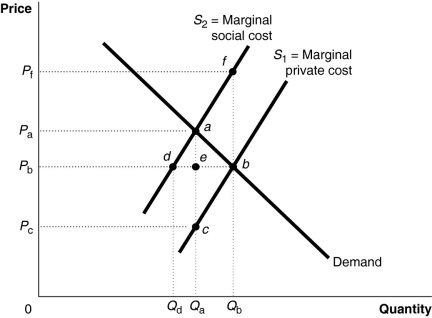 Figure 5-2 shows a market with a negative externality.
-Refer to Figure 5-2.The deadweight loss due to the externality is represented by the area
Figure 5-2 shows a market with a negative externality.
-Refer to Figure 5-2.The deadweight loss due to the externality is represented by the area (Multiple Choice)
4.9/5 (86)
(86) Economic incentives are designed to make individual self-interest coincide with social interest.According to economists,which of the following methods of pollution control best uses economic incentives to reduce pollution?
(Multiple Choice)
4.7/5 (80)
(80) When there is a negative externality,the competitive output is greater than the economically efficient output level.
(True/False)
4.8/5 (76)
(76) Kenneth Chay and Michael Greenstone examined the impact of reductions in air pollution since the passage of the Clean Air Act of 1970.Which of the following statements summarizes their findings?
(Multiple Choice)
4.8/5 (83)
(83) Which of the following criteria should be used to evaluate if government intervention in a market for the purpose of environmental protection is justified?
(Multiple Choice)
4.7/5 (77)
(77) Alternative approaches for reducing carbon dioxide emissions are
(Multiple Choice)
5.0/5 (88)
(88) A major problem with using a tradable emission allowances system to control pollution is
(Multiple Choice)
4.7/5 (74)
(74) 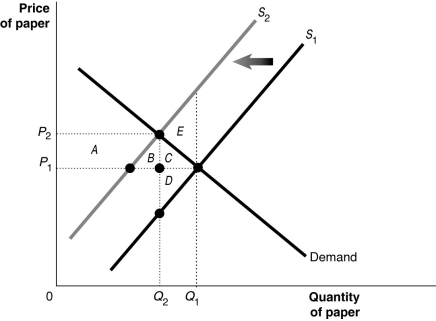 Suppose there are several paper mills producing paper for a market.These mills,located upstream from a fishing village,discharge a large amount of wastewater into the river.The waste material affects the number of fish in the river and the use of the river for recreation and as a public water supply source.Figure 5-4 shows the paper market.Use this Figure to answer the following question(s).
-Refer to Figure 5-4.What is the deadweight loss from producing at the market equilibrium?
Suppose there are several paper mills producing paper for a market.These mills,located upstream from a fishing village,discharge a large amount of wastewater into the river.The waste material affects the number of fish in the river and the use of the river for recreation and as a public water supply source.Figure 5-4 shows the paper market.Use this Figure to answer the following question(s).
-Refer to Figure 5-4.What is the deadweight loss from producing at the market equilibrium? (Multiple Choice)
4.8/5 (83)
(83) 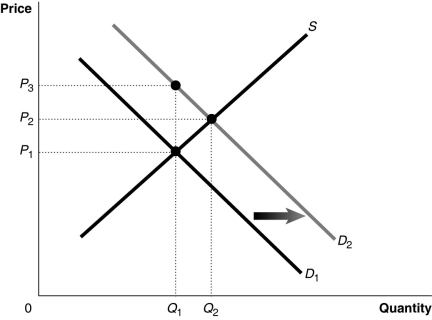 Figure 5-5 shows a market with an externality.The current market equilibrium output of Q1 is not the economically efficient output.The economically efficient output is Q2.
-Refer to Figure 5-5.If,because of an externality,the economically efficient output is Q2 and not the current equilibrium output of Q1,what does D2 represent?
Figure 5-5 shows a market with an externality.The current market equilibrium output of Q1 is not the economically efficient output.The economically efficient output is Q2.
-Refer to Figure 5-5.If,because of an externality,the economically efficient output is Q2 and not the current equilibrium output of Q1,what does D2 represent? (Multiple Choice)
4.9/5 (81)
(81) Haiti was once a heavily forested country.Today,80 percent of Haiti's forests have been cut down,primarily to be burned to create charcoal.The reduction in the number of trees has lead to devastating floods when it rains heavily.This is an example of
(Multiple Choice)
4.9/5 (76)
(76) What is a private benefit from consumption? What is a social benefit from consumption? When is the private benefit from consumption equal to the social benefit from consumption?
(Essay)
4.7/5 (79)
(79)  Figure 5-15 shows the market for Atlantic salmon,a common resource.The current market equilibrium output of Q1 is not the economically efficient output.The economically efficient output is Q2.
-Refer to Figure 5-15.Identify the area that shows the deadweight loss from overfishing.
Figure 5-15 shows the market for Atlantic salmon,a common resource.The current market equilibrium output of Q1 is not the economically efficient output.The economically efficient output is Q2.
-Refer to Figure 5-15.Identify the area that shows the deadweight loss from overfishing. (Multiple Choice)
4.8/5 (81)
(81) 
Filters
- Essay(0)
- Multiple Choice(0)
- Short Answer(0)
- True False(0)
- Matching(0)