



 Chat with AI
Exam 11: Technology,production,and Costs

Exam 1: Economics: Foundations and Models447 Questions
Exam 2: Trade-Offs, comparative Advantage, and the Market System492 Questions
Exam 3: Where Prices Come From: the Interaction of Demand and Supply476 Questions
Exam 4: Economic Efficiency, government Price Setting, and Taxes420 Questions
Exam 5: Externalities, environmental Policy, and Public Goods263 Questions
Exam 6: Elasticity: the Responsiveness of Demand and Supply294 Questions
Exam 7: The Economics of Health Care338 Questions
Exam 8: Firms,the Stock Market,and Corporate Governance522 Questions
Exam 9: Comparative Advantage and the Gains From International Trade377 Questions
Exam 10: Consumer Choice and Behavioral Economics300 Questions
Exam 11: Technology,production,and Costs327 Questions
Exam 12: Firms in Perfectly Competitive Markets296 Questions
Exam 13: Monopolistic Competition: the Competitive Model in a More Realistic Setting272 Questions
Exam 14: Oligopoly: Firms in Less Competitive Markets258 Questions
Exam 15: Monopoly and Antitrust Policy279 Questions
Exam 16: Pricing Strategy261 Questions
Exam 17: The Markets for Labor and Other Factors of Production281 Questions
Exam 18: Public Choice, taxes, and the Distribution of Income258 Questions
Exam 19: Gdp: Measuring Total Production and Income261 Questions
Exam 20: Unemployment and Inflation291 Questions
Exam 21: Economic Growth, the Financial System, and Business Cycles253 Questions
Exam 22: Long-Run Economic Growth: Sources and Policies262 Questions
Exam 23: Aggregate Expenditure and Output in the Short Run301 Questions
Exam 24: Aggregate Demand and Aggregate Supply Analysis286 Questions
Exam 25: Money,banks,and the Federal Reserve System281 Questions
Exam 26: Monetary Policy275 Questions
Exam 27: Fiscal Policy306 Questions
Exam 28: Inflation, unemployment, and Federal Reserve Policy257 Questions
Exam 29: Macroeconomics in an Open Economy278 Questions
Exam 30: The International Financial System258 Questions
Select questions type


If a firm experiences diminishing returns its marginal product must be negative.
(True/False)
4.8/5  (89)
(89) 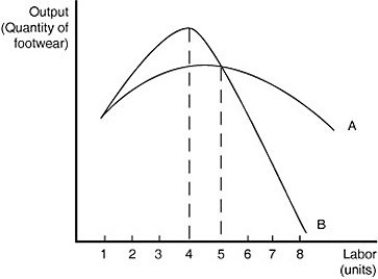 Fancy Footwear manufactures shoes.Figure 11-3 shows Fancy Footwear's marginal product of labor and average product of labor curves in the short run.
-Refer to Figure 11-3.Which of the following statements correctly describes the curves in the figure?
Fancy Footwear manufactures shoes.Figure 11-3 shows Fancy Footwear's marginal product of labor and average product of labor curves in the short run.
-Refer to Figure 11-3.Which of the following statements correctly describes the curves in the figure? (Multiple Choice)
4.9/5 (65)
(65) Table 11-9
Fixed Cost Average Variable Cost Small plant \ 10,000 \ 2.00 Medium plant 15,000 1.30 Large plant 25,000 0.50
-Refer to Table 11-9.Clock It To Me manufactures clock radios.The table above shows estimates of fixed cost per period and average variable cost for three possible plant sizes.
a.You are employed as the company's cost accountant and have been asked to prepare cost estimates for various output levels for each of the three possible plant sizes.Record your calculations in the table below.
Average Cost of Production
5,000 Clock Radios Clock Radios 20,000 Clock Radios Small plant Medium plant Large plant b.For each of the three output levels,which plant size will generate the lowest average total cost of production?
c.Suppose the firm currently sells 8,000 clock radios per period (using the optimal plant size for this output level).Now,however,it has just secured a long-term contract to supply 20,000 clock radios per period.In the short run,what is the average total cost of producing 20,000 clock radios? Provide a numerical value based on your answer in part a.
d.What happens to average total cost of production in the long run? Provide a numerical value based on your answer in part a.
(Essay)
4.7/5 (82)
(82) Figure 11-13  -Refer to Figure 11-13.The lines shown in the diagram are isocost lines.If the price of labor is $50 per unit,what is the price of capital along the isocost CE?
 (Multiple Choice)
4.8/5 (87)
(87) Is it possible for technological change to be negative? If so,give an example.
(Essay)
4.9/5 (82)
(82) The marginal cost curve is U-shaped because of the law of increasing opportunity costs.
(True/False)
4.9/5 (85)
(85) Describe the difference between technology and positive technological change.
(Essay)
4.9/5 (75)
(75) If the 15th unit of output has a marginal cost of $29.50 and the average cost of producing 14 units of output is $30.23,what will happen to the average cost of production if the 15th unit is produced?
(Multiple Choice)
4.8/5 (87)
(87) 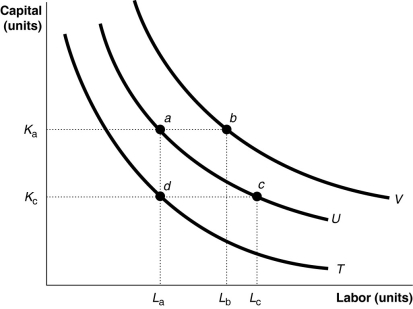 -Refer to Figure 11-12.The movement from isoquant T to isoquant U depicts
 (Multiple Choice)
4.8/5 (74)
(74) Maximizing the level of output for a given total cost of production
(Multiple Choice)
4.9/5 (87)
(87)  Figure 11-7 shows the cost structure for a firm.
-Refer to Figure 11-7.If output is 100 units what is the fixed cost of production?
Figure 11-7 shows the cost structure for a firm.
-Refer to Figure 11-7.If output is 100 units what is the fixed cost of production? (Multiple Choice)
4.8/5 (70)
(70) Figure 11-8 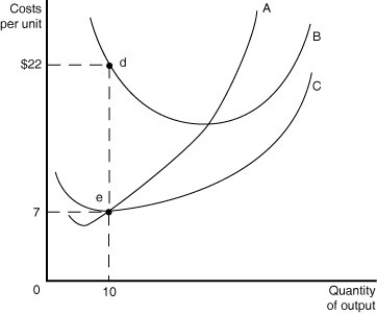 -Refer to Figure 11-8 above to answer the following questions.
a.Identify the curves in the diagram.
A ________ B ________ C ________
b.What is the numerical value of fixed cost when the quantity of output=10?
c.What is the numerical value of variable cost when the quantity of output=10?
d.What is the numerical value of total cost when the quantity of output =10?
e.What is the numerical value of average fixed cost when the quantity of output =10?
f.What is the numerical value of average total cost when the quantity of output =10?
g.On the graph identify the area that represents the total variable cost of production when the quantity of output =10.
h.On the graph identify the area that represents the fixed cost of production when the quantity of output =10.
-Refer to Figure 11-8 above to answer the following questions.
a.Identify the curves in the diagram.
A ________ B ________ C ________
b.What is the numerical value of fixed cost when the quantity of output=10?
c.What is the numerical value of variable cost when the quantity of output=10?
d.What is the numerical value of total cost when the quantity of output =10?
e.What is the numerical value of average fixed cost when the quantity of output =10?
f.What is the numerical value of average total cost when the quantity of output =10?
g.On the graph identify the area that represents the total variable cost of production when the quantity of output =10.
h.On the graph identify the area that represents the fixed cost of production when the quantity of output =10. (Essay)
4.9/5 (70)
(70) As the level of output increases,what happens to the value of average fixed cost,and what happens to the difference between the value of average total cost and average variable cost?
(Essay)
4.8/5 (82)
(82) Jill Johnson owns a pizzeria.She currently produces 10,000 pizzas per month at a total cost of $500.If she produced one more pizza her total cost rises to $500.11.What does this tell us about Jill's marginal cost of producing pizzas?
(Multiple Choice)
4.9/5 (77)
(77) Which of the following are examples of a firm experiencing a positive technological change?
a.A firm is able to reduce its inputs by 15 percent and still produce the same level of output.
b.A seminar attended by the firm's workers makes them more productive.
c.A firm adds 5 percent to its workforce and is able to maintain its initial level of output.
d.A firm restructures its distribution system and is able to save on its shipping times.
e.A firm rearranges its warehouse and finds that it can use fewer workers to maintain its productivity level.
(Essay)
4.8/5 (96)
(96) Table 11-3
Quantity of Workers Quantity of Boxes Marginal Product of Labor Average Product of Labor 0 0 ---- ---- 1 50 2 200 3 240 4 264 5 284
-Refer to Table 11-3.The table above refers to the relationship between the quantity of workers employed and the number of cardboard boxes produced per day by Manny's House of Boxes.The capital used to produce the boxes is fixed.The average product of labor will equal 66 boxes when Manny hires
(Multiple Choice)
4.8/5 (77)
(77) 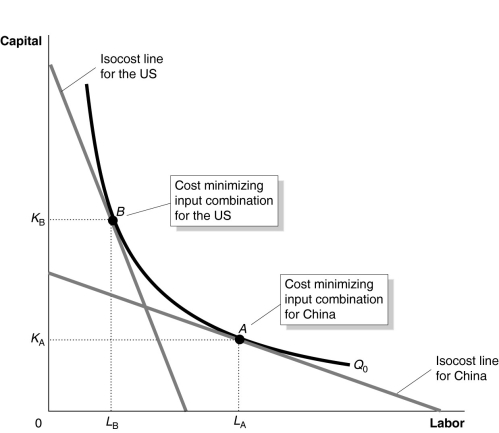 Figure 11-14 shows the optimal input combinations for the production of a given quantity of cotton in the United States and in China.
-Refer to Figure 11-14.Consider the following statements: a.For each country,the marginal product per dollar spent on labor equals to the marginal product per dollar spent on capital.
B.The price of labor is relatively higher in the United States than in China and the price of capital is relatively lower in the United States than in China.
C.The price of labor and the price of capital are relatively higher in the United States than in China.
Based on the figure,which of the statements above is true?
Figure 11-14 shows the optimal input combinations for the production of a given quantity of cotton in the United States and in China.
-Refer to Figure 11-14.Consider the following statements: a.For each country,the marginal product per dollar spent on labor equals to the marginal product per dollar spent on capital.
B.The price of labor is relatively higher in the United States than in China and the price of capital is relatively lower in the United States than in China.
C.The price of labor and the price of capital are relatively higher in the United States than in China.
Based on the figure,which of the statements above is true? (Multiple Choice)
5.0/5 (77)
(77) Table 11-5
Number of Workers Output (boxes) Marginal Product af Labor Office Rent (dollars) Labor Cost (dollars) Total Cost (dollars) 0 0 -- 1 220 400 200 2 250 800 3 680 4 160 1,200 5 940 1,000 6 980 1,600
-Refer to Table 11-5.Suzette's Fancy Packaging subcontracts with Sunshineland Pecans to box dried fruit and nuts for Suzette's mail order business.Suzette rents space for her factory for $400 a week in a nearby strip mall.She can hire temporary workers for $200 a week.Table 11-5 above shows her output and cost data.Use the table to answer questions a-e.
a.Complete the table.
b.In the last week of summer Suzette closes her business to go on a family vacation.What are her costs during that week?
c.In one week Suzette exactly breaks even.If her revenue for the week is $1,200,how many boxes of fruit and nuts did she produce?
d.Judging from the marginal product of labor data,would you say that Suzette had to settle for increasingly unproductive workers? Explain your answer.
e.Suzette has received an order for 1,500 boxes of nuts per week for the next 3 months.If she expects the trend in the marginal product of labor will continue in the same direction,what do you think she should do? Should she not commit until she can move to a larger space or should she just hire more workers? Explain your answer.
(Essay)
4.9/5 (76)
(76) Figure 11-15  -Refer to Figure 11-15.Suppose Hilda produces 100 gooseberry pies.What is the marginal rate of technical substitution of labor for capital when labor is increased from 10 to 20 hours?
 (Multiple Choice)
4.9/5 (82)
(82) 
Filters
- Essay(0)
- Multiple Choice(0)
- Short Answer(0)
- True False(0)
- Matching(0)