



 Chat with AI
Exam 11: Technology,production,and Costs

Exam 1: Economics: Foundations and Models447 Questions
Exam 2: Trade-Offs, comparative Advantage, and the Market System492 Questions
Exam 3: Where Prices Come From: the Interaction of Demand and Supply476 Questions
Exam 4: Economic Efficiency, government Price Setting, and Taxes420 Questions
Exam 5: Externalities, environmental Policy, and Public Goods263 Questions
Exam 6: Elasticity: the Responsiveness of Demand and Supply294 Questions
Exam 7: The Economics of Health Care338 Questions
Exam 8: Firms,the Stock Market,and Corporate Governance522 Questions
Exam 9: Comparative Advantage and the Gains From International Trade377 Questions
Exam 10: Consumer Choice and Behavioral Economics300 Questions
Exam 11: Technology,production,and Costs327 Questions
Exam 12: Firms in Perfectly Competitive Markets296 Questions
Exam 13: Monopolistic Competition: the Competitive Model in a More Realistic Setting272 Questions
Exam 14: Oligopoly: Firms in Less Competitive Markets258 Questions
Exam 15: Monopoly and Antitrust Policy279 Questions
Exam 16: Pricing Strategy261 Questions
Exam 17: The Markets for Labor and Other Factors of Production281 Questions
Exam 18: Public Choice, taxes, and the Distribution of Income258 Questions
Exam 19: Gdp: Measuring Total Production and Income261 Questions
Exam 20: Unemployment and Inflation291 Questions
Exam 21: Economic Growth, the Financial System, and Business Cycles253 Questions
Exam 22: Long-Run Economic Growth: Sources and Policies262 Questions
Exam 23: Aggregate Expenditure and Output in the Short Run301 Questions
Exam 24: Aggregate Demand and Aggregate Supply Analysis286 Questions
Exam 25: Money,banks,and the Federal Reserve System281 Questions
Exam 26: Monetary Policy275 Questions
Exam 27: Fiscal Policy306 Questions
Exam 28: Inflation, unemployment, and Federal Reserve Policy257 Questions
Exam 29: Macroeconomics in an Open Economy278 Questions
Exam 30: The International Financial System258 Questions
Select questions type


After Suzie,owner of Suzie's Sweet Shop,hires her 8th worker the average product of labor declines.Which of the following statements must be true?
(Multiple Choice)
4.7/5  (78)
(78) Figure 11-15  -Refer to Figure 11-15.Suppose Hilda hires labor at $8 per hour and capital costs $10 per unit.What is the minimum cost of producing 200 gooseberry pies?
 (Multiple Choice)
4.9/5 (68)
(68) If an airport decides to expand by building an additional passenger terminal,and in doing so it lowers its average cost per airplane landing,it was previously operating at
(Multiple Choice)
4.8/5 (73)
(73) To improve package delivery,one change UPS made involved improvements in how packages were routed.The firm started using more detailed maps to plan the routes for packages.As a result,the typical delivery driver could travel several miles less per day while delivering more packages.Which of the following statements best describes this change at UPS?
(Multiple Choice)
4.9/5 (97)
(97) If the total cost of producing 20 units of output is $1,000 and the average variable cost is $35,what is the firm's average fixed cost at that level of output?
(Multiple Choice)
4.8/5 (89)
(89) Describe how UPS has used positive technological change to improve its package handling and delivery schedule.
(Essay)
4.9/5 (84)
(84) 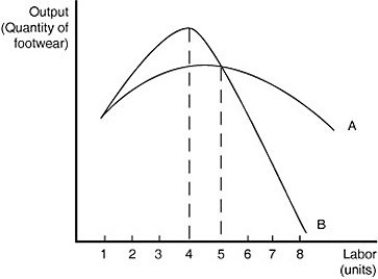 Fancy Footwear manufactures shoes.Figure 11-3 shows Fancy Footwear's marginal product of labor and average product of labor curves in the short run.
-Refer to Figure 11-3.For what quantity of labor does production start to display diminishing returns?
Fancy Footwear manufactures shoes.Figure 11-3 shows Fancy Footwear's marginal product of labor and average product of labor curves in the short run.
-Refer to Figure 11-3.For what quantity of labor does production start to display diminishing returns? (Multiple Choice)
4.9/5 (84)
(84) Figure 11-15
-Refer to Figure 11-15.What is the combination of inputs that produces 200 gooseberry pies at the lowest cost?
-Refer to Figure 11-15.What is the combination of inputs that produces 200 gooseberry pies at the lowest cost? (Multiple Choice)
4.8/5 (90)
(90) Two stores-Lazy Guys and Ralph's Recliners-are located in the same city.Both stores buy recliner chairs from the same manufacturer at the same price and both stores are about the same size,so that the fixed costs of production for both stores are the same.Ralph's Recliners sells more recliners per month and Ralph's has a lower average total cost of production.Which of the following can explain why the average total cost of production is lower for Ralph's Recliners?
(Multiple Choice)
4.8/5 (79)
(79) A curve showing the lowest cost at which a firm is able to produce a given level of output in the long run is
(Multiple Choice)
4.9/5 (78)
(78) Suppose you have just opened a store to sell espresso machines.Both you and a competing store buy this machine from a manufacturer for $130 each.Your competitor who has a store of the same size as yours is currently selling about 10 machines a month at a price of $200 per machine.You expect to sell about 6 machines a month at a price of $220 per machine.If you lower your price,you expect to make a loss.Which of the following could explain why your competitor is able to profitably sell the machine at a lower price although the cost of purchasing the machine is the same for the both of you?
(Multiple Choice)
4.8/5 (91)
(91) If,when a firm doubles all its inputs,its average cost of production decreases,then production displays
(Multiple Choice)
4.7/5 (95)
(95) Economists Cade Massey and Richard Thaler analyzed whether teams in the National Football League distributed salaries efficiently.Massey and Thaler found that
(Multiple Choice)
5.0/5 (78)
(78) Figure 11-18  -Refer to Figure 11-18.Starting from point E,a movement along the isocost to point F
 (Multiple Choice)
4.8/5 (68)
(68) An important reason why diseconomies of scale arise is because firms may have to hire lower-skilled workers as firms expand.
(True/False)
4.9/5 (70)
(70) 
Filters
- Essay(0)
- Multiple Choice(0)
- Short Answer(0)
- True False(0)
- Matching(0)