



 Chat with AI
Exam 11: Technology,production,and Costs

Exam 1: Economics: Foundations and Models447 Questions
Exam 2: Trade-Offs, comparative Advantage, and the Market System492 Questions
Exam 3: Where Prices Come From: the Interaction of Demand and Supply476 Questions
Exam 4: Economic Efficiency, government Price Setting, and Taxes420 Questions
Exam 5: Externalities, environmental Policy, and Public Goods263 Questions
Exam 6: Elasticity: the Responsiveness of Demand and Supply294 Questions
Exam 7: The Economics of Health Care338 Questions
Exam 8: Firms,the Stock Market,and Corporate Governance522 Questions
Exam 9: Comparative Advantage and the Gains From International Trade377 Questions
Exam 10: Consumer Choice and Behavioral Economics300 Questions
Exam 11: Technology,production,and Costs327 Questions
Exam 12: Firms in Perfectly Competitive Markets296 Questions
Exam 13: Monopolistic Competition: the Competitive Model in a More Realistic Setting272 Questions
Exam 14: Oligopoly: Firms in Less Competitive Markets258 Questions
Exam 15: Monopoly and Antitrust Policy279 Questions
Exam 16: Pricing Strategy261 Questions
Exam 17: The Markets for Labor and Other Factors of Production281 Questions
Exam 18: Public Choice, taxes, and the Distribution of Income258 Questions
Exam 19: Gdp: Measuring Total Production and Income261 Questions
Exam 20: Unemployment and Inflation291 Questions
Exam 21: Economic Growth, the Financial System, and Business Cycles253 Questions
Exam 22: Long-Run Economic Growth: Sources and Policies262 Questions
Exam 23: Aggregate Expenditure and Output in the Short Run301 Questions
Exam 24: Aggregate Demand and Aggregate Supply Analysis286 Questions
Exam 25: Money,banks,and the Federal Reserve System281 Questions
Exam 26: Monetary Policy275 Questions
Exam 27: Fiscal Policy306 Questions
Exam 28: Inflation, unemployment, and Federal Reserve Policy257 Questions
Exam 29: Macroeconomics in an Open Economy278 Questions
Exam 30: The International Financial System258 Questions
Select questions type


Jayanthi moves her yoga studio from her home to a space she rents in Oakland,California.Holding everything else constant,as a result of this move
(Multiple Choice)
4.8/5  (85)
(85) In economics,technology only refers to the development of new products.
(True/False)
4.7/5 (75)
(75) The rules of accounting generally require that ________ costs be used for purposes of keeping a company's financial records and for paying taxes.These costs are sometimes called ________ costs.
(Multiple Choice)
4.9/5 (80)
(80) In a diagram showing the average total cost and average variable cost curves,the minimum point of the average total cost is
(Multiple Choice)
4.9/5 (80)
(80) Figure 11-9 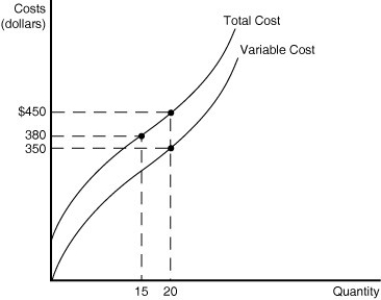 -Refer to Figure 11-9 above to solve the following problems.
a.Calculate the fixed cost of production.
b.Calculate the average total cost of production when the firm produces 20 units of output.
c.Calculate the average variable cost of production when the firm produces 20 units of output.
d.Calculate the average fixed cost of production when the firm produces 20 units of output.
e.Calculate the average fixed cost of production when the firm produces 15 units of output.
f.If the firm increases output from 15 to 20 units,what is the marginal cost of output?
-Refer to Figure 11-9 above to solve the following problems.
a.Calculate the fixed cost of production.
b.Calculate the average total cost of production when the firm produces 20 units of output.
c.Calculate the average variable cost of production when the firm produces 20 units of output.
d.Calculate the average fixed cost of production when the firm produces 20 units of output.
e.Calculate the average fixed cost of production when the firm produces 15 units of output.
f.If the firm increases output from 15 to 20 units,what is the marginal cost of output? (Essay)
4.8/5 (80)
(80) Golda Rush quit her job as a manager for Home Depot to start her own hair dressing salon,Goldilocks.She gave up a salary of $40,000 per year,invested her savings of $30,000 (which was earning 5 percent interest)and borrowed $10,000 from a close friend,agreeing to pay 5 percent interest per year.In her first year,Golda spent $18,000 to rent a salon,hired a part-time assistant for $12,000 and incurred another $15,000 in expenses on equipment and hairdressing material.Based on this information,what is the amount of her explicit costs?
(Multiple Choice)
4.9/5 (75)
(75) A firm's short-run average total cost curve is parallel to its short-run average variable cost curve.
(True/False)
4.9/5 (83)
(83)  Figure 11-11 illustrates the long-run average cost curve for a firm that produces picture frames.The graph also includes short-run average cost curves for three firm sizes: ATCa,ATCb and ATCc.
-Refer to Figure 11-11.Constant returns to scale
Figure 11-11 illustrates the long-run average cost curve for a firm that produces picture frames.The graph also includes short-run average cost curves for three firm sizes: ATCa,ATCb and ATCc.
-Refer to Figure 11-11.Constant returns to scale (Multiple Choice)
4.8/5 (72)
(72) State the law of diminishing returns.How do diminishing returns differ from diseconomies of scale? Be sure to define diseconomies of scale in your answer.
(Essay)
4.8/5 (76)
(76) Which of the following statements regarding a firm's long-run average total cost (LRATC)curve and its short-run average total cost (SRATC)curve is true?
(Multiple Choice)
5.0/5 (65)
(65) The difference between technology and technological change is that
(Multiple Choice)
4.9/5 (91)
(91) If average product is decreasing,then marginal product must be negative.
(True/False)
4.9/5 (73)
(73) If a firm produces 20 units of output and incurs a total cost of $1,000 and a variable cost is $700,calculate the firm's average fixed cost of production if it expands output to 25 units.
(Multiple Choice)
4.8/5 (76)
(76) Over the past twenty years,the number of small family farms has fallen significantly and in their place there are fewer,but larger,farms owned by corporations.Which of the following best explains this trend?
(Multiple Choice)
4.9/5 (89)
(89) Average variable cost can be calculated using any of the formulas below except
(Multiple Choice)
4.8/5 (83)
(83) Golda Rush quit her job as a manager for Home Depot to start her own hair dressing salon,Goldilocks.She gave up a salary of $40,000 per year,invested her savings of $30,000 (which was earning 5 percent interest)and borrowed $10,000 from a close friend,agreeing to pay 5 percent interest per year.In her first year,Golda spent $18,000 to rent a salon,hired a part-time assistant for $12,000 and incurred another $15,000 in expenses on equipment and hairdressing material.Based on this information,what is the amount of her implicit costs?
(Multiple Choice)
4.8/5 (83)
(83) If production displays economies of scale,the long-run average cost curve is
(Multiple Choice)
4.7/5 (86)
(86) Which of the following is typically considered a fixed cost by academic book publishers but a variable cost by companies that print books?
(Multiple Choice)
4.7/5 (77)
(77) The slope of an isoquant is equal to the ratio of the price of the input on the horizontal axis divided by the price of the input on the vertical axis,multiplied by -1.
(True/False)
4.9/5 (75)
(75) 
Filters
- Essay(0)
- Multiple Choice(0)
- Short Answer(0)
- True False(0)
- Matching(0)